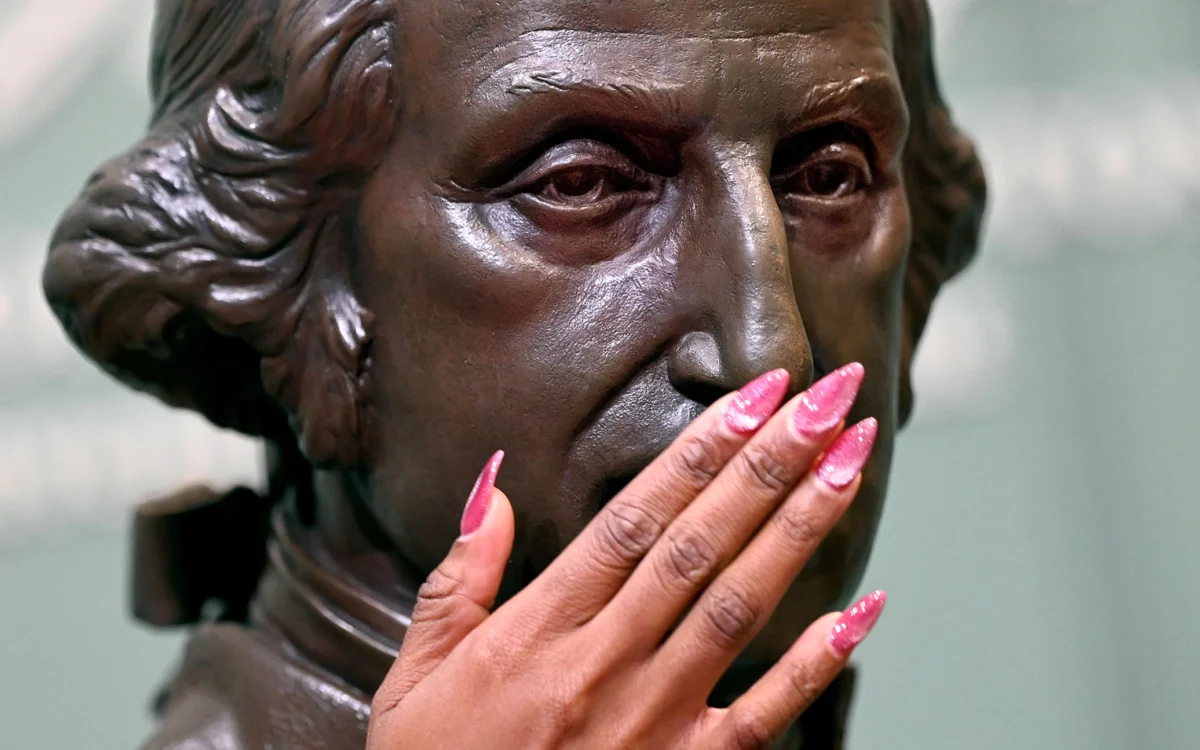
PHILADELPHIA – The National Constitution Center, in a significant stride toward enhancing accessibility, has launched "Feel the Founders’ Faces," an innovative tactile tour program designed to engage blind and low-vision visitors with the historical figures of the nation’s founding. Developed in collaboration with Philly Touch Tours, a leading organization in creating accessible museum experiences, this program offers a unique sensory dimension to exploring the esteemed delegates depicted in Signers’ Hall. The initiative, a culmination of a year of meticulous planning and development, aims to democratize historical engagement by allowing individuals to connect with the past through the sense of touch.
The program, which is scheduled to run four to six times annually on Sunday mornings before the museum opens to the general public, provides an unhurried and immersive experience within Signers’ Hall. This dedicated time allows participants to fully explore the detailed bronze statues of the Founding Fathers, gaining insights into their personalities, social standing, and even their historical context through tactile exploration.
Kosi Asabere, a participant in the inaugural tour, shared her profound connection with the statues. "You can tell a lot about someone from their posture," she remarked, her hands tracing the contours of a statue. As she moved her fingers over the figure’s hands, noting their placement and positioning, she stepped into the pose herself. "He seems confident," she observed, feeling the grip on the lapels of a long coat and the backward pull of the shoulders, with one foot forward. "I feel like his body language shows he is a man of status." Asabere, a Philadelphia native in her early forties, found that through touch, she could "read" the individuals depicted, even without sight.
The tactile tour focuses on the nuanced details of the sculptures, transforming abstract historical figures into tangible presences. Benjamin Franklin, represented as he was at 81 during the Constitutional Convention, conveyed a sense of age to Asabere through the "fine lines on his forehead." Alexander Hamilton, with his "puffed-out chest," was perceived as "a little cocky." The statue of Virginia delegate George Mason, after further tactile examination, was described by Asabere as "self-assured."
This program represents a significant expansion of the National Constitution Center’s commitment to inclusivity. Vince Stango, the Center’s interim president, articulated the institution’s broader mission: "Our goal is to make all of our programming more accessible to more audiences. Because of the way the statues are created, the texture and the features, Signers’ Hall is a great way to start." The choice of Signers’ Hall was particularly fitting, as Katherine Allen, program director for Philly Touch Tours, noted the natural suitability of the environment for a tactile exploration. "I’ve been on a lot of tours," Allen stated, "It’s like these statues were conceived for a touch tour."
Philly Touch Tours has a well-established track record of designing and leading tactile tours in various cultural institutions, including the Mütter Museum and the Philadelphia Flower Show, since its inception in 2014. However, the specific context of the National Constitution Center offered a unique opportunity. The delegates are not depicted in static, formal poses, but rather in dynamic, almost "action photo" like stances, which naturally lends itself to interpretation through touch. Cory Lloyd, another tour participant, remarked, "These are like action photos. You can tell the people are in the middle of discussions – not posing, per se." This dynamism allows visitors to perceive the delegates as individuals engaged in the active process of debate and decision-making.
The effectiveness of the tour lies in its ability to foster a deeper, more personal connection with historical figures. Simon Bonenfant, a young man in his mid-twenties from Drexel Hill, experienced this firsthand when mimicking the pose of Elbridge Gerry, a dissenter. Positioned by his tour guide with hands at his sides, mirroring Gerry’s stance, Bonenfant described the feeling as "Obstinate." This moment encapsulates the program’s core objective: to move beyond mere factual recitation and empower visitors to interpret the body language and implied personalities of the Founding Fathers.
Bonenfant, who also serves as a cultural accessibility consultant for Philly Touch Tours, played a crucial role in training the National Constitution Center’s staff for the "Feel the Founders’ Faces" program. His expertise in disability awareness, guiding blind visitors, verbal description techniques, and the practical logistics of leading tactile tours was instrumental. He also contributed to the trial runs, meticulously refining the best routes through the hall and determining optimal time allocations for each statue to maximize participant engagement.
The program’s success is also attributed to the detailed craftsmanship of the statues themselves. Jasmin Sethi, a 40-year-old participant, was engrossed in the intricate details of a different Virginia delegate’s shirt. While her guide had informed her that the delegate was a wealthy man who enslaved people, the tactile experience of feeling "the fancy buttons on the shirt" made the historical context "more memorable." This sensory reinforcement of factual information underscores the power of tactile learning.
For Jeff Boudwin, 35, who lost his sight at four months old due to a brain tumor, the tour offered a revelation, even after previous visits to the Constitution Center. As his hand traced the back of a delegate’s head, he discovered a detail previously unnoticed: a bow securing the man’s powdered queue. "I’ve been here before," he said, "But I never noticed that." This anecdote highlights how tactile exploration can uncover hidden details and provide new perspectives on familiar exhibits, enriching the visitor experience for all, regardless of prior familiarity with the museum.
The creation of "Feel the Founders’ Faces" is part of a broader trend in the museum and cultural sector towards greater accessibility and universal design. Institutions are increasingly recognizing the importance of offering diverse modes of engagement to cater to a wider range of abilities and learning styles. The National Constitution Center’s initiative aligns with this movement, setting a precedent for other historical sites and museums to consider similar inclusive programming.
The development of such programs often involves significant research and collaboration. The partnership between the National Constitution Center and Philly Touch Tours exemplifies a best-practice model for creating sensory-rich educational experiences. The year-long development period likely involved extensive consultation with blind and low-vision individuals to ensure the tour’s effectiveness and user-friendliness. This collaborative approach is crucial for ensuring that accessibility initiatives are not only well-intentioned but also genuinely impactful.
The historical context of the Constitutional Convention itself adds another layer of significance to this tactile tour. The delegates gathered in Philadelphia in 1787 to draft the United States Constitution, a document that continues to shape American governance and society. Understanding the personalities and diverse perspectives of these men, as facilitated by the "Feel the Founders’ Faces" program, offers a more nuanced appreciation of the challenges and compromises involved in establishing the nation’s foundational law. The very act of touching these representations can evoke a sense of connection to the individuals who grappled with monumental decisions that still resonate today.
The program’s focus on body language and posture taps into the field of kinesics, the study of how we communicate through body movement. While often associated with interpersonal communication, applying these principles to historical representation through tactile means allows for a unique interpretation of historical figures. The way a delegate stood, the tension in their shoulders, or the placement of their hands could subtly convey their disposition, their confidence, or their reservations during a critical historical juncture.
The National Constitution Center’s commitment to accessibility is not limited to this specific program. It is an ongoing effort to ensure that its exhibits and educational offerings are welcoming and engaging for everyone. By providing tactile tours, the Center is not only accommodating visually impaired visitors but also enriching the experience for sighted individuals who may choose to participate and engage with the exhibits in a different, more tactile manner. This inclusive approach fosters a more comprehensive understanding of history and the individuals who shaped it.
The success of "Feel the Founders’ Faces" could also have broader implications for the field of museum accessibility. It demonstrates that with thoughtful design and dedicated partnerships, even complex historical narratives can be made accessible through touch. This could inspire other institutions to explore similar tactile exhibits, potentially leading to a wider availability of such programs across the country. The economic impact, though not directly measured in the initial report, could also be considered as increased visitor engagement and satisfaction can lead to greater institutional support and visitor numbers.
The ongoing nature of the program, with its scheduled runs throughout the year, ensures that this valuable accessibility initiative will be a consistent offering for the community. The commitment to running the program before public hours provides a quiet, focused environment, free from the distractions of larger crowds, further enhancing the sensory experience for participants. This thoughtful scheduling underscores the program’s dedication to providing the best possible experience for its intended audience.
In conclusion, "Feel the Founders’ Faces" represents a significant advancement in inclusive historical interpretation. By leveraging the power of touch, the National Constitution Center and Philly Touch Tours are opening new avenues for understanding and connecting with the nation’s founding principles and the individuals who championed them. This initiative not only enhances the visitor experience for blind and low-vision individuals but also broadens the definition of how history can be learned and appreciated, setting a positive example for cultural institutions nationwide. The program’s success hinges on its ability to translate the visual representations of history into tangible, memorable experiences, allowing participants to literally "feel the founders’ faces" and the weight of their historical significance.