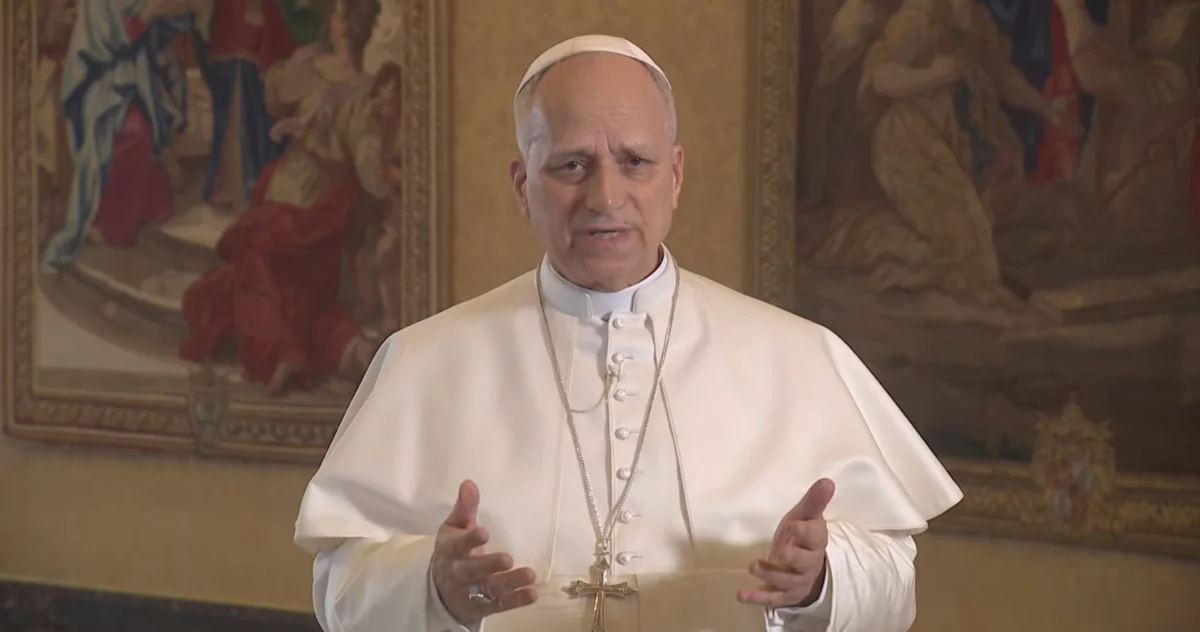
Vatican City – Pope Leo XIV delivered a powerful video message on April 24, joining the global chorus of advocates celebrating the 15th anniversary of Illinois’ landmark decision to abolish the death penalty. His address served as a profound affirmation of human dignity and a fervent call to action for the complete eradication of capital punishment across the United States and worldwide. The Pontiff’s intervention underscores the Catholic Church’s unwavering and increasingly vocal opposition to the death penalty, rooting its stance in the inherent value of every human life, regardless of transgressions.
Pope Leo XIV’s Resounding Call for Dignity and Justice
In his video message, made public by the Mother of God parish in Chicago, Pope Leo XIV extended his "support to those who advocate for abolishing capital punishment in the U.S. and around the world." He expressed a hopeful prayer: "I pray that your efforts will lead to a greater acknowledgment of the dignity of every person, and will inspire others to work for the same just cause." This statement directly reinforces the core tenet of Catholic social teaching that human life is sacred from conception to natural death.
The Pope elaborated on this theological foundation, asserting that "only when a society safeguards the sanctity of human life will it flourish and prosper." He challenged the notion that grave crimes diminish a person’s fundamental worth, stating unequivocally, "the dignity of the person is not lost even after very serious crimes are committed." This assertion forms the bedrock of the Church’s contemporary argument against capital punishment, moving beyond earlier justifications for its limited use.
Pope Leo XIV further elucidated that modern societies possess "effective systems of detention that protect citizens while preserving the possibility of redemption for those who are guilty." This practical reality, he explained, allows the Catechism of the Catholic Church to instruct that "the common good can be safeguarded and the requirements of justice can be met without recourse to capital punishment." His words directly echoed and reinforced the transformative revision to the Catechism made by his predecessor, Pope Francis. Citing this pivotal change, Pope Leo XIV concluded, "Consequently, the Church teaches that ‘the death penalty is inadmissible because it is an attack on the inviolability and dignity of the person.’" This declaration solidifies the Church’s absolute opposition, positioning capital punishment as fundamentally incompatible with Christian principles and modern ethical standards.
The Catholic Church’s Evolving Stance: A Historical Context
The Catholic Church’s journey to its current unequivocal stance against the death penalty has been a significant evolution over centuries, culminating in recent decades. Historically, Catholic doctrine, while emphasizing the sanctity of life, permitted capital punishment under specific, stringent conditions, often invoking the principle of legitimate defense of society. Figures like St. Thomas Aquinas, in his Summa Theologica, argued that the state could justly execute criminals to protect the common good, likening a condemned criminal to a diseased limb that must be amputated to save the body.
However, the late 20th century witnessed a profound shift, largely spearheaded by Pope John Paul II. In his 1995 encyclical Evangelium Vitae (The Gospel of Life), he significantly narrowed the permissible use of the death penalty, stating it should only be employed in "absolute necessity," where society could not otherwise be defended from the aggressor. He argued that modern penal systems, with effective means of detention, rendered such extreme necessity "very rare, if not practically non-existent." This marked a pivotal moment, shifting the burden of proof firmly onto the state to justify execution.
Pope Benedict XVI continued this trajectory, consistently calling for the abolition of the death penalty and commuting sentences during his pontificate. However, it was Pope Francis who enacted the most decisive change. In 2018, he ordered a revision to paragraph 2267 of the Catechism of the Catholic Church, declaring the death penalty "inadmissible because it is an attack on the inviolability and dignity of the person." The revised text explicitly notes that "the Church, in the light of the Gospel, understands that the death penalty is inadmissible because it is an attack on the inviolability and dignity of the person, and she works with determination for its abolition worldwide." This revision moved the Church’s position from one of extreme reservation to one of outright rejection, considering it an offense against fundamental human dignity in all circumstances.
Pope Leo XIV’s recent message thus stands as a direct continuation and reinforcement of this definitive teaching. His advocacy is not merely a personal opinion but a faithful expression of the updated, authoritative doctrine of the universal Church, underscoring a commitment to justice that prioritizes rehabilitation and mercy over punitive retribution.
Illinois’ Landmark Abolition: A Beacon of Progress
The 15th anniversary of Illinois’ abolition of the death penalty, which Pope Leo XIV chose to highlight, serves as a powerful case study for the arguments against capital punishment. Illinois has a particularly poignant history with the death penalty, marked by a disturbing number of wrongful convictions.
The state reinstated capital punishment in 1977. However, by the late 1990s and early 2000s, a series of investigative reports and legal challenges revealed that 13 men on Illinois’ death row had been exonerated – more than the number of individuals executed in the state during the same period. This alarming statistic, highlighted by investigative journalism students at Northwestern University, exposed systemic flaws in the justice system, including coerced confessions, unreliable witness testimony, and prosecutorial misconduct.
The revelations prompted then-Governor George Ryan, a Republican and a supporter of the death penalty, to declare a moratorium on executions in 2000, calling the system "fraught with error." He later commuted the sentences of all 167 death row inmates to life imprisonment in 2003, famously stating, "Because the Illinois capital punishment system is arbitrary and capricious, and therefore immoral, I no longer shall tinker with the machinery of death."
The moratorium remained in place for over a decade, allowing for extensive study and public debate. Advocacy groups, including the Illinois Coalition to Abolish the Death Penalty, the ACLU of Illinois, and various faith-based organizations (including the Catholic Conference of Illinois), worked tirelessly to educate the public and lobby lawmakers. Their efforts emphasized the moral objections, the risk of executing innocent people, the disproportionate application based on race and socioeconomic status, and the exorbitant costs associated with capital cases compared to life imprisonment.
Finally, in March 2011, after years of legislative efforts, Governor Pat Quinn signed legislation officially abolishing the death penalty in Illinois, converting the sentences of the remaining 15 death row inmates to life in prison. Quinn cited "the fundamental questions of fairness, justice, and humanity" as reasons for his decision, recognizing that "it is impossible to create a perfect system, one that is free of all mistakes." Illinois became the 16th state to ban capital punishment, a decision hailed by human rights organizations globally as a testament to progress and a model for other states and nations.
The Global and National Landscape of Capital Punishment
The global trend is undeniably towards abolition. According to Amnesty International, as of the end of 2023, 116 countries have abolished the death penalty for all crimes, and 144 countries have abolished it in law or practice. Only a minority of countries, primarily China, Iran, Saudi Arabia, and Egypt, account for the vast majority of executions annually. The United Nations General Assembly has repeatedly called for a moratorium on the use of the death penalty with a view to its eventual abolition.
In the United States, the picture is more complex, with a patchwork of laws across states. Currently, 23 states have abolished the death penalty, and three others (California, Oregon, and Pennsylvania) have gubernatorial moratoria in place. This means that a majority of states have either legally ended capital punishment or effectively paused it. Executions have steadily declined since their peak in the late 1990s, with only 24 executions nationwide in 2023, primarily concentrated in a few southern states.
Public support for the death penalty in the U.S. has also seen a significant decline. While a majority of Americans still express support for it in cases of murder, polls show a notable shift when alternatives like life imprisonment without parole are presented. Furthermore, growing awareness of issues such as racial bias (Black defendants are disproportionately sentenced to death), the risk of executing innocent individuals (over 190 death row exonerees since 1973), and the immense financial costs of capital punishment trials and appeals continue to erode public and political will for its retention. Studies consistently demonstrate that capital cases are significantly more expensive than those seeking life imprisonment, largely due to lengthy appeals processes and the specialized legal resources required.
Pope Leo XIV’s Broader Advocacy: A Week of Consistent Messaging
Pope Leo XIV’s video message on Illinois’ anniversary was not an isolated pronouncement but part of a consistent week of advocacy for human dignity and penal reform. Just two days prior, on April 22, the Pontiff spoke directly to incarcerated individuals at Bata Prison in Equatorial Guinea, a nation with a troubling human rights record. His visit and address in such a challenging context underscored his commitment to reaching those on the margins of society and offering a message of hope.
Amidst a rainstorm, the Pope emphasized to the prisoners that the administration of justice "must always promote the dignity and potential of every person." He offered a profound insight into the human condition: "Life is not defined solely by one’s mistakes, which are often the result of difficult and complex circumstances." Crucially, he instilled a sense of possibility, affirming, "There is always the possibility to start over, learn and become a new person." This message of redemption and rehabilitation, delivered directly to those deprived of liberty, powerfully complements his call for the abolition of the death penalty. It highlights a holistic vision of justice that seeks to transform individuals and society, rather than merely punishing or eliminating offenders. The juxtaposition of these two messages within days of each other clearly demonstrates Pope Leo XIV’s focused and intentional leadership on issues of criminal justice reform and human dignity.
Reactions and Broader Implications
The Pope’s latest pronouncement is expected to resonate deeply within both religious and secular communities globally. Advocacy groups dedicated to ending capital punishment were quick to commend Pope Leo XIV’s strong stance. The Catholic Mobilizing Network to End the Death Penalty, for instance, is likely to view this as a powerful affirmation of their mission, providing renewed impetus for their efforts in U.S. states that still retain capital punishment. Similarly, organizations like the American Civil Liberties Union (ACLU) and human rights watchdogs will recognize the significant moral authority lent by the Pontiff’s message to their long-standing campaigns.
In Illinois, the Pope’s message serves as a validation for the state’s courageous decision 15 years ago. Former legislators and activists who championed the abolition are likely to feel their efforts have been acknowledged on the highest moral platform, reinforcing the notion that their decision was not only legally sound but ethically imperative.
Beyond immediate reactions, Pope Leo XIV’s intervention carries several broader implications:
- Reinforcement for U.S. Abolition Efforts: For the remaining states in the U.S. that still practice capital punishment, the Pope’s message adds significant moral weight to the arguments for repeal. Catholic legislators and citizens in these states may feel further compelled to advocate for legislative change, aligning their public policy with the Church’s definitive teaching.
- Strengthening Global Human Rights Discourse: The Vatican’s consistent and increasingly firm position on the death penalty contributes to the international human rights framework, bolstering the arguments of organizations and nations working towards global abolition. It underscores that the right to life is universal and inviolable.
- Moral Leadership of the Church: In an era of complex global challenges, the Catholic Church, through its clear ethical pronouncements, continues to assert its role as a leading moral voice on issues of human dignity and social justice. This stance against the death penalty is a clear demonstration of that leadership.
- Continued Dialogue within Catholic Communities: The Pope’s message will undoubtedly foster further reflection and discussion within Catholic parishes, schools, and organizations worldwide, deepening understanding of the theological and ethical underpinnings of the Church’s position.
In conclusion, Pope Leo XIV’s message celebrating Illinois’ 15-year abolition of the death penalty is far more than a commemorative address. It is a powerful articulation of the Catholic Church’s definitive moral stance, a robust call for universal respect for human dignity, and a strategic reinforcement for the global movement to end capital punishment. By weaving together theological principles, the practical realities of modern justice systems, and the compelling evidence from places like Illinois, the Pontiff continues to guide humanity towards a more just and merciful future where every life is cherished and the possibility of redemption is never extinguished.