On June 23, 1926, a pivotal moment in American higher education unfolded as approximately 8,000 high school students across the United States took the inaugural Scholastic Aptitude Test (SAT). This landmark examination, a precursor to the standardized tests familiar to millions today, marked the beginning of a transformative era in college admissions. From its inception, the SAT has undergone significant alterations in its structure, content, and technological delivery, reflecting broader societal and educational shifts over nearly a century. Today, approximately two million students annually engage with the SAT, a testament to its enduring, albeit evolving, role in the academic landscape.
Genesis of the SAT: A Military-Inspired Approach to Intelligence
The origins of the SAT are deeply intertwined with the need for a standardized method to assess academic potential. The test was initially conceived and developed by Carl Brigham, a psychologist who had previously worked on the Army Alpha and Beta intelligence tests used during World War I to classify recruits. Brigham adapted these military assessment tools, seeking to identify students with the intellectual capacity to succeed in the rigorous academic environments of elite colleges. The underlying philosophy was to gauge innate intelligence rather than acquired knowledge, thereby aiming to provide a more objective measure for admissions committees. This foundational approach, rooted in psychometric principles, set the stage for the SAT’s long-standing influence on college selection processes.
The Early Years: A Marathon of Questions
The very first SAT in 1926 was a stark contrast to its modern iteration. It was an exhaustive examination, featuring 315 questions administered within a demanding 97-minute timeframe. This format was so fast-paced that students were explicitly informed they would likely not complete all the questions. This intensity underscores the early test’s focus on rapid problem-solving and cognitive agility. Over the subsequent two decades, test developers recognized the need for adjustment, gradually shortening the exam and extending the time limits to create a more manageable and equitable testing experience. This evolutionary process highlights a continuous effort to refine the test’s efficacy and accessibility.
Content Evolution: From IQ to Application
The content of the SAT has mirrored the changing pedagogical approaches and priorities in education. Initially designed to measure general intelligence, the test’s structure and question types have been consistently revised. A significant shift occurred in 1994 when the College Board introduced math questions that required students to generate their own answers, moving beyond the traditional multiple-choice format. This change aimed to assess deeper mathematical reasoning and problem-solving skills. Simultaneously, the test moved away from vocabulary questions that relied heavily on rote memorization, such as identifying antonyms, to emphasize a more nuanced understanding of language and critical reading. These content modifications reflect a broader educational trend towards assessing analytical skills and conceptual understanding rather than mere recall.
Technological Advancements and Digital Transformation
The SAT’s evolution has also been profoundly shaped by technological advancements. The introduction of calculators in 1994 was a landmark decision, acknowledging the integral role of these tools in modern mathematics. However, the most radical transformation arrived in 2024 with the full transition to a digital testing format. Administered on laptops or tablets, the digital SAT employs an adaptive testing model. This means the difficulty of subsequent questions adjusts in real-time based on a student’s performance on earlier sections. This adaptive approach aims to provide a more precise measurement of a student’s abilities by tailoring the test to their individual skill level, ensuring that students are neither overwhelmed by excessively difficult questions nor bored by overly simple ones.

The SAT and ACT: A Comparative Landscape
In 1959, a significant competitor to the SAT emerged: the American College Test (ACT). Founded with a different philosophy, the ACT was designed to assess students’ mastery of high school curriculum content, aiming to serve a broader range of colleges beyond the elite institutions that were the initial focus of the SAT. While their origins and initial aims differed, the SAT and ACT have evolved to occupy similar positions in the college admissions landscape. Today, both tests are widely accepted by a vast array of colleges and universities, and many students opt to take both exams to maximize their application options.
In the high school graduating class of 2023, a substantial portion of students participated in these standardized tests. Approximately 51% of students took the SAT, while 37% opted for the ACT. This data indicates a continued reliance on these assessments, though it also highlights a segment of students who may not take either test or who choose to apply to colleges that have adopted test-optional or test-blind policies.
The ACT comprises four multiple-choice sections: English, Mathematics, Reading, and Science. Notably, the Science section became optional starting in 2025, and an optional essay section has been available since 2005. The standard ACT, with its four multiple-choice sections, requires students to answer 171 questions within 165 minutes. The test can be administered in either a computer-based or paper-based format.
Trends in Test Scores: A Shifting Performance Landscape
Analyzing trends in SAT and ACT scores provides crucial insights into student performance over time. The College Board has implemented score "recentering" to account for changes in the test’s difficulty and the evolving demographic of test-takers. However, significant structural changes, such as the elimination of the penalty for incorrect answers in 2016, mean that scores from that year onward are not directly comparable to those from earlier periods.
SAT Score Trends:
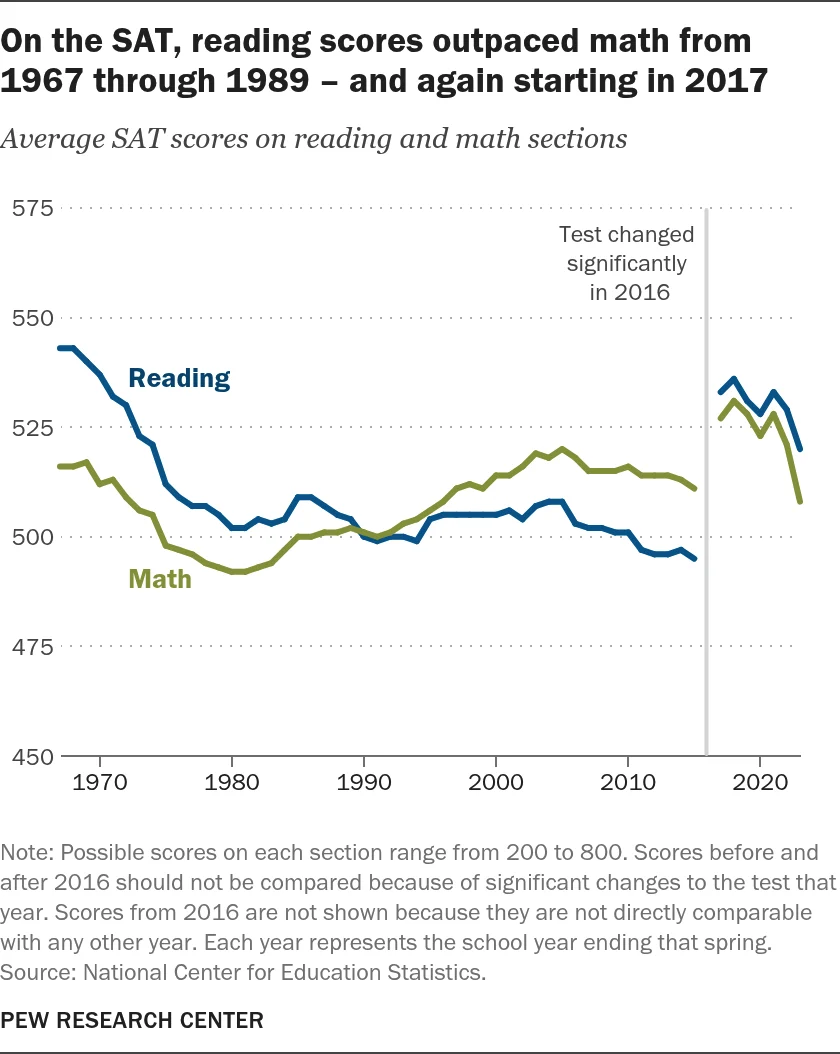
Data from the National Center for Education Statistics (NCES) reveals a general decline in average SAT scores between the 1966-67 and 2014-15 school years. The overall average score dropped from 1059 to 1006 out of a possible 1600. A notable pattern within this decline is that the average reading score experienced a more significant decrease than the average math score. In the 1966-67 academic year, the average reading score was 543 out of 800, while the average math score was 516 out of 800. For over two decades, reading scores consistently outperformed math scores. However, by the 1989-90 school year, the average math score surpassed the average reading score. This trend continued through the 2014-15 academic year, when the average math score stood at 511, and the average reading score had fallen to 495.
Following the significant test revisions in 2016, the scoring patterns showed a resurgence of a trend reminiscent of the late 1960s and early 1970s. For the new reading and writing section, scores were initially slightly higher than for the new math section. However, between the 2016-17 and 2022-23 school years, both sets of scores generally exhibited a downward trend. The most recent data indicates a continued fluctuation, with the 2023 scores showing a dip in both reading/writing and math compared to the previous year.

ACT Score Trends:
Similar to the SAT, ACT scores have also shown a general downward trend since the mid-1990s. According to NCES data, the average composite ACT score in the 1994-95 academic year was 20.8 out of a possible 36. By the 2022-23 academic year, this average had decreased to 19.5. This decline is reflected across all four subject areas of the ACT. In 1995, average scores in all four sections (English, Math, Reading, and Science) were above 20.0. However, by 2022-23, only the average reading score remained above the 20.0 mark.
A consistent difference between the ACT and SAT is observed in the comparative performance of reading versus math scores. Unlike the SAT, the average ACT score has historically been higher in reading than in math for every year documented by NCES.
The Evolving Role of Standardized Tests in Admissions
The significance of standardized tests like the SAT and ACT in college admissions has been a subject of ongoing debate and evolution. By the year 2000, a notable number of colleges, nearly 300, had adopted "test-optional" policies, allowing applicants to choose whether or not to submit their SAT or ACT scores. This trend accelerated dramatically during the COVID-19 pandemic due to widespread test center closures and disruptions. However, in recent years, a counter-movement has emerged, with some highly selective institutions reinstating standardized test score requirements. This dynamic reflects a complex interplay of factors, including institutional priorities, applicant pool characteristics, and evolving societal perspectives on assessment.
Public opinion on the role of standardized tests in college admissions remains divided, though a majority generally favors their consideration. Pew Research Center surveys have consistently shown that a significant portion of U.S. adults believe standardized test scores are important factors in college admissions. A December 2022 survey indicated that 71% of U.S. adults felt colleges should consider standardized test scores when making admission decisions. Further underscoring this sentiment, a March 2022 survey found that 85% of respondents viewed standardized test scores as either a major or minor factor in college admissions. This ongoing dialogue suggests that while the methods of assessment may change, the desire for objective measures of academic readiness in college admissions persists.
The journey of the SAT from its inception as a military-inspired intelligence test to its current digital, adaptive format is a compelling narrative of adaptation and responsiveness to societal and technological change. As colleges continue to refine their admissions criteria and educational philosophies evolve, the SAT and its counterparts will undoubtedly continue to be subjects of scrutiny and innovation, shaping the pathways for future generations of students.