Juneteenth, celebrated annually on June 19th, marks a pivotal moment in American history: the effective end of slavery in the United States. Officially recognized as Juneteenth National Independence Day, this federal holiday commemorates the day in 1865 when Union soldiers, two and a half years after the Emancipation Proclamation, arrived in Galveston, Texas, to announce that all enslaved people were free. While the holiday has gained national prominence and federal recognition, its implementation and observance vary significantly across the United States, particularly concerning its status as a legal holiday with a paid day off for state government workers. As of June 2026, a comprehensive analysis reveals that a substantial majority of states are now acknowledging Juneteenth with paid time off for their public employees, though the nuances of this recognition continue to evolve.
The Growing Embrace of Juneteenth: A State-by-State Overview
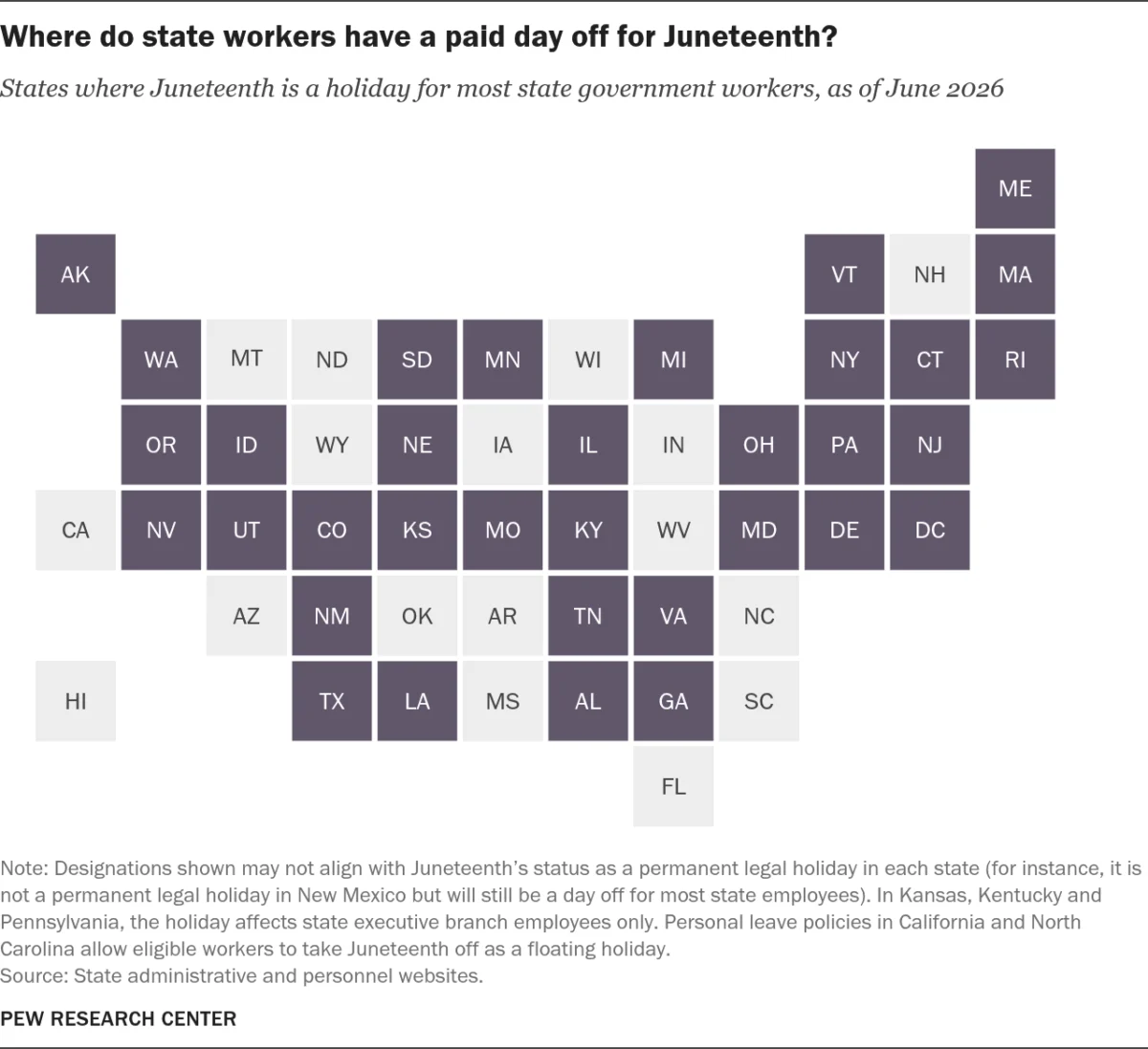
The landscape of Juneteenth recognition has dramatically shifted in recent years. In 2026, administrative calendars indicate that at least 33 states, along with the District of Columbia, will observe Juneteenth by granting a paid day off to the majority of their state government workers. This represents a significant increase in recognition, underscoring a broader national movement to commemorate this crucial historical event.
The Pew Research Center’s analysis, drawing on state administrative and personnel websites, highlights this growing trend. Thirty of these states, plus the District of Columbia, have established Juneteenth as a permanent legal holiday, ensuring its annual observance with paid leave for state employees. This legal framework provides a consistent and official acknowledgment of the holiday’s significance.
However, the implementation is not uniform. In three additional states, Juneteenth is recognized as a paid day off for state workers this year, even though it has not yet been codified as a permanent legal holiday. This suggests an ongoing legislative process in these states to solidify the holiday’s status. Such a distinction is crucial, as permanent legal holidays carry a different weight and permanence than those established through annual proclamations or administrative decisions.
Variations in State-Level Recognition: Beyond the Paid Day Off
While the number of states offering a paid day off is substantial, the specific designation of Juneteenth as a holiday varies. In California, for instance, while Juneteenth was recognized as a legal state holiday in 2022, state government employees do not receive an automatic paid day off. Instead, eligible workers can opt to use Juneteenth as a personal holiday, leveraging their existing leave policies. Similarly, in North Carolina, employees may be eligible for paid personal leave on days of cultural or religious significance, which can be applied to Juneteenth. These instances illustrate how states are finding different pathways to acknowledge the holiday, even if it doesn’t translate into a universal paid day off for all state employees.
A notable exception to the trend of paid days off is West Virginia. While former Governor Jim Justice had annually proclaimed Juneteenth as a state holiday between 2021 and 2024, current Governor Patrick Morrisey chose not to continue this practice in 2025. Consequently, West Virginia state employees will not receive a paid day off for Juneteenth in 2026. Instead, June 19th will be observed as West Virginia Day, a state holiday that predates Juneteenth’s widespread recognition. This decision highlights the discretionary nature of holiday declarations by state executives and the potential for shifts in policy with changes in administration.
The Historical Roots and Evolving Recognition of Juneteenth
The significance of Juneteenth lies in its historical context. The term itself is a portmanteau of "June" and "nineteenth," commemorating the day when enslaved African Americans in Galveston, Texas, finally received news of their freedom. This announcement came over two months after the Confederate surrender at Appomattox and more than two years after President Abraham Lincoln’s Emancipation Proclamation. The delay in information and enforcement meant that enslaved people in Texas remained in bondage long after freedom had been legally declared elsewhere.
The local observance of Juneteenth in Texas dates back to the 1860s, and the state officially recognized it as a permanent holiday in 1980, making it the first state to do so. However, widespread national recognition and adoption by other states gained significant momentum more recently.

The year 2020 proved to be a watershed moment for Juneteenth. Amidst nationwide protests for racial justice following the police killings of George Floyd and Breonna Taylor, public awareness and calls for recognizing Juneteenth intensified. This period of heightened social consciousness spurred legislative action across the country. A bipartisan bill was signed into law by President Joe Biden in June 2021, officially establishing Juneteenth as a federal holiday. This federal designation has undoubtedly influenced states in their own considerations of the holiday.
The Congressional Research Service (CRS) has meticulously tracked the adoption of Juneteenth as a legal holiday or observance. Their data indicates that a significant majority of states that now recognize Juneteenth as a permanent legal holiday did so in 2020 or later. This clustering of legislative action around the period of heightened racial justice awareness underscores the holiday’s evolving role in national memory and identity.
A Nationally Recognized Holiday: Federal Closures and Market Impact
As one of 11 annual federal holidays, Juneteenth grants federal government employees a paid day off. This typically means that federal offices are closed, and there is no mail delivery by the United States Postal Service on this day. Beyond federal operations, Juneteenth’s status as a federal holiday also impacts financial markets. Major stock exchanges and bond markets, including those operated by SIFMA (Securities Industry and Financial Markets Association), observe Juneteenth, leading to closures and the suspension of trading activities. Furthermore, some prominent national banks also close their doors on Juneteenth, reflecting its growing integration into the national calendar of significant events. While most retail businesses, supermarkets, and other commercial enterprises remain open, the closure of federal institutions and financial markets signifies the holiday’s increasing national importance.
The Nuances of State Observance: Beyond a Simple "Yes" or "No"
The data reveals a complex tapestry of how states are integrating Juneteenth into their official calendars. While 33 states and D.C. offer a paid day off, the underlying legal status and the specific conditions of this recognition can differ. For example, in Kansas, Kentucky, and Pennsylvania, the paid day off is limited to state executive branch employees, rather than all state government workers. This distinction can impact a significant portion of the state workforce.
The CRS report further clarifies that the year legislation was adopted does not always precisely align with when Juneteenth was first observed as a legal holiday. This can be due to legislative timelines or the phased implementation of new holiday policies.
Moreover, the distinction between a "permanent legal holiday" and an "observance" is critical. While all 50 states now officially recognize Juneteenth in some capacity, the level of recognition varies. An observance is a day of public awareness that does not typically include a paid day off for state employees. States like Florida, Oklahoma, and Minnesota were among the first to establish Juneteenth as an official observance in the 1990s, long before it became a federal holiday. Minnesota, for instance, has since elevated its recognition to a permanent holiday in 2023.
The most recent states to provide formal recognition of any kind for Juneteenth were Hawaii and North Dakota, which made it an observance in 2021. South Dakota followed suit by adopting it as a permanent holiday in 2022. These late adoptions highlight the ongoing and evolving nature of Juneteenth’s integration into the American consciousness and governmental practices.
For states where Juneteenth is designated as an observance only, such as Arkansas, Iowa, and Montana, the holiday is often aligned with the third Saturday in June. This practice ensures a consistent day of observance each year, even if it does not translate into a paid weekday off for state employees.
Looking Ahead: The Enduring Significance of Juneteenth
The increasing recognition of Juneteenth across the United States is a testament to its profound historical and cultural significance. As a federal holiday and a widespread state observance, it serves as a vital reminder of the struggle for freedom and equality, and the ongoing work required to ensure justice for all Americans. The variations in how states observe Juneteenth underscore the decentralized nature of holiday legislation in the U.S. and the diverse ways communities choose to commemorate pivotal historical moments. As more states solidify its status and as public awareness continues to grow, Juneteenth is poised to remain a cornerstone of American historical reflection and a celebration of enduring freedom. The trend towards greater recognition suggests a collective commitment to acknowledging this critical chapter of American history and its lasting impact on the nation’s identity.