The widespread adoption of unconscious bias awareness (UBA) training has emerged as the prevailing strategy for organizations globally seeking to address issues of discrimination and foster more equitable and inclusive environments. This phenomenon has fueled a multi-billion dollar industry, with companies and institutions investing heavily in programs designed to enlighten employees about their inherent biases. However, a growing body of research and real-world experience suggests that this ubiquitous approach is largely ineffective, and in some cases, may even exacerbate the very problems it aims to solve. This article delves into the origins of this trend, scrutinizes the scientific basis for its failings, and proposes a more robust, design-led pathway toward genuine systemic change.
The Ascendance of Unconscious Bias Training: A Response to Social Imperatives
The surge in UBA training can be traced back to significant societal shifts and powerful social justice movements that brought issues of systemic discrimination and inequality to the forefront of public consciousness. Over the past decade, global movements like #MeToo, highlighting pervasive sexual harassment and gender inequality, and #BlackLivesMatter, exposing deep-seated racial injustice and police brutality, pressured organizations to confront their own internal cultures and practices. These movements, coupled with an increasing recognition of the business benefits of diversity, equity, and inclusion (DEI), spurred a reactive demand for solutions.
In many corporate boardrooms and human resources departments, the default response to calls for greater inclusion or in the face of employee grievances—ranging from individual complaints of unfair treatment to broader systemic critiques—became the implementation of UBA training. This approach was often perceived as a visible, tangible commitment to change, a defensive shield against criticism, and a seemingly straightforward path to "fix" deep-seated issues. The logic was simple: if individuals are made aware of their unconscious biases, they will consciously work to mitigate them, leading to more inclusive behaviors and decisions. This belief system propelled UBA training into a global trend, with consultants and platforms offering a vast array of programs. By 2020, the DEI market, largely driven by such training, was estimated to be worth over $8 billion, a testament to the scale of organizational investment in this particular remedy.
The Cognitive Dilemma: Why Awareness Falls Short
Despite its popularity and the good intentions behind its implementation, the fundamental premise of UBA training—that awareness alone can significantly alter unconscious behavior—is increasingly challenged by insights from cognitive psychology and behavioral economics. The human mind operates on two distinct systems, often referred to as System 1 and System 2 thinking, as popularized by Nobel laureate Daniel Kahneman.
- System 1 (Unconscious Mind): This system is fast, intuitive, automatic, and emotional. It operates effortlessly and is responsible for the vast majority of our cognitive functioning, including the formation of unconscious biases and stereotypes. These biases are mental shortcuts, evolved to help us process information quickly, but they can lead to flawed judgments and discriminatory actions without our conscious intent.
- System 2 (Conscious Mind): This system is slow, deliberate, effortful, and logical. It’s engaged when we need to pay attention, solve complex problems, or override System 1 impulses.
UBA training primarily targets System 2, attempting to educate individuals about biases through knowledge-based presentations, discussions, and exercises. The critical flaw, however, is that while System 2 can understand bias, it struggles to control the automatic processes of System 1 in real-time, especially under conditions of stress, time pressure, or cognitive load. This creates a significant gap between knowing and doing, making lasting behavioral change elusive. As research highlights, simply knowing about one’s biases, or having good intentions, does not inherently reduce their impact on behavior.
Documented Failures: The Backlash and Ineffectiveness of UBA
Empirical studies and real-world observations increasingly reveal that UBA training is not only ineffective but can also produce counterproductive outcomes, undermining the very goals of diversity and inclusion.
Mental Overload and Enhanced Bias
The attempt to be constantly conscious of unconscious biases can lead to what psychologists term "mental overload." When individuals are burdened with the cognitive effort of constantly monitoring their thoughts and decisions for bias, their mental resources become depleted. Paradoxically, this state of cognitive exhaustion has been shown to strengthen the influence of System 1 biases, making individuals more likely to rely on default, often biased, behaviors. The pressure to "fix" oneself can lead to paralysis, where knowing without the ability to act on that knowledge results in an increased reliance on automatic, biased responses, creating a vicious cycle.
Reinforcing Stereotypes and Biased Thinking
Several studies indicate that UBA training can inadvertently reinforce the very biases and stereotypes it aims to dismantle. By explicitly discussing stereotypes and group differences, training sessions can make these associations more salient in people’s minds. Research published by the American Psychological Association (APA) suggests that such exposure can enhance biased thinking and strengthen stereotypes rather than diminish them. This occurs because the act of bringing a stereotype to conscious awareness, even with the intent to refute it, can inadvertently solidify its presence in the unconscious mind.
Strengthening Misconceptions of Inequality
A concerning finding from 2020 research published in Personality and Social Psychology Bulletin demonstrated that making individuals in privileged positions aware of racial prejudice and inequality in society does not necessarily alter their belief in society being largely fair. Instead, it can paradoxically strengthen this belief and even lead to a more optimistic perception of past inequalities. This phenomenon, often linked to the "just-world hypothesis," suggests that when confronted with evidence of injustice, some individuals may rationalize it or perceive it as less severe, rather than accepting the systemic nature of the problem. Awareness, in this context, can backfire by entrenching existing cognitive biases that resist uncomfortable truths about societal structures.
Moral Licensing: The Illusion of Virtue
Perhaps one of the most insidious effects of UBA training is "moral licensing." This psychological phenomenon occurs when individuals engage in a moral act, such as attending a bias training session, which then creates a self-perception of being virtuous or "one of the good people." This positive self-image can unconsciously grant them permission to subsequently behave in less inclusive or even discriminatory ways, as their moral "credit" allows them to deviate from their stated values without feeling guilt. Studies have shown that people who strongly disavowed sexist or racist statements were later more likely to make sexist comments, hire a man for a job over a woman, or unconsciously discriminate against racial minorities, precisely because they felt secure in their "non-sexist" or "non-racist" self-image. The training, instead of fostering lasting change, provides a temporary moral shield that can ironically enable biased behavior.
Activating Shame, Fear, and Resistance
The very terminology used—"Unconscious Bias Awareness Training" or "Diversity & Inclusion Training"—can trigger negative psychological responses. For many, these terms implicitly suggest that they are biased, flawed, or in need of "fixing." This can activate emotions such as anxiety, defensiveness, and fear of losing privilege, status, or power. Such emotional states are counterproductive to learning and change, often leading to resistance, resentment, or a "check-the-box" mentality where participants passively endure the training without genuine engagement or intent to change. Some individuals may even react with overt hostility, viewing the training as an accusation or an attempt at ideological indoctrination. The result is often a reinforcement of existing divides rather than bridge-building.
The Economic and Organizational Toll
Beyond the psychological pitfalls, the over-reliance on UBA training carries significant economic and organizational costs. Organizations collectively spend billions of dollars annually on these programs, often with little to no measurable long-term impact on diversity metrics, employee satisfaction, or incident rates of discrimination. This represents a substantial misallocation of resources that could otherwise be invested in proven, evidence-based interventions. The opportunity cost is immense: instead of addressing root causes through systemic redesign, organizations often settle for a superficial "quick fix" that provides an illusion of progress while fundamental issues persist and even worsen. This can lead to cynicism among employees, particularly those from marginalized groups, who perceive these efforts as performative rather than substantive.
A More Effective Path: Designing for Inclusion Through Nudges
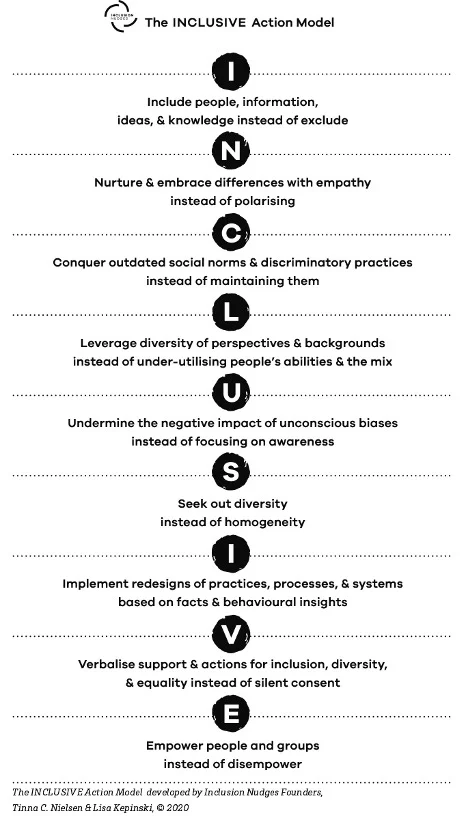
Given the documented limitations of awareness-based training, a paradigm shift is urgently needed—one that moves beyond individual enlightenment to systemic, design-based interventions. The solution lies not in attempting to rewire the fundamental workings of the human mind, but in strategically altering environments and processes to mitigate the influence of unconscious bias by default. This is where the concept of "Inclusion Nudges" proves transformative.
What are Inclusion Nudges?
An Inclusion Nudge is an action designed to influence the unconscious mind, making it easy to be inclusive and to practice inclusion automatically in daily actions. Drawing insights from behavioral economics, social sciences, and nudge theory (pioneered by Richard Thaler and Cass Sunstein), Inclusion Nudges are practical applications that leverage an understanding of human behavior and decision-making, particularly how the unconscious mind processes information and makes choices. These inclusive actions and designs work by "nudging" (steering) the unconscious mind—both one’s own and others’—to change behavior to be inclusive automatically, without requiring constant conscious effort or rational persuasion. They minimize the impact of mental shortcuts (biases) by altering the choice architecture. This approach aligns desired behavior with self-interest and intent, typically with minimal cost, no threats or punishments, and while preserving freedom of choice.
The Power of Design: The Symphony Orchestra Example
A classic and compelling illustration of an Inclusion Nudge is the blind audition process adopted by many symphony orchestras worldwide since the 1970s. Faced with a predominant demographic of white males, some orchestras began questioning their recruitment practices. The pioneering change involved having musicians audition behind a screen, preventing the selection committee from seeing candidates. Some orchestras even went as far as placing a carpet on the stage to muffle the sound of shoes, recognizing that even subtle cues like heel clicks could unconsciously prime gender biases in how committee members perceived musical performance.
The results of these pilot programs were profound. The number of women selected for orchestras increased dramatically, in some cases by 50% or more, and the ethnic diversity of successful candidates also saw radical shifts. This simple design change effectively neutralized biases related to gender, ethnicity, and appearance, ensuring that evaluations were based purely on merit—the musical performance itself. This evidence, available for over four decades, demonstrates the immense power of altering the environment to bypass unconscious bias, making the desired inclusive outcome the default. Despite its proven effectiveness, the widespread adoption of similar blind processes in other industries has been surprisingly slow, although technological platforms are now making such implementations easier.
Broader Applications of Inclusion Nudges
The principles behind the blind orchestra audition can be applied across numerous organizational processes:
- Hiring: Anonymizing résumés, using structured interviews with standardized questions, and ensuring diverse interview panels can mitigate biases in candidate selection.
- Performance Reviews: Implementing clear, objective criteria, training managers to focus on observable behaviors rather than subjective impressions, and utilizing multi-rater feedback can reduce bias in evaluations.
- Meetings: Designing meeting protocols that ensure equitable speaking time, actively soliciting input from all participants, and using anonymous suggestion boxes can foster more inclusive discussions and decision-making.
- Promotions: Establishing transparent promotion criteria, requiring diverse candidate slates, and implementing "talent calibration" processes can counteract favoritism and ensure merit-based advancements.
- Mentorship Programs: Systematically matching mentors and mentees across diverse demographics, rather than relying on informal networks, can broaden access to career development opportunities.
These design-led interventions work because they acknowledge the reality of human cognition and leverage it to create environments where inclusive behavior is the easy, automatic choice, rather than a constant, effortful struggle against unconscious impulses.
Conclusion: Shifting from Awareness to Action and Design
The evidence is clear: while awareness has a role in initiating conversations, it is not the solution to deeply ingrained systemic issues of discrimination and inequality. The multi-billion dollar industry built around unconscious bias awareness training has, at best, yielded negligible results, and at worst, actively exacerbated the problem through moral licensing, stereotype reinforcement, and the activation of defensive reactions.
To truly build a more just and equitable world, organizations must move beyond the superficial "quick fix" of awareness training and embrace an evidence-based approach centered on systemic design. By strategically implementing Inclusion Nudges—small, intelligent changes to environments and processes—we can mitigate the influence of unconscious bias, making inclusive behavior the default and the norm. This shift from attempting to "fix" individuals to designing inclusive systems represents a profound and necessary evolution in the pursuit of genuine diversity, equity, and inclusion for the greater good of all. It is time to accelerate the adoption of proven, behavioral science-informed solutions and make inclusion an automatic reality, everywhere, for everyone.