Although health providers remain the primary source for health information for most Americans, social media influencers and podcasts have emerged as significant players in shaping health and wellness knowledge, particularly among younger demographics. A comprehensive analysis by the Pew Research Center, based on two surveys conducted in June and October of 2025, reveals a notable trend: young women are more likely than young men to seek and consume health and wellness advice from these digital personalities.
The Evolving Landscape of Health Information Consumption
For decades, the trusted physician’s office has been the cornerstone of health guidance in the United States. However, the digital revolution has fundamentally altered how individuals access and process information related to their well-being. The Pew Research Center’s findings underscore a growing reliance on non-traditional sources, with social media influencers and podcasts playing an increasingly prominent role. This shift is not uniform across all age groups or genders, with younger women showing a particularly strong engagement with these digital health and wellness narrators.
The Pew Research Center’s analysis is built upon data from two extensive surveys of U.S. adults. The first, conducted from June 9-15, 2025, involved 5,023 participants, while the second, carried out from October 17-26, 2025, surveyed 5,111 adults. Both surveys utilized the Center’s established American Trends Panel, a nationally representative online survey panel designed to capture the experiences and opinions of a broad spectrum of the U.S. population. The research specifically aimed to understand the demographics and content preferences of individuals who turn to social media influencers and podcasts for health and wellness advice.
Young Women Lead the Charge in Influencer-Driven Health Information
The data reveals a clear gender disparity in the adoption of influencer-generated health and wellness content. Overall, 42% of U.S. adult women report ever getting health and wellness information from social media influencers or podcasts, compared to 37% of men. This gap widens significantly among younger age groups.
Specifically, 57% of women between the ages of 18 and 29 stated they utilize these sources for health information. This figure represents a substantial 10 percentage point lead over young men in the same age bracket, where 47% reported similar engagement. Even among the 30-49 age group, women (52%) were more likely than men (47%) to tap into influencer-driven content. While the disparity narrows for older adults, with 29% of women aged 50 and older and 25% of men in the same age group reporting such behavior, the trend of higher engagement among women persists across all surveyed age brackets.
This trend suggests that social media influencers and podcast hosts have cultivated a significant following among young women seeking guidance on various health and wellness topics. The perceived accessibility, relatability, and often aspirational nature of these online personalities may contribute to their appeal.

Diverse Content Streams: What Influencers Are Talking About
The Pew Research Center identified seven key topics that individuals might encounter through health and wellness influencers. The study found that a significant portion of both young men and women, half or more, report at least occasionally hearing about these topics from influencers. However, distinct patterns emerge when examining the frequency of exposure, particularly for specific content categories.
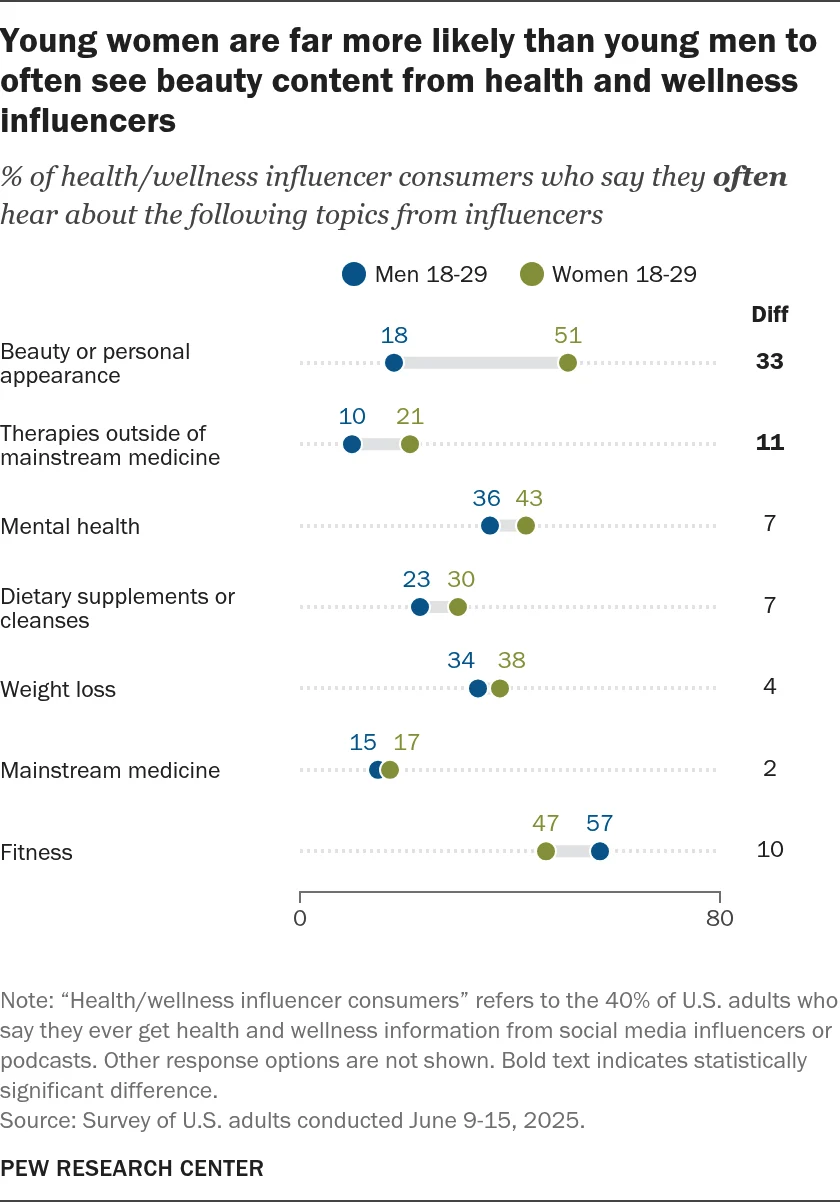
Beauty and Personal Appearance Dominate for Young Women: A striking difference was observed in the prevalence of content related to "beauty or personal appearance." Among those who consume health and wellness information from influencers, a remarkable 51% of young women (ages 18-29) reported often hearing about this topic. In stark contrast, only 18% of young men in the same age group reported frequent exposure to beauty-related content from influencers. This 33-percentage-point difference highlights a significant divergence in the types of wellness narratives being disseminated and consumed by these two demographic groups.
Alternative Therapies and Mental Health Resonance: Beyond beauty, young women also showed a higher propensity to engage with content on "therapies outside of mainstream medicine." Approximately 21% of young women indicated frequent exposure to such topics, compared to 10% of young men, a difference of 11 percentage points.
Interestingly, when it comes to "mental health," a substantial portion of both young men and women reported frequent engagement. Thirty-six percent of young men and 43% of young women indicated they often hear about mental health from influencers, with a statistically significant seven-percentage-point difference favoring women. This suggests that mental well-being is a prevalent theme across influencer content for both genders, though perhaps with a slightly greater emphasis or reception among young women.
Weight Loss and Fitness: Common Ground with Nuances: Topics like "weight loss" and "dietary supplements or cleanses" also registered considerable engagement. While 34% of young men and 38% of young women reported often hearing about weight loss, and 23% of young men versus 30% of young women encountered information on supplements and cleanses, these differences were less pronounced than those observed for beauty or alternative therapies.
"Fitness" emerged as a topic frequently discussed by a majority of young men (57%), while a slightly lower, though still substantial, 47% of young women reported similar engagement. This indicates that physical activity and exercise routines are a significant area of influencer content for both genders.

"Mainstream medicine" was the least frequently discussed topic among the options provided, with comparable shares of young men (15%) and women (17%) reporting frequent exposure. This finding may suggest that influencers are more likely to focus on lifestyle, preventative, or alternative approaches rather than in-depth discussions of conventional medical treatments.
Motivations for Seeking Influencer Guidance
The reasons why young men and women turn to health and wellness influencers for information reveal further insights into their motivations and perceived needs. A significant driver for young women is the desire for personal transformation. Approximately half of young women (51%) who engage with influencer content cited "wanting to make a change in their health or lifestyle" as a major reason for their engagement. This motivation was less pronounced among young men, with only 37% indicating it as a primary driver.
Another key factor for young women is the search for relatable experiences and information not readily available through traditional channels. Around 23% of young women reported that "hearing from people who share their background or beliefs" was a major reason for seeking influencer advice, compared to 14% of young men. Furthermore, 19% of young women indicated that "learning about things they don’t want to ask their doctor about" was a significant motivation, a sentiment shared by only 10% of young men.
These findings suggest that for young women, influencers may offer a sense of community, validation, and a comfortable space to explore health topics that might feel sensitive or difficult to broach with healthcare professionals. The emphasis on lifestyle changes also points to a proactive approach to well-being, where influencers are seen as guides and motivators.
Broader Implications and Future Considerations
The Pew Research Center’s findings have several significant implications for public health communication, digital literacy, and the evolving role of healthcare providers.
The Rise of Digital Health Navigators: The increasing reliance on social media influencers and podcasts signifies a fundamental shift in how health information is disseminated and consumed. This trend necessitates a greater understanding of the content being shared, its accuracy, and its potential impact on public health. Public health organizations and healthcare providers may need to consider strategies for engaging with these platforms and influencers to ensure accurate health messaging reaches target audiences.

Gendered Health Narratives: The distinct differences in content consumption between young men and women highlight the existence of gendered health narratives in the digital space. While influencers addressing mental health and fitness resonate across genders, the strong focus on beauty and appearance for young women, and potentially different areas of interest for young men, warrants further investigation. This divergence could influence perceptions of health, body image, and self-care practices.
The Role of Trust and Credibility: While the study does not directly assess trust levels, the consistent engagement with influencers suggests a degree of perceived credibility or relatability. However, the potential for misinformation on social media remains a significant concern. Educating the public about critical evaluation of online health information and promoting digital literacy skills are crucial.
Complementary Healthcare Models: The finding that individuals seek information on topics they may not wish to discuss with their doctor suggests that influencers are filling perceived gaps in traditional healthcare. This could prompt a re-evaluation of how healthcare systems can foster more open communication and address a broader range of patient concerns, including those related to lifestyle, appearance, and sensitive personal issues.
Future Research Directions: This research opens avenues for further exploration. Future studies could delve into the specific types of influencers being followed, the perceived credibility of different platforms, the long-term health outcomes associated with influencer-driven advice, and the effectiveness of public health interventions on social media. Understanding the nuances of influencer-audience relationships and the impact of sponsored content on health recommendations will also be critical.
In conclusion, the Pew Research Center’s study provides a compelling snapshot of the contemporary health information landscape, underscoring the growing influence of digital personalities, particularly among young women. As these platforms continue to evolve, so too will the dynamics of health education and decision-making, necessitating ongoing research and adaptive strategies from all stakeholders in the health and wellness ecosystem.