The discourse surrounding diversity, equity, belonging, and inclusion (DEBI) initiatives within contemporary organizations is often fraught with subtle complexities, yet its efficacy hinges significantly on a foundational element: the precise framing and definition of these terms. How an organization articulates its DEBI objectives and the language it employs to describe them directly impacts stakeholder engagement, shapes cultural perceptions, and ultimately determines the success or failure of these critical efforts. This article delves into the profound influence of linguistic precision, drawing on insights from behavioral science and practical experience, to underscore why a thoughtful approach to DEBI terminology is not merely semantic but strategically imperative for fostering truly inclusive environments.
The Semantic Minefield: Why Words Trigger Strong Reactions
The mere mention of terms like "diversity," "equity," or "inclusion" can evoke a spectrum of reactions, from genuine understanding and enthusiasm to skepticism, defensiveness, or even outright disengagement. Imagine the internal monologues: "Uhhh!" or "Blah blah blah!" — these visceral responses underscore the deeply personal and often unconscious associations people attach to such loaded concepts. For decades, experts in organizational change have observed recurring patterns of thought, feeling, and memory activated by DEBI terminology.
Consider these common refrains, which highlight prevalent misunderstandings and resistance:
- "Oh, diversity isn’t my issue! It only applies to people from minority groups, not me!" – This reveals a perception of diversity as an "other’s" problem, fostering disengagement from majority groups.
- "I am the one being discriminated against. Don’t ask me how to fix it — it’s your problem." (Implying majority group people) – This highlights a sense of burden and resentment, shifting responsibility.
- "Don’t ask me how to fix it. You’re diverse, so you need to fix it — it’s your problem." (Implying minority group people) – This unjustly delegates the responsibility for systemic change to those most impacted by its absence.
- "Diversity and inclusion are not my day job, so I don’t really have time for that. Someone else has got to fix it." – This demonstrates a lack of perceived relevance or personal accountability.
- "Let’s make sure we attract some diversity talent." (Often meaning: minority or women) – This tokenizes individuals, reducing them to a demographic characteristic rather than valuing their full contributions.
- "If we are going to promote women and minorities, then we have to exclude others." (Often meaning: white men) – This zero-sum thinking triggers fear of loss and fosters a sense of unfairness, undermining collective progress.
These reactions are not arbitrary; they are symptomatic of deeply ingrained perceptions shaped by how DEBI efforts have historically been presented and implemented. Many organizations, with the best of intentions, have inadvertently set "hidden tripwires" through strategies that focus on "fixing the minority" or "helping the women," rather than engaging all people in systemic change. This often leads to initiatives designed for assimilation, rather than genuine inclusion, reinforcing "us and them" divisions and ultimately working against the very benefits diversity is intended to bring.
A Brief History of DEBI and the Evolution of Understanding
The journey towards greater workplace equality has evolved significantly over the past half-century. Initially rooted in affirmative action mandates of the 1960s and 70s, the focus was largely on legal compliance and numerical representation, primarily for racial minorities and women. The 1990s saw a shift towards "diversity management," recognizing the business case for diversity in terms of market access and varied perspectives. However, this often remained superficial, focusing on headcount without addressing underlying cultural barriers.
The early 21st century brought "inclusion" to the forefront, acknowledging that mere presence isn’t enough; people need to feel valued and have a voice. More recently, "equity" has gained prominence, pushing beyond equality (treating everyone the same) to address systemic barriers and provide tailored support to ensure fair outcomes. The addition of "belonging" underscores the emotional and psychological need for individuals to feel truly accepted and secure. This chronological progression highlights a deepening understanding of the multi-faceted nature of workplace fairness, yet the language used to articulate these concepts has not always kept pace with this evolving sophistication, leading to the "absurd realities" described above.
The Psychological Impact: How Words Shape Perception and Behavior
The power of language is not merely anecdotal; it is profoundly rooted in cognitive and social psychology. Words are not neutral vessels of meaning; they are potent primes that unconsciously influence our thoughts, emotions, and behaviors.
- Priming Effect: Studies have consistently demonstrated the priming effect, where exposure to certain words or images can subtly alter subsequent actions. For instance, research has shown that participants primed with words associated with the elderly (e.g., "wrinkle," "forgetful") subsequently walked slower than those exposed to neutral words. In the context of DEBI, if language repeatedly frames diversity as a challenge or burden, it can unconsciously prime individuals to view related initiatives with apprehension or resistance.
- Stereotype Reinforcement: Counterintuitively, even well-intentioned phrases can reinforce stereotypes. A study aiming to encourage girls in math by stating "girls are as good as boys at math" inadvertently backfired, strengthening the underlying (false) stereotype that boys are inherently better. This highlights the delicate balance required in DEBI communication to avoid inadvertently validating the biases one seeks to dismantle.
- Loss Aversion and the Zero-Sum Game: Humans are wired with a powerful loss-aversion bias, meaning the pain of losing something is psychologically more potent than the pleasure of gaining something equivalent. When DEBI initiatives are framed as a zero-sum game – where one group’s gain (e.g., promotion of women and minorities) is perceived as another group’s loss (e.g., exclusion of white men) – it triggers this bias. This fear of losing power, privilege, or opportunity can lead to strong resistance, entrenching the status quo and blocking meaningful change.
- Tribalism and Fear of the Unknown: Our evolutionary psychology includes an innate tendency towards tribalism, fostering a preference for "in-group" members and suspicion of "out-groups." When DEBI language inadvertently creates or reinforces distinctions between groups, it can activate this unconscious tribal mentality, leading to unintentional exclusion of diverse perspectives and a heightened sense of anxiety when interacting with those perceived as "different." This impacts how information is processed and trust is built, hindering collaboration essential for inclusive environments.
- The Weight of Shame: A significant, often unspoken, emotional barrier in DEBI work is shame. Individuals, particularly those in majority groups, may experience shame when confronted with language that implies past discriminatory behavior (even if unintentional) or highlights their unearned privilege in the face of inequality. This uncomfortable emotion can trigger defensive reactions, including micro-aggressions or withdrawal, creating a "stuck pattern" that impedes constructive dialogue and action.
These psychological mechanisms clearly demonstrate that words, far from being mere labels, are powerful drivers of emotional and behavioral responses, profoundly impacting engagement with DEBI initiatives.
The Peril of Undefined Terms: An Absurd Reality
In many organizations, despite the widespread use of DEBI terms, their formal definitions are rarely articulated. This vacuum forces individuals to construct their own interpretations based on personal experiences, social constructs, and fragmented knowledge. The result is a cacophony of differing mindsets, leading to misalignment, confusion, and stalled progress.
- For some, "diversity" might solely mean "women" or "racial minorities."
- "Inclusion" might be reduced to organizing "diversity networks" rather than fundamentally altering how decisions are made or how work gets done.
- "Equity" might be misinterpreted as merely setting "minority hiring targets" without addressing systemic barriers to advancement.
While these interpretations might capture parts of the concepts, they fall far short of their full scope. Without a common framework, expecting aligned actions and behaviors becomes an "absurd reality." Organizations inadvertently create a Tower of Babel, where everyone speaks about DEBI but understands entirely different things, thus limiting collective ownership and effective implementation.
The Inclusion Nudges Approach: A Framework for Clarity and Action
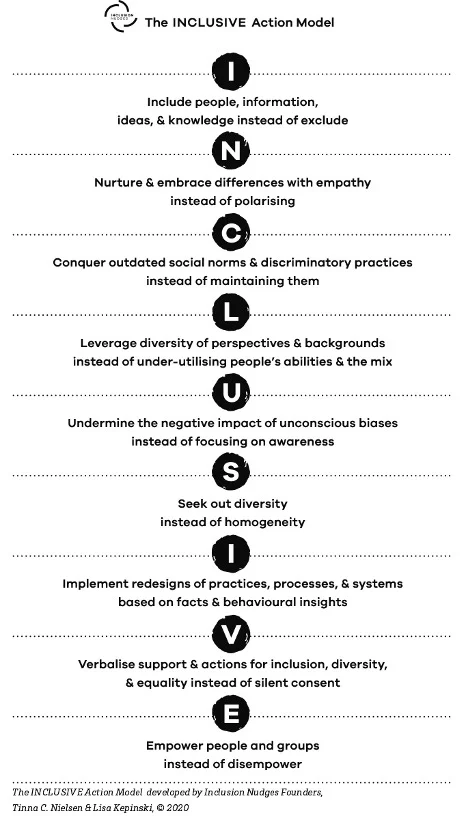
Recognizing these challenges, practitioners like Lisa and Tinna, founders of the Inclusion Nudges global initiative, advocate for precisely defined, action-oriented terms as "guiding stars" for change. Their approach emphasizes that definitions should not be abstract academic exercises but practical tools that inform the design of systems, processes, cultures, and behaviors.
The Inclusion Nudges framework offers clear, expansive definitions designed to foster universal understanding and engagement:
-
Diversity: The Mix of All of Us
Diversity encompasses all people, recognizing their demographic differences, varied backgrounds, multiple identities, and unique experiences, perspectives, knowledge, abilities, and ideas. Crucially, it moves beyond referencing specific characteristics of only "the minority" to embrace the full spectrum of human difference present in any group or society. It is about acknowledging and valuing the entirety of who we are, together. -
Equity: The Fairness Frame for the Mix
Equity ensures that all individuals have genuine access to opportunities and fair treatment, actively working to eliminate discriminatory practices, systems, laws, policies, social norms, and cultural traditions. It involves balancing power dynamics and proactively correcting existing inequalities. Equity is not just about intent but about tangible patterns of behavior and processes that prevent or perpetuate inequality. Its ultimate goal is fairness for all, recognizing that achieving this may require different approaches for different groups to overcome historical and systemic disadvantages. -
Belonging: I Feel Valued as a Part of the Mix
Belonging focuses on the individual’s lived experience within an environment. It signifies feeling welcomed, safe, seen, heard, and valued, where structures exist to ensure fairness. It’s about being able to bring one’s full, authentic self to a culture, group, or setting without needing to "cover" or downplay personal traits. When diversity, equity, and inclusion are effectively implemented, belonging is the natural and desired outcome—a state where individuals naturally feel connected and integral to the group. -
Inclusion: Welcoming and Applying the Mix
Inclusion is the active fostering of structures, systems, processes, culture, behaviors, and mindsets that embrace and respect all people and their diverse attributes. It is about actively seeking out and leveraging the diversity of knowledge, perspectives, information, and ideas. Inclusion means challenging exclusionary norms and stereotypes, being open to others, and speaking up against injustice. It is the continuous process of ensuring that all people are valued, can participate fully, and contribute to their fullest potential. Inclusion is the dynamic act of welcoming and applying the richness of "the mix of all of us."
Beyond Definitions: Engaging in Inclusive Actions
While clear definitions provide a vital foundation, simply articulating them is insufficient. Rational understanding, residing in the conscious mind (System 2 thinking), often fails to translate into inclusive behavior, which is frequently driven by unconscious biases (System 1). To bridge this gap, the Inclusion Nudges approach emphasizes engaging "the people it’s about" in defining DEBI, not through abstract words, but through concrete actions.
- Focus on Actions, Not Just Words: Instead of debating definitions, involve people in identifying observable behaviors that exemplify inclusivity, respect, empathy, and make them feel valued, included, and empowered. This collaborative process ensures that the definitions are grounded in real-life experiences and relevant to the specific organizational context.
- Co-creation for Ownership: By including individuals in the development of these action-oriented definitions, organizations achieve a dual benefit: contextually relevant definitions and immediate onboarding of participants into the change initiative. This approach inherently leverages internal diversity and fosters a strong sense of ownership.
- Visibility and Normalization: Once these inclusive behaviors are identified, the next step is to make them highly visible. Share diverse, real-life examples and personal stories through various communication channels—internal newsletters, posters in common areas, digital platforms. The key is to illustrate how inclusion plays out daily, making it tangible and relatable. Avoid burying these valuable insights in complex reports or spreadsheets; instead, showcase them in easily digestible formats.
- Peer Influence: Emphasize that these actions are being performed by "peers and similar others." Highlighting social norms—e.g., "8 out of 10 of your colleagues are doing X"—can be a powerful nudge for widespread adoption, leveraging the psychological tendency to conform to perceived group behavior.
Achieving Inclusion Without Talking About Inclusion
Ultimately, the goal is to embed inclusive practices so deeply that they become "how work gets done here" or "how people experience being in the group," rather than a standalone initiative or a buzzword. This involves a strategic shift in language and communication:
- Focus on Desired Outcomes: Challenge the default to use DEBI terms explicitly. Instead, articulate the desired outcomes. For example, instead of saying "we need more diversity," say "we need the thinking from everyone for new solutions." Instead of "we need equity," say "we need our systems designed to enable our most objective decision-making." This reframing connects DEBI directly to business value and universal benefits, making it less about compliance and more about strategic advantage.
- Integrate into Core Values: When DEBI concepts are integrated into an organization’s core values, mission, and strategic objectives—and communicated through their practical manifestations—they cease to be separate programs. They become an intrinsic part of the organizational DNA.
- Measure Behavior, Not Just Demographics: While demographic data is important, true progress is measured by changes in behavior, experience, and system design. Tracking metrics related to psychological safety, equitable opportunity, and diverse input in decision-making provides a more accurate picture of an organization’s inclusive maturity.
Broader Implications for Organizational Culture and Success
The meticulous framing of DEBI is not an academic exercise; it has profound, tangible implications for an organization’s overall health and success. When language is clear, inclusive, and action-oriented:
- Enhanced Engagement and Retention: Employees feel seen, valued, and understood, leading to higher morale, stronger commitment, and reduced turnover. Research consistently shows that inclusive workplaces have significantly lower attrition rates.
- Increased Innovation and Problem-Solving: By genuinely welcoming and applying diverse perspectives, organizations unlock greater creativity and more robust problem-solving capabilities. A variety of viewpoints challenges assumptions and leads to more innovative solutions.
- Stronger Reputation and Brand Appeal: Organizations known for their authentic commitment to DEBI attract top talent, appeal to a broader customer base, and build a more resilient brand image in an increasingly conscious marketplace.
- Improved Decision-Making: When systems are designed for equity and inclusion, and diverse voices are actively sought and integrated, decision-making processes become more objective, robust, and less prone to groupthink or unconscious bias.
- Resilience and Agility: Inclusive cultures foster psychological safety, encouraging employees to speak up, share ideas, and adapt to change. This enhances an organization’s agility and resilience in navigating complex and uncertain environments.
The challenge of translating abstract definitions into widespread, aligned actions remains a central "headache" for change makers. This is precisely why methodologies like the Inclusion Nudges approach are crucial. By focusing on behavioral science-informed interventions, they provide practical tools to shift perceptions, foster positive associations, and embed inclusive behaviors as the norm, rather than a fleeting initiative.
In an era where the demand for equitable and inclusive environments is growing louder, the deliberate framing of diversity, equity, belonging, and inclusion is a non-negotiable strategic imperative. By choosing our words with care, grounding them in shared understanding and observable actions, and subtly embedding them into the fabric of daily operations, organizations can move beyond mere rhetoric to truly make inclusion the norm—everywhere, for everyone.