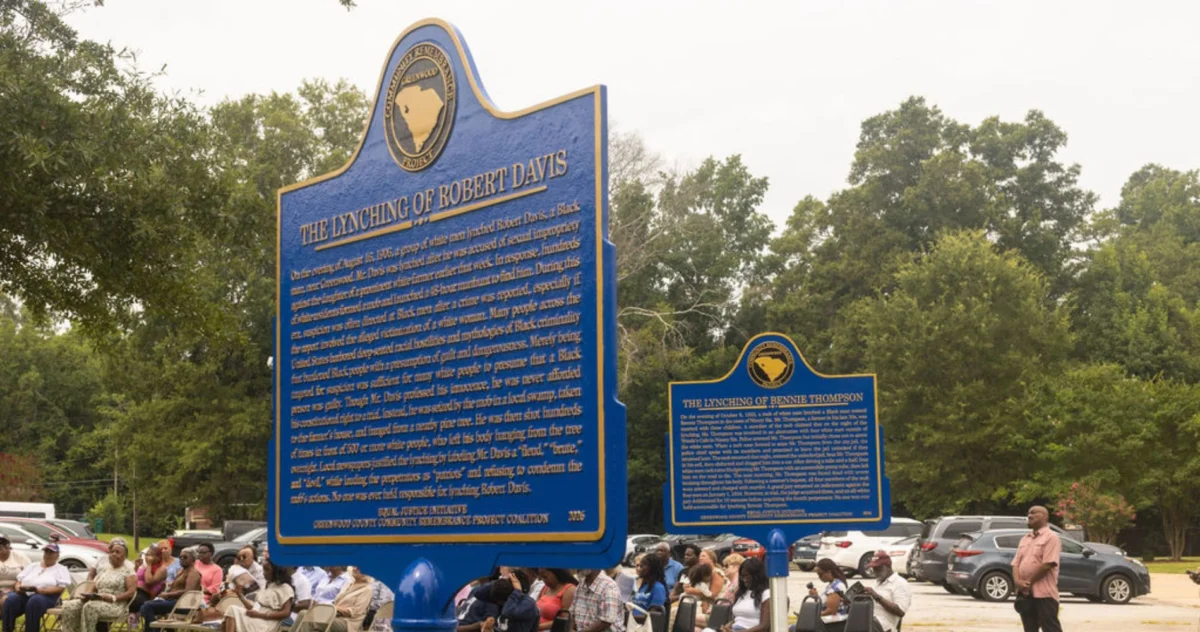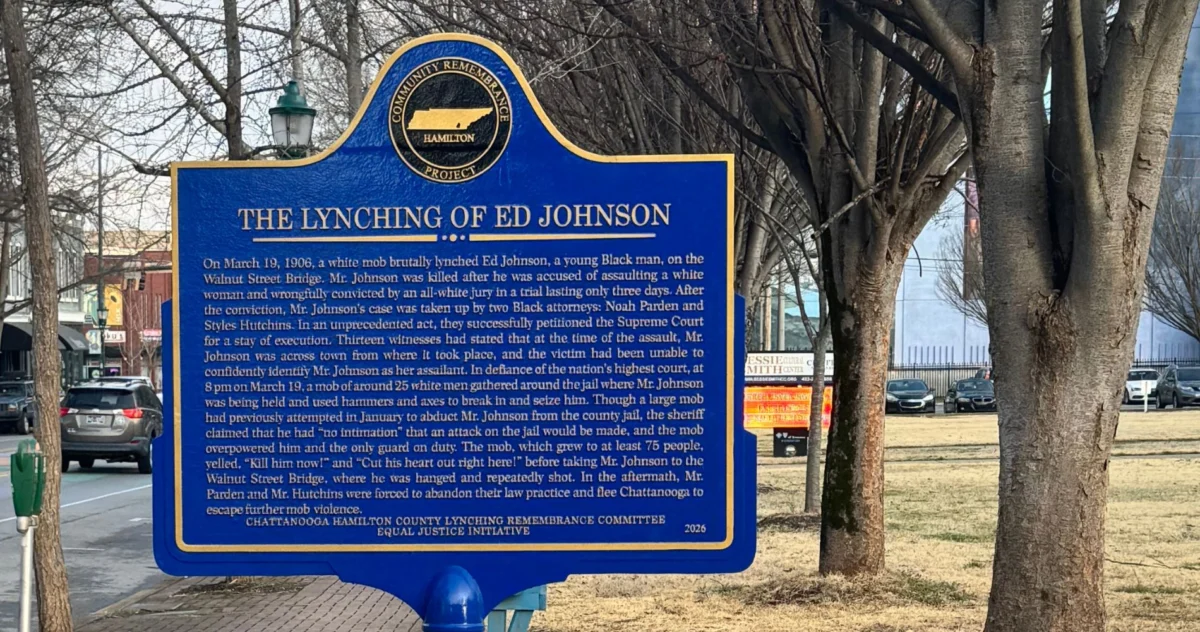
In a profound act of historical remembrance and community solidarity, local residents in collaboration with the Equal Justice Initiative (EJI) unveiled a historical marker in Hamilton County, Tennessee, last week. The dedication ceremony, held on February 26, served to memorialize Ed Johnson, a young Black man brutally lynched by a white mob in 1906, marking a pivotal moment in the community’s ongoing commitment to confronting its past and fostering reconciliation.
A Ceremony of Remembrance and Resolve
The somber yet hopeful marker dedication ceremony unfolded in downtown Chattanooga, Tennessee, hosted by the Bessie Smith Cultural Center and its president, Paula Wilkes, alongside Eric Atkins from the Unity Group. The Bessie Smith Cultural Center, established in 1983, has long been a cornerstone of the Chattanooga community, recognized for its dedication to preserving and celebrating African American history and culture through a multifaceted approach encompassing art, education, research, and entertainment. Its central role in facilitating this event underscored its mission to bring vital historical narratives to the forefront.
Eric Atkins, a dedicated community activist, has been instrumental in efforts to preserve history, particularly in marginalized communities, believing firmly in its power to promote education and understanding. His prior collaboration with EJI in 2017 saw a soil collection ceremony honoring Ed Johnson and other lynching victims in Chattanooga, laying the groundwork for the recent marker dedication and demonstrating a sustained commitment to this critical work.
During the ceremony, the solemnity of the occasion was underscored by a prayer led by the Rev. Ernest Reid of the Second Missionary Baptist Church. His invocation honored the sacrifices of the past while articulating a fervent hope for unity and healing in the future, resonating deeply with attendees who gathered to bear witness to this significant historical acknowledgment.
Echoes of Hope and Unity
Paula Wilkes, president of the Bessie Smith Cultural Center, delivered poignant remarks that encapsulated the essence of the event. "By naming what happened here, we honor Ed Johnson’s humanity and affirm that remembrance is a necessary step toward justice and healing," Wilkes stated, her words echoing through the assembled crowd. She further emphasized the dual responsibility inherent in such an act of remembrance: "May this marker remind us not only of the past we must confront, but of the responsibility we carry forward." Her statement underscored the active role communities must play in not just recalling history but learning from it to shape a more just future.
Brandon McRae, a Community Remembrance Project Team Member, spoke on behalf of EJI, expressing gratitude for the tireless efforts of the local community and their collective resolve in bringing this project to fruition. His remarks highlighted the collaborative spirit that underpins EJI’s national initiative, emphasizing the power of communities uniting to reclaim difficult histories.
Community Leaders Affirm Historical Imperative
The dedication also saw participation from local government officials, signaling a broader civic recognition of the historical imperative. Alexa LeBoefu, Hamilton County’s economic and community development director, and Carmen Elliot, representing Chattanooga Mayor Tim Kelly, both addressed the attendees. They articulated the profound positive impact that sharing a community’s complete history, including its painful chapters, has on its collective well-being and progress. Both officials expressed their strong desire to continue supporting and advancing educational efforts that foster a deeper understanding of the region’s past, reinforcing the idea that historical reckoning is vital for civic growth and development.
Mr. Atkins, reflecting on the journey of the project, remarked on its evolution from initial conception to its tangible impact on the community. "This has been five and a half years in the making," he revealed, a testament to the perseverance and dedication of all involved. He concluded with a powerful call for communal cohesion, stating, "We have to love together, we have to pray together, we have to stand together. Together is the only way we are at our best as a community." His words served as a rallying cry, emphasizing that collective action and shared commitment are essential for progress and true community strength.
The Unfolding Tragedy of Ed Johnson: A Detailed Chronology
The historical marker stands as a stark reminder of the horrific events of March 19, 1906, when Ed Johnson, a young Black man, was brutally lynched by a white mob on the Walnut Street Bridge in downtown Chattanooga. Johnson’s story is a harrowing illustration of the racial terror that pervaded the American South in the post-Reconstruction era, where the accusation of a crime against a white person, particularly a white woman, often served as a death sentence for Black men, irrespective of guilt or due process.
The False Accusation and Swift Injustice
The tragic chain of events began with an accusation: Ed Johnson was alleged to have assaulted a white woman. In the deeply segregated and racially charged climate of the early 20th century, such an accusation against a Black man was almost invariably met with immediate and often violent retribution. Johnson was swiftly apprehended and subjected to a trial that lasted a mere three days, presided over by an all-white jury. This expedited process, devoid of genuine impartiality, resulted in a wrongful conviction, sealing Johnson’s fate within a system designed to deny justice to Black individuals. The lack of credible evidence and the rush to judgment were hallmarks of a legal system deeply entrenched in racial bias.
An Unprecedented Legal Fight: U.S. Supreme Court Intervention
In an extraordinary and courageous act of legal advocacy, two Black attorneys, Noah Parden and Styles Hutchins, took up Ed Johnson’s case. Recognizing the profound injustice, they mounted a desperate legal challenge that reached the highest court in the nation: the U.S. Supreme Court. In an unprecedented move, Parden and Hutchins successfully petitioned the Supreme Court for a stay of execution, arguing that Johnson had been denied due process and faced imminent danger. Their petition highlighted critical exculpatory evidence: thirteen witnesses had testified that Johnson was across town from the location of the assault at the time it occurred, providing a solid alibi. Furthermore, the victim herself had been unable to confidently identify Johnson as her assailant, casting significant doubt on the prosecution’s case.
The Supreme Court’s intervention, in the case known as United States v. Shipp, was a landmark moment. It marked the first and only time the nation’s highest court intervened directly to prevent a lynching, and subsequently, it launched the only criminal contempt of court proceedings in its history against a sheriff and his deputies for defying its order. This federal intervention represented a rare, albeit ultimately insufficient, attempt by the federal judiciary to assert its authority against the rampant racial violence and disregard for law prevalent in Southern states. The stay of execution, issued on March 17, 1906, mandated that Johnson’s case be reviewed, offering a flicker of hope for justice.
Defiance of Justice: The Mob’s Violent Act
However, the Supreme Court’s order was brazenly defied by local authorities and a white mob. On the evening of March 19, 1906, at 8 p.m., a mob of approximately 25 white men gathered outside the Hamilton County jail where Johnson was held. Armed with hammers and axes, they forcibly broke into the facility, overwhelming the sheriff, Joseph F. Shipp, and the lone guard on duty. Sheriff Shipp’s claims of having "no intimation" of an impending attack, despite a previous attempt by a large mob in January to abduct Johnson from the same jail, underscored a pervasive pattern of official negligence, if not outright complicity, in allowing lynch mobs to operate with impunity.
As the mob seized Johnson, its numbers swelled to at least 75 people, fueled by racial hatred and a thirst for extralegal violence. Shouts of "Kill him now!" and "Cut his heart out right here!" filled the air, reflecting the brutal intent of the crowd. Johnson was then dragged to the Walnut Street Bridge, a prominent landmark in Chattanooga. There, in a public spectacle of terror, he was hanged and repeatedly shot, his life extinguished in a horrific act of collective brutality that sent a chilling message of racial subjugation and unchecked white supremacy.
The Aftermath: Further Intimidation and Flight
The aftermath of Johnson’s lynching was equally grim for those who dared to challenge the racial order. Attorneys Noah Parden and Styles Hutchins, having valiantly fought for Johnson’s life, were themselves subjected to severe intimidation and threats of mob violence. Their courage came at a steep personal and professional cost; they were forced to abandon their law practice in Chattanooga and flee the city to ensure their safety, a stark reminder of the immense risks faced by Black individuals who sought justice or challenged the prevailing racial hierarchy. The Supreme Court’s subsequent contempt proceedings against Sheriff Shipp and others involved, while unprecedented, resulted in convictions that were later overturned or reduced, further illustrating the deep-seated challenges in holding perpetrators of racial violence accountable.
A National Scourge: Contextualizing Racial Terror Lynching in America
Ed Johnson’s lynching was not an isolated incident but rather a single, tragic thread in a vast tapestry of racial terror that swept across the United States, particularly the South, between the end of the Civil War in 1865 and the mid-20th century in 1950. During this period, more than 6,500 Black people were victims of mob violence and lynching, a systemic campaign of intimidation and murder designed to enforce white supremacy and suppress Black social and economic advancement.
Statistics of a Dark Era
The sheer scale of lynchings during this era highlights a pervasive and unaddressed crisis of human rights. These acts were often public spectacles, drawing large crowds, and were meticulously documented by organizations like the NAACP and later the Equal Justice Initiative. The graphic nature of these events served to terrorize the entire Black community, reinforcing a racial hierarchy through extreme violence. Ed Johnson was one of at least five documented victims of racial terror lynching killed in Hamilton County between 1865 and 1950, and one of more than 375 victims killed in the state of Tennessee, underscoring the widespread nature of this brutality within the region.
The Weaponization of Allegations: Black Men and White Women
A significant proportion of these lynchings—nearly 25 percent—involved allegations of "inappropriate behavior" between a Black man and a white woman, frequently characterized as "assault." This particular accusation was a potent catalyst for mob violence, fueled by deeply ingrained racist tropes that portrayed Black men as inherently violent and sexually aggressive, posing a threat to the purity of white womanhood. This narrative was a cornerstone of white supremacist ideology, used to justify extreme violence and maintain racial segregation.
The definition of "assault" in this context was chillingly broad and arbitrary, extending far beyond any conventional understanding of the term. Accusations could be triggered by actions as innocuous as a Black man merely looking at a white woman, accidentally bumping into her, smiling, winking, or simply being perceived as "getting too close" or "disagreeable." These fabricated or exaggerated transgressions were enough to ignite a murderous frenzy, demonstrating how the pervasive fear and preoccupation with interracial sexual contact served as a tool of racial control and terror.
Systemic Complicity: Law Enforcement and Lynch Mobs
One of the most disturbing aspects of this era was the widespread complicity of law enforcement and judicial systems. It was alarmingly common for lynch mobs to seize their victims from jails, prisons, courtrooms, or directly from police custody. In countless instances, police officials almost never used force to resist white lynch mobs intent on killing Black people. More egregiously, in some cases, law enforcement officials were found to be active participants in lynchings, either by directly aiding the mob or by deliberately creating conditions that allowed the mob to act unhindered. This systemic failure to protect Black citizens and uphold the rule of law deeply undermined any pretense of justice and reinforced the message that Black lives held little value in the eyes of the state.
Hamilton County’s Own Grim Count
The historical marker for Ed Johnson serves as a localized testament to this national tragedy. His lynching, alongside at least four other documented racial terror lynchings in Hamilton County between 1865 and 1950, paints a stark picture of the region’s entanglement in the broader American history of racial violence. These numbers represent not just statistics, but individual lives brutally cut short, families shattered, and communities traumatized. Recognizing these local victims is a crucial step in understanding the pervasive and intimate nature of racial terror, bringing the national narrative home to specific communities.
The Community Remembrance Project: A Path Towards Truth and Reconciliation
The dedication of the Ed Johnson marker is a vital component of EJI’s broader Community Remembrance Project. This ambitious initiative aims to acknowledge the thousands of victims of racial terror lynching across the United States through a multi-pronged approach that includes collecting soil from lynching sites, erecting historical markers, and developing the Legacy Sites in Montgomery, Alabama, including the National Memorial for Peace and Justice and the Legacy Museum.
EJI’s Vision for Historical Reckoning
EJI operates on the fundamental belief that a true reckoning with the truth of racial violence is not just an academic exercise but a necessary precursor for communities to embark on a journey of healing and reconciliation. By directly confronting these painful historical realities, EJI seeks to initiate conversations that promote understanding, empathy, and ultimately, a more just society. The markers are not merely monuments to the dead; they are educational tools designed to provoke thought, challenge narratives, and foster a deeper, more accurate understanding of American history.
The Symbolism of Markers and Soil Collection
The act of erecting historical markers, like the one for Ed Johnson, serves a crucial symbolic and educational purpose. These markers physically reclaim public spaces where acts of racial terror occurred, transforming sites of past violence into places of remembrance and education. They ensure that the victims are not forgotten and that the historical context of their deaths is preserved for future generations. Similarly, the practice of collecting soil from lynching sites, a ritualistic act of remembrance, connects the present to the past, grounding the memory of the victims in the very earth that witnessed their suffering. Each jar of soil represents a life lost, a community traumatized, and a truth that demands acknowledgment.
Implications and The Path Forward
The dedication of the Ed Johnson historical marker carries significant implications for Hamilton County and the broader national dialogue on racial justice. It represents a powerful step towards correcting historical omissions and confronting uncomfortable truths that have long been suppressed or ignored.
Educational Imperative and Future Generations
Firstly, these markers serve as critical educational resources. By making visible the previously invisible history of racial terror, they provide tangible opportunities for learning, particularly for younger generations. They challenge sanitized versions of history and encourage a deeper exploration of the systemic racism that shaped American society. This historical literacy is essential for understanding contemporary issues of racial inequality, police brutality, and criminal justice reform.
From Remembrance to Systemic Change
Secondly, the act of remembrance is not an end in itself but a catalyst for ongoing efforts toward systemic change. As Paula Wilkes articulated, remembrance carries a "responsibility forward." This responsibility extends to advocating for policies that address the lingering effects of historical injustices, such as inequities in education, housing, and the justice system. The acknowledgment of past wrongs creates a moral imperative to work towards a future where such atrocities cannot recur and where justice is truly blind.
The Enduring Call for Unity and Justice
Finally, the collaborative spirit demonstrated by EJI, the Bessie Smith Cultural Center, the Unity Group, and local government officials in Hamilton County offers a model for other communities grappling with similar histories. It underscores the idea that confronting painful truths can, paradoxically, be a unifying force, bringing people together to build a more inclusive and equitable future. The call for love, prayer, and standing "together," as expressed by Eric Atkins, is not just a sentiment but a blueprint for collective action that can lead to profound and lasting societal transformation. The Ed Johnson marker thus stands not only as a memorial to a tragic past but also as a beacon of hope for a future defined by unity, understanding, and unwavering commitment to justice for all.