The conventional wisdom that diversity enhances innovation, improves problem-solving capabilities, and mitigates risks is now firmly established. When this inherent variety in human experience and thought is nurtured by inclusive leadership, it fosters an environment where better decisions are not only made but also smoothly implemented due to increased buy-in and trust across the organization. Yet, a significant number of diversity, equity, and inclusion (DEI) initiatives continue to prioritize achieving demographic parity and representation, sometimes at the expense of a holistic approach that also encompasses the cognitive spectrum. It is only when these multifaceted aspects of human diversity are simultaneously addressed that organizations can truly unlock their full collective potential.
The Evolving Landscape of Diversity and Inclusion
The journey of diversity and inclusion in the corporate world has evolved significantly over recent decades. Initially driven by compliance requirements and social justice imperatives, the focus largely centered on rectifying historical imbalances in representation. The 1960s and 70s saw the rise of affirmative action policies, aiming to ensure equal opportunity. By the late 20th and early 21st centuries, the conversation broadened to embrace the "business case" for diversity, demonstrating a quantifiable link between diverse workforces and improved financial performance, market share, and employee engagement. Studies from institutions like McKinsey & Company consistently highlight that companies with more diverse executive teams are more likely to outperform their peers on profitability. However, even within this business-centric framework, the emphasis frequently remained on visible markers of diversity.
As organizations grapple with increasingly complex, volatile, and ambiguous environments, the understanding of diversity has deepened. Leaders are realizing that simply having people from different backgrounds is not enough; the true power lies in harnessing the diverse ways these individuals think and approach challenges. This recognition has paved the way for cognitive diversity to emerge as a vital component of strategic talent management and team building, moving beyond the foundational demographic considerations to explore the underlying mental frameworks that shape individual contributions.
Deciphering Cognitive Diversity: Insights from Leading Research
Decades of rigorous academic inquiry have illuminated the profound impact of cognitive diversity. Notably, the extensive research conducted by professors and authors Alison Reynolds and David Lewis stands out. Their work has meticulously examined how individuals respond to and engage with novel, uncertain, and complex scenarios, pinpointing the characteristics that define the most effective and efficient problem-solving teams. Their findings consistently underscore two critical elements: high cognitive diversity and a pervasive culture of psychological safety.
Teams that excel in complex environments typically exhibit high levels of curiosity and a propensity for experimentation. Conversely, teams lacking in these two attributes often fall prey to common organizational pitfalls, either succumbing to group conformity, where dissenting opinions are suppressed, or descending into unproductive combativeness, where conflict becomes destructive rather than constructive.
Reynolds and Lewis’s research further refines the understanding of cognitive diversity by categorizing it into two primary types, drawing from an assessment tool originally developed by psychiatrist Peter Robertson. These categories illuminate distinct aspects of information processing and expertise facilitation:
-
Knowledge and Information Processing: This dimension measures an individual’s preferred approach when confronted with new, uncertain, or complex issues. Some individuals exhibit a preference for consolidating and implementing existing knowledge, relying on established frameworks, best practices, and proven methodologies. They excel at refining current processes and optimizing known solutions. Others lean towards generating new knowledge, exploring novel concepts, challenging assumptions, and seeking innovative, untested solutions. These individuals are often pioneers, comfortable with ambiguity and driven by discovery. A team with a healthy mix of both styles ensures that problems are tackled with both foundational understanding and forward-thinking exploration.
-
Perspective and Expertise Facilitation: This aspect assesses whether an individual primarily prefers to apply their own specialized expertise or to orchestrate and synthesize the ideas and knowledge of others when navigating new situations and uncertainty. Individuals high in the former often bring deep subject matter mastery, offering authoritative insights from their specific domain. Those high in the latter are adept at collaboration, drawing out diverse viewpoints, facilitating dialogue, and integrating disparate pieces of information to form a holistic understanding. A balanced team benefits from both deep expertise and the capacity to synthesize and leverage collective intelligence.
The synergy achieved when team members possess a high degree of diversity across both these parameters is consistently linked to superior performance in dynamic and complex situations. Such teams inherently access a broader spectrum of knowledge and perspectives. When this is coupled with a robust culture of psychological safety, team members are emboldened to engage in behaviors and collaborative styles that foster constructive conflict, vigorous exploration of ideas, and a willingness to challenge the status quo without fear of retribution. This dynamic interaction leads to more robust solutions, better risk identification, and greater adaptability.
Beyond these two core dimensions, cognitive diversity also encompasses a broader array of individual differences, including personality styles (e.g., extroversion vs. introversion), mental frameworks, and inherent approaches to risk, process, and complexity. For instance, some individuals are inherently risk-averse, meticulously planning and mitigating potential downsides, while others are comfortable with calculated risks, preferring rapid prototyping and iterative learning. Similarly, some thrive on structured processes, valuing order and predictability, while others prefer agile, fluid approaches, embracing emergent strategies. These complementary styles, when effectively integrated, create a more resilient and versatile team capable of addressing a wider range of challenges.
The logic underpinning the importance of cognitive diversity is compelling: dealing with unknown and evolving issues demands a multifaceted approach that judiciously blends the application of existing knowledge with an active exploration of the unknown. However, striking this optimal balance in team composition remains a significant challenge. A prevalent issue is the insufficient attention given to cognitive diversity when forming teams, often overshadowed by a predominant focus on demographic diversity. While demographic diversity remains unequivocally important for equity, representation, and broader societal impact, organizations must also consciously cultivate and leverage the immense benefits derived from diverse ways of processing information, applying expertise, and framing perspectives.
The Indispensable Role of Psychological Safety
Cognitive diversity, however robust, cannot flourish in a vacuum. Its full potential is unlocked only when underpinned by a strong foundation of psychological safety. Pioneered by Harvard Business School professor Amy Edmondson, psychological safety describes a climate where individuals feel safe to take interpersonal risks—to speak up, ask questions, offer dissenting opinions, admit mistakes, and experiment—without fear of embarrassment, rejection, or punishment.
In a cognitively diverse team, psychological safety is the lubricant that allows different thinking styles to interact constructively. Without it, team members who process information differently or hold unconventional views might self-censor, fearing they will be perceived as ignorant, incompetent, negative, or disruptive. This suppression of diverse thought inevitably leads to groupthink, missed opportunities, and suboptimal decision-making. Conversely, in a psychologically safe environment, the inherent tensions arising from diverse perspectives are transformed into productive debates, leading to deeper insights and more innovative solutions. It encourages the very curiosity and experimentation that Reynolds and Lewis identified as hallmarks of high-performing teams.
Inclusive Leadership: The Catalyst for Cognitive Diversity
The realization of cognitive diversity’s benefits is inextricably linked to the practice of inclusive leadership and the cultivation of an inclusive culture. Such a culture ensures that every team member feels treated with fairness and respect, values their unique contributions, experiences a strong sense of belonging, is actively invited and encouraged to voice their perspectives, and feels empowered to take initiative.
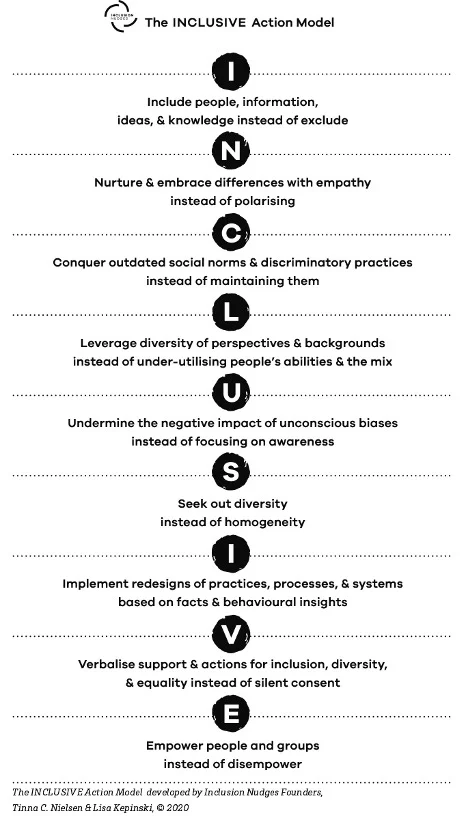
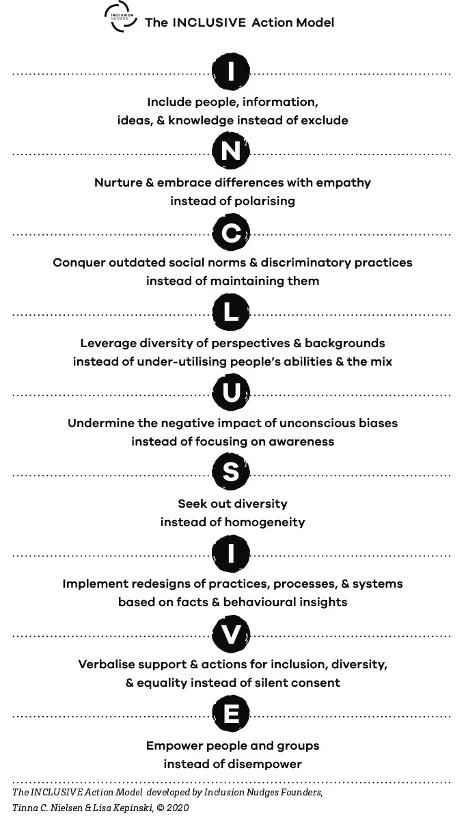
This demanding endeavor requires simultaneous effort from both leaders and team members. Recognizing this complexity, experts Lisa and Tinna created the Inclusion Nudges Inclusive Action Model. This holistic framework provides a comprehensive overview of the myriad ways to intentionally design inclusive cultures, structures, and behaviors, ensuring that inclusion is embedded into the organizational DNA rather than remaining a superficial add-on.
Despite a heartening increase in support for diversity, equity, and inclusion from CEOs and global leaders in recent years, a persistent challenge lies in effectively cascading this executive-level commitment across all layers of management within organizations and ensuring tangible action takes root. Sustainable cultural change is contingent upon this widespread adoption and consistent application of inclusive practices.
Research by Deloitte Australia powerfully illustrates the impact of leadership, indicating that the behaviors of leaders can account for up to a 70 percentage point difference in the proportion of employees who feel highly included versus those who do not. This effect is even more pronounced for members of minority groups, for whom inclusive leadership can make a transformative difference in their workplace experience and sense of belonging.
Yet, a significant gap persists between intent and execution. While Lisa and Tinna observe a growing number of leaders actively striving for change within the organizations they collaborate with, a majority still express feeling "ill-equipped" to act inclusively. They often articulate a lack of clear guidance on how to implement inclusive practices, particularly when it comes to navigating sensitive conversations and facilitating dialogues about issues related to exclusion and discrimination. This hesitancy stems from a fear of making mistakes, saying the wrong thing, or being perceived negatively.
To bridge this critical knowledge-action gap, the "Inclusion Nudges for Leaders" Action Guide was developed, offering 30 easily applicable inclusive actions. These behavioral design interventions are crafted to make inclusion the default and the norm in daily leadership practices. Leaders across diverse organizations and sectors are successfully applying these proven designs, experiencing a tangible increase in their confidence to understand and implement inclusive actions. This initial boost in confidence often sparks a virtuous cycle, encouraging leaders to undertake further inclusive actions, thereby catalyzing a broader, more profound culture change. The core motivation behind this and other Inclusion Nudges guidebooks is to dismantle the pervasive dynamic where leaders feel paralyzed by uncertainty about where to start or what to do, and to alleviate the perceived risk of blame or shame associated with admitting this uncertainty.
The strategic embrace of cognitive diversity, buttressed by psychological safety and championed by inclusive leadership, is no longer a niche HR concern but a fundamental organizational imperative. As businesses navigate an increasingly unpredictable global landscape, the ability to synthesize disparate ideas, challenge entrenched assumptions, and innovate continuously will be the hallmark of resilient and successful enterprises.
Further Resources for Deepening Understanding:
- 4 Ways You Access Diverse Insights for Innovation: Exploring practical methods to tap into varied perspectives for creative problem-solving.
- 3 Inclusive Actions for Psychological Safety: Concrete steps leaders can take to foster an environment where individuals feel safe to contribute their authentic selves and diverse thoughts.
By moving beyond conventional definitions of diversity to actively cultivate cognitive variety and empower it through inclusive practices, organizations can build teams that are not merely representative but are truly equipped to thrive amidst the complexities of the 21st century. This proactive approach ensures that every mind within the organization is not just present but actively engaged, contributing its unique lens to the collective pursuit of progress and resilience.