A growing majority of Americans report that they primarily encounter news passively, rather than actively pursuing it, according to a comprehensive new study by the Pew Research Center, conducted in collaboration with the John S. and James L. Knight Foundation. This trend signifies a notable shift in how individuals engage with information in the digital age, moving away from intentional news gathering towards a more incidental consumption pattern. The findings, released on April 20, 2026, paint a detailed picture of how different types of news are accessed and the demographic factors influencing these behaviors.
The Pew-Knight Initiative, dedicated to understanding how Americans absorb civic information and engage with their communities, highlights a significant increase in passive news consumption. In 2026, 49% of U.S. adults state that they mostly get news because they "happen to come across it," a substantial rise from 39% in 2019 when this question was first posed. This upward trend suggests a fundamental alteration in news habits, potentially driven by the pervasive nature of social media feeds, algorithmic content curation, and the sheer volume of information available across various platforms.
The Dichotomy of News Discovery: Opinion and Humor vs. Deep Dives and Updates
The research reveals a clear dichotomy in how Americans consume different types of news content. While lighthearted or opinion-based content is more likely to be encountered serendipitously, in-depth and timely information often requires intentional effort.
Incidental Consumption Dominates for Opinions and Humor:
The study found that a significant majority of Americans report encountering opinions and humor related to news events by chance.
- Funny Posts: A striking 66% of U.S. adults indicate that they mostly see funny posts about news because they "happen to come across it." This highlights the role of entertainment and shareability in the viral spread of information, often detached from direct news-seeking behavior.
- Opinions: Similarly, 64% of adults report stumbling upon opinion pieces related to news rather than actively searching for them. This suggests that commentary and analysis, often presented in easily digestible formats, are more frequently consumed passively, likely through social media or curated news aggregators.
In contrast, only 21% of adults actively seek out opinion content, and a mere 14% specifically look for funny posts related to news. This indicates a preference for passive engagement with these more subjective or lighthearted forms of news-related content.

Active Seeking for Depth and Timeliness:
Conversely, when it comes to more substantive news, Americans are more inclined to engage in active seeking.
- In-depth Information/Deep Dives: Only 31% of U.S. adults say they mostly get in-depth information or deep dives into issues because they happen to come across it. This suggests that detailed analysis and investigative journalism require a more deliberate approach from the consumer. A considerably larger proportion, 58%, state they actively seek out this type of content.
- Up-to-Date Information: The pursuit of the most current news also leans towards active seeking. While 38% report happening upon the latest updates, 55% actively look for the most up-to-date information about events. This underscores the ongoing demand for real-time news, particularly in an era of rapidly evolving global events.
Demographic Divides in News Consumption Habits
The study also identified significant variations in news consumption patterns based on age and education level, pointing to a generational and educational stratification in how Americans engage with information.
Generational Differences: The Digital Native vs. The Established Consumer
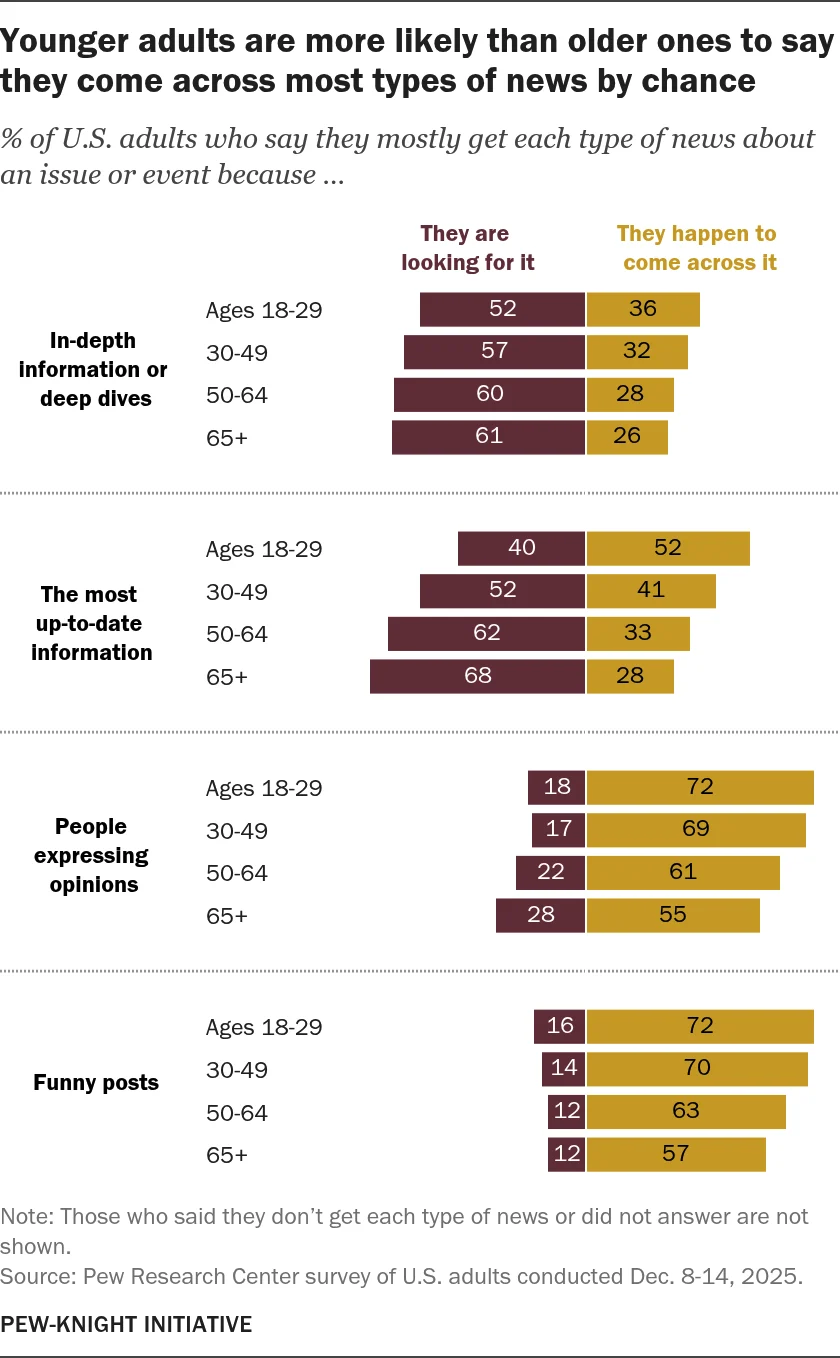
Younger adults are demonstrably more likely than their older counterparts to report encountering news passively across most content categories. This generational divide is a key finding of the research, reflecting differing media ecosystems and lifelong habits.
- Up-to-Date Information: For example, 52% of adults aged 18 to 29 say they mostly get up-to-date information by chance. This contrasts sharply with only 28% of adults aged 65 and older who report the same. Conversely, 68% of older adults actively seek out the latest news, compared to 40% of younger adults.
- In-depth Information: The trend continues for more substantive content. While at least half of adults in every age group report actively seeking in-depth information, younger demographics are more likely to encounter it passively. 36% of 18-29 year olds find deep dives by chance, compared to 26% of those 65 and older.
- Opinion and Humor: The propensity for passive consumption is even more pronounced for opinion and humor among younger demographics. 72% of adults aged 18 to 29 report coming across opinion content by chance, a figure that gradually decreases with age, reaching 55% among those 65 and older. Similarly, 72% of the youngest demographic encounter funny posts by chance, compared to 57% of the oldest.
These findings suggest that younger generations are more embedded in digital environments where news is often algorithmically delivered and integrated into social feeds, making passive discovery the norm. Older generations, potentially with longer-established media routines and less reliance on social media for news, tend to be more deliberate in their information-seeking.
Educational Attainment: A Key Factor in Information Seeking
Education level also plays a role in how Americans access news, particularly for more complex or timely content.

- In-depth and Up-to-Date Information: College graduates are more likely to actively seek out in-depth information (70%) and up-to-date news (65%) compared to adults without a college degree (52% and 51%, respectively). This suggests that a higher level of education may correlate with a greater perceived need for or ability to engage in dedicated news research.
- Passive Consumption: Consequently, adults without a college degree are more likely to report encountering these types of news passively. For in-depth information, 52% of those without a degree get it by chance, compared to 30% of college graduates. For up-to-date information, this figure stands at 51% for those without a degree versus 35% for college graduates.
- Opinions and Humor: Interestingly, educational background appears to have less impact on how people consume opinion and humor. College graduates and those without a degree are about equally likely to say they encounter these types of content by chance rather than actively seeking them out.
This disparity suggests that while social media and other digital platforms may be saturating all demographics with incidental news, those with higher education are more likely to supplement this with intentional efforts to gain deeper understanding or current information.
Political Affiliation and News Engagement
The study also delved into how political leanings might influence news consumption habits, revealing nuances within party affiliations. While similar proportions of Democrats and Republicans report actively seeking news, there are notable distinctions between more ideologically committed individuals and their moderate counterparts.
- Ideological Extremes Seek More Depth: Conservative Republicans and liberal Democrats are more inclined than their moderate peers to actively seek out in-depth or up-to-date information. For instance, 65% of conservative Republicans and 69% of liberal Democrats report seeking out in-depth news, whereas only 54% of moderate/liberal Republicans and 51% of moderate/conservative Democrats claim the same.
- Moderate Engagement: This pattern holds for up-to-date information as well, with 63% of conservative Republicans and 65% of liberal Democrats actively seeking it, compared to 49% and 51% of their respective moderate factions.
- Opinion and Humor: For opinion and humor, ideological alignment appears to have less influence on seeking behavior, with relatively consistent percentages across all political subgroups reporting they encounter these types of content by chance.
These findings suggest that individuals with stronger ideological convictions may be more motivated to actively engage with news to support or challenge their existing viewpoints, particularly when it comes to factual reporting and detailed analysis.
The Perceived Ease of Understanding News
A significant implication of these consumption patterns relates to the ease with which individuals understand the news they encounter. Generally, most Americans report that understanding news is easy for them, regardless of how they obtain it. However, the research indicates a subtle but important difference.
- Incidental vs. Sought-After News: Those who report getting in-depth or up-to-date information by chance are slightly less likely to find it easy to understand compared to those who actively seek it out. Specifically, 70% of those who stumble upon detailed or current news find it easy to comprehend, while 81% of those who actively search for such content report the same ease of understanding.
- Potential for Misinterpretation: This disparity could imply that passively encountered news, which may lack context or be presented in fragmented forms, could pose a greater challenge to comprehension for some individuals. The deliberate act of seeking news might inherently involve a greater cognitive investment, leading to better understanding.
Background and Methodology
This research is part of the ongoing work of the Pew-Knight Initiative, a collaborative effort between Pew Research Center and the John S. and James L. Knight Foundation. The initiative aims to provide critical insights into the evolving landscape of news consumption, public trust in media, and community engagement in the digital age. The findings are based on a survey of 3,560 U.S. adults conducted from December 8-14, 2025, utilizing the Pew Research Center’s American Trends Panel, a nationally representative online survey panel.

The survey questions were designed to explore the nuances of news discovery, differentiating between actively seeking information and passively encountering it across various content types. The methodology ensures that the results reflect the views of the broader U.S. adult population, with detailed responses and survey questionnaires made available for public review.
Implications for the Future of Journalism and Information Literacy
The observed shift towards passive news consumption has profound implications for news organizations, policymakers, and educators. For news outlets, it underscores the need to adapt distribution strategies to meet audiences where they are, potentially by optimizing content for social media and algorithmic discovery while still providing avenues for in-depth engagement. It also highlights the challenge of ensuring that complex and vital information reaches audiences effectively when they are not actively seeking it.
Furthermore, the findings raise important questions about media literacy. As more individuals rely on serendipitous discovery, the potential for encountering misinformation or biased content increases. Efforts to enhance media literacy skills, teaching individuals how to critically evaluate sources and discern fact from opinion, become even more crucial in this evolving information ecosystem. The Pew-Knight Initiative’s continued research in this area is vital for understanding and navigating the complexities of how Americans inform themselves and engage with the world around them. The trend toward passive news consumption is not merely a statistical shift; it represents a fundamental redefinition of the relationship between citizens and the information that shapes their understanding of society and democracy.