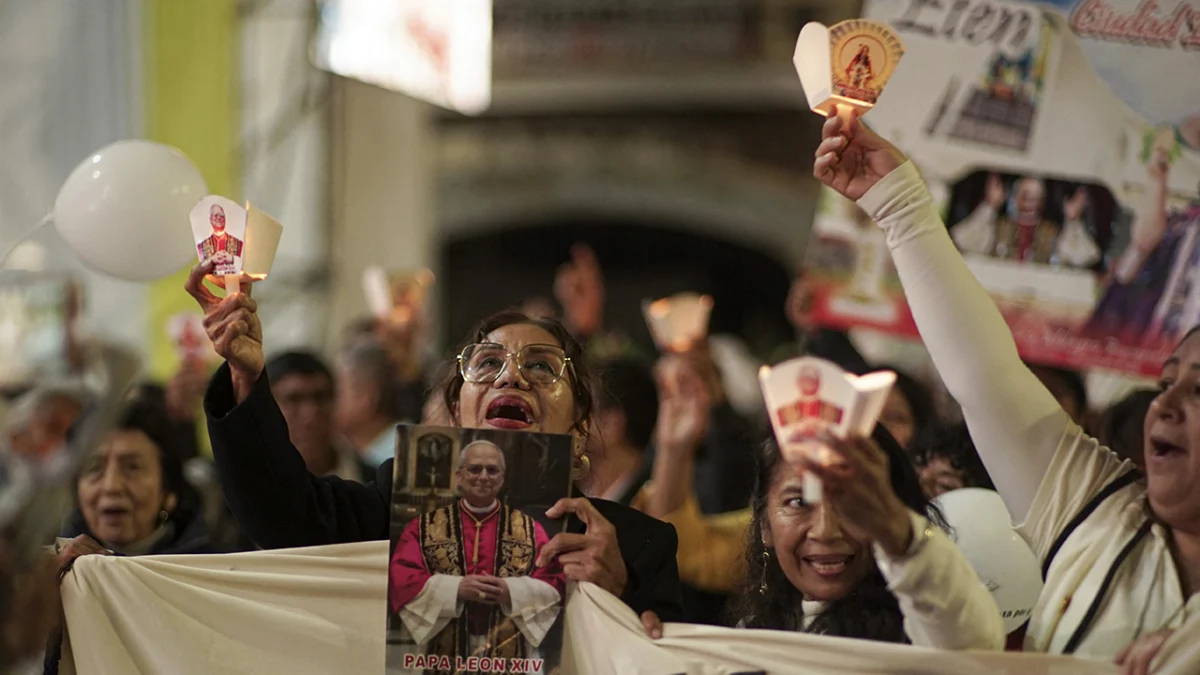
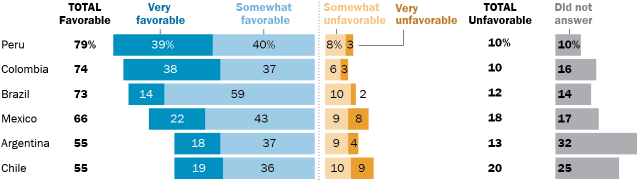
A recent comprehensive survey conducted in 2026 by the Pew Research Center reveals that Pope Leo XIV enjoys a generally favorable standing among Catholics across six major Latin American nations. The study, which polled over 6,000 individuals, including more than 3,500 self-identified Catholics, indicates that a majority of the region’s Catholic population holds positive views of the pontiff. This sentiment is particularly strong in Peru, where an impressive 79% of Catholics expressed a favorable opinion of Pope Leo XIV, with nearly four in ten (39%) reporting a "very favorable" view.
While Pope Leo XIV is the first pontiff to hail from the United States, his deep-seated connections to Peru are a significant factor in his strong approval ratings in the Andean nation. He resided in Peru for approximately two decades and served as the Bishop of Chiclayo from 2015 to 2023, a period that solidified his presence and influence within the local Catholic community. Holding both Peruvian and U.S. citizenship, his dual heritage likely resonates with a diverse populace. The survey data, gathered between February 12 and May 13, 2026, involved respondents from Argentina, Brazil, Chile, Colombia, Mexico, and Peru, countries that collectively represent about three-quarters of the Catholic population in Latin America and the Caribbean.
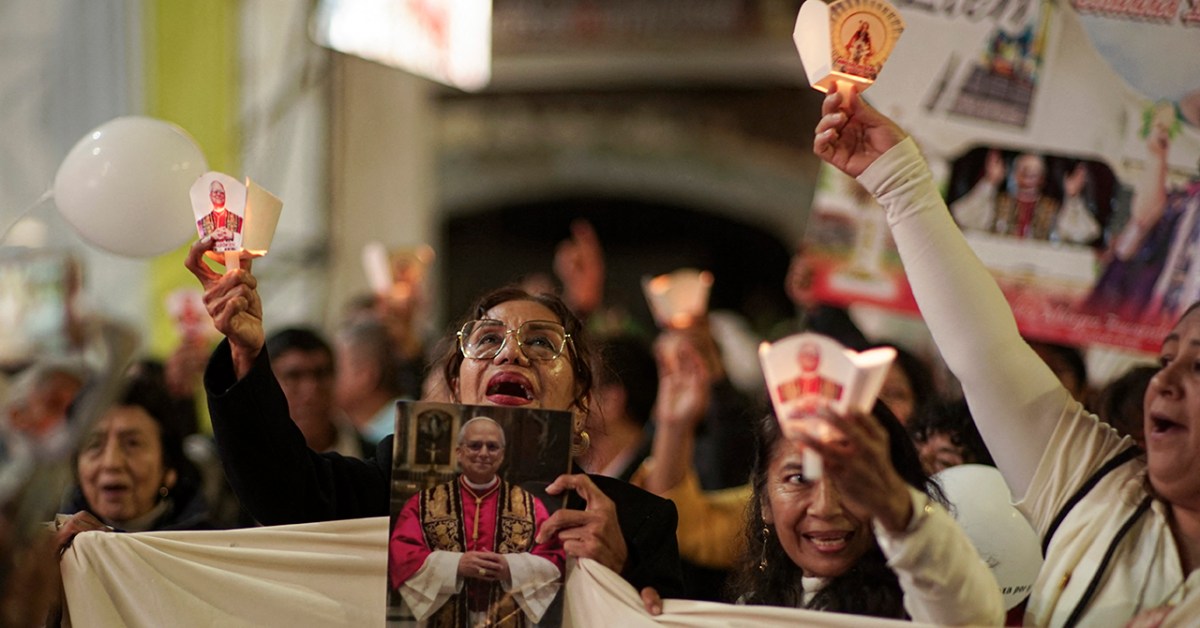
A Tale of Two Pontiffs: Pope Leo XIV’s Reception vs. Pope Francis’s Inaugural Embrace
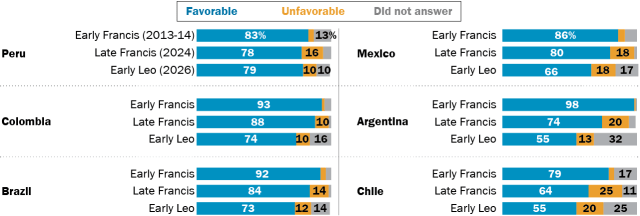
Despite the generally positive reception, a comparative analysis of attitudes towards Pope Leo XIV and his predecessor, Pope Francis, reveals a notable difference in the initial enthusiasm shown by Latin American Catholics. Early in Pope Francis’s pontificate (2013-2014), his favorability ratings in the surveyed countries were significantly higher than those for Pope Leo XIV in 2026. For instance, in Colombia, 93% of Catholics held a favorable view of Pope Francis shortly after his election, a figure that stands in stark contrast to the 74% who currently view Pope Leo XIV favorably. Similarly, Mexico saw 86% favorability for Francis in the early years of his papacy, compared to 66% for Leo XIV in the 2026 survey.
This divergence is partly attributed to a higher percentage of respondents in the most recent survey indicating they are unfamiliar with Pope Leo XIV or chose not to offer an opinion. However, the data also suggests a modest increase in unfavorable opinions towards Pope Leo XIV in some countries when compared to the initial assessments of Pope Francis. For example, unfavorable views of Pope Francis in Mexico in 2013-14 stood at 5%, while the current unfavorable rating for Pope Leo XIV in the same country is 18%.
Even when comparing the current views of Pope Leo XIV to more recent assessments of Pope Francis (2024), Pope Francis’s favorability ratings, despite a decline from his initial surge, generally remain higher than those for Pope Leo XIV in 2026. The percentage of unfavorable views towards Francis in 2024 closely mirrors those for Leo XIV in 2026, indicating that the difference in overall favorability is largely driven by the increased number of Catholics who are not offering an opinion on the current pontiff.
Peru emerges as a consistent outlier in this trend. Across all surveys conducted by Pew Research Center regarding papal favorability in Latin America, Peruvian Catholics have consistently shown robust positive regard for the pontiff. In 2013-14, 83% of Peruvian Catholics viewed Pope Francis favorably. This figure dipped slightly to 78% in 2024 but remained high. In the 2026 survey, 79% of Peruvian Catholics hold a favorable view of Pope Leo XIV, underscoring a deep-seated and enduring positive sentiment towards the papacy within the country. While unfavorable views of Pope Francis in Peru rose from 4% in 2013-14 to 16% in 2024, Pope Leo XIV currently garners a 10% unfavorable rating among Peruvian Catholics.
Regional Variations in Perception and Awareness
While Peru exhibits overwhelmingly positive sentiment, the reception of Pope Leo XIV varies across other surveyed nations. In Argentina and Chile, for instance, his approval ratings are lower, with a substantial portion of Catholics reporting either no familiarity with the pontiff or declining to offer an opinion. In Argentina, only 55% of Catholics expressed a favorable view of Pope Leo XIV, with a significant 32% not providing an answer. Chile mirrors this with 55% favorable views and 25% undecided or unaware.
Conversely, Colombia and Brazil demonstrate strong, though slightly less pronounced, favorable opinions. In Colombia, 74% of Catholics view Pope Leo XIV favorably, while in Brazil, the figure stands at 73%. Mexico reports a 66% favorable opinion, with a notable 18% holding an unfavorable view.
The survey also sought to understand the views of other religious demographics. Protestants and religiously unaffiliated adults in Latin America are considerably less likely to express favorable opinions of the Pope compared to Catholics. However, a significant number within these groups also indicated a lack of awareness of Pope Leo XIV or opted not to answer the question, suggesting a broader challenge in recognition beyond the Catholic faithful.
The Pope’s Background and its Influence
Pope Leo XIV’s biographical details appear to play a crucial role in shaping perceptions, particularly his extensive history in Peru. As noted, his nearly two-decade residency and service as a bishop in Chiclayo from 2015 to 2023 have fostered a strong personal connection with the Peruvian Catholic populace. His dual Peruvian and U.S. citizenship is also a noteworthy aspect, potentially contributing to his broad appeal. The fact that he is the first American-born Pope could also be a point of interest, though the survey does not explicitly detail how this demographic characteristic influences opinion across different regions.
The research methodology involved a rigorous survey process, with interviews conducted over a three-month period in 2026. Pew Research Center’s commitment to understanding the role of religion in public life underpins this type of detailed demographic and opinion polling. This particular study is part of the broader Pew-Templeton Global Religious Futures project, which aims to analyze global religious trends and their societal impacts. The project receives funding from The Pew Charitable Trusts, the John Templeton Foundation, and Templeton Religion Trust.

Analysis of Implications and Future Trends
The findings suggest that while Pope Leo XIV enjoys a generally positive standing in Latin America, his popularity is not as universally high as that of his predecessor, Pope Francis, particularly during Francis’s initial years as pontiff. This difference may indicate several factors at play. Firstly, the novelty and historic nature of Pope Francis, being the first Latin American Pope, likely contributed to an exceptionally strong initial wave of support and identification. Pope Leo XIV, as the first American Pope, may not evoke the same regional resonance.
Secondly, the current religious landscape in Latin America is evolving, with a noted decline in Catholicism over the past decade, as highlighted by previous Pew Research Center work. This shifting demographic could influence how religious leaders are perceived. The increased number of "don’t know" or "no opinion" responses for Pope Leo XIV might reflect this evolving religious adherence or a greater degree of skepticism or disengagement among some segments of the population.
The varying levels of awareness and favorability across different countries also point to the importance of localized engagement and communication strategies for the Vatican. While Pope Leo XIV’s strong ties to Peru have clearly yielded significant dividends, efforts to increase his visibility and connect with Catholics in countries like Argentina and Chile may be necessary to bolster his support base.

The comparison with Pope Francis’s favorability ratings, both early in his papacy and more recently, provides a valuable benchmark. The data suggests that while Pope Leo XIV is viewed favorably by a majority, the peak levels of enthusiasm seen for Pope Francis in his early years have not been replicated. However, the fact that unfavorable views of Pope Leo XIV are comparable to the recent unfavorable views of Pope Francis indicates that the challenges and perceptions of the current pontiff are not entirely unprecedented in the region.
The survey also highlights that demographic factors such as age and gender do not appear to be significant drivers of opinion regarding Pope Leo XIV among Catholics in these six countries. This suggests that his perceived leadership and policies are evaluated more uniformly across these basic demographic lines.
Looking ahead, the sustained positive sentiment in Peru, coupled with the generally favorable views in other major Catholic nations, suggests that Pope Leo XIV maintains a solid foundation of support. However, the challenges of increasing awareness in some regions and the comparative reception against his popular predecessor will likely remain key areas of focus for understanding his pontificate’s trajectory in Latin America. The ongoing evolution of religious demographics in the region will also continue to shape how papal influence and approval are measured in future studies. The detailed breakdown of responses, available in the topline document and through the survey methodology, offers a deeper dive into the nuances of these findings, providing a robust dataset for continued analysis of religious trends and leadership perceptions in Latin America.