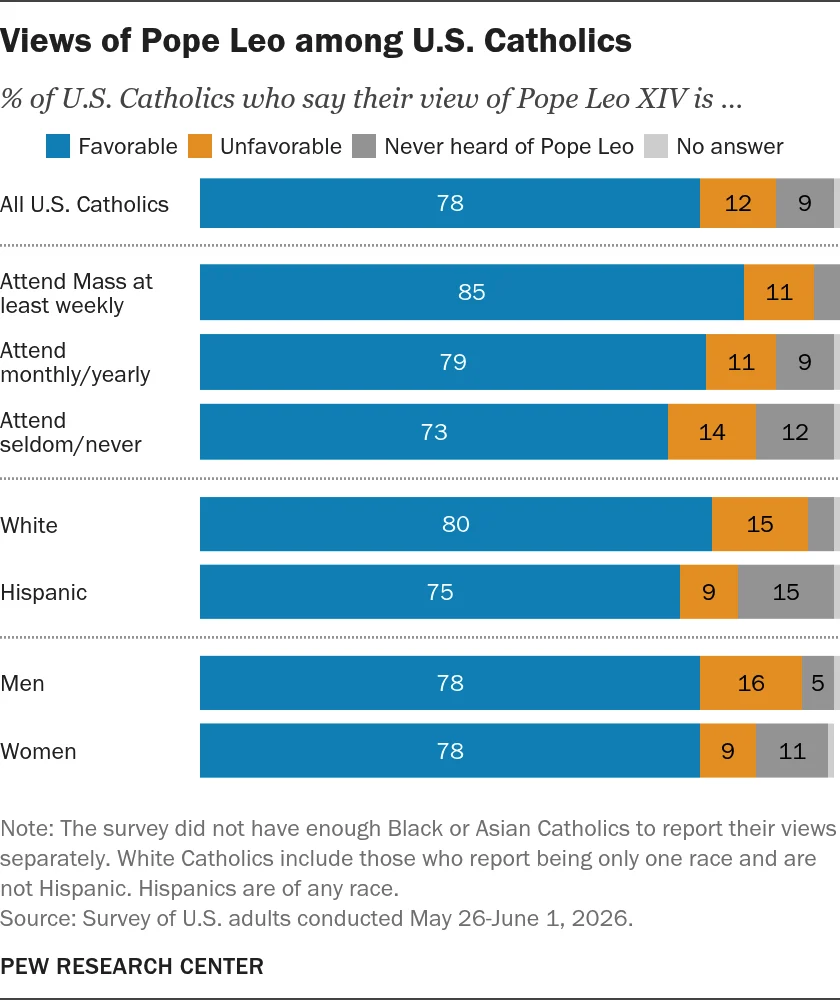
A recent survey by the Pew Research Center reveals that while Pope Leo XIV continues to enjoy broad approval among U.S. Catholics, his favorability rating has seen a slight decrease. The poll, conducted from May 26 to June 1, 2026, indicates that 78% of U.S. Catholics hold a favorable view of the American-born pontiff, a marginal dip from the 84% recorded in the summer of 2025. This current approval rating remains comparable to the levels observed for his predecessor, Pope Francis, during the latter part of his pontificate.
The survey, which polled 9,750 U.S. adults, including 1,848 Catholics, also delved into the complex relationship between the Vatican and the Trump administration, particularly in the wake of recent geopolitical events and public exchanges between the Pope and former President Donald Trump. The findings offer a nuanced picture of how U.S. Catholics perceive these dynamics and their respective leaders.
Shifting Favorability and the Shadow of Geopolitical Events
The slight decline in Pope Leo XIV’s favorability rating occurs against a backdrop of heightened international tension. In April 2026, Pope Leo XIV publicly addressed the escalating conflict in Iran, speaking out against war and attributing the "delusion of omnipotence" to unnamed leaders. This statement was widely interpreted as a veiled critique of policies that had contributed to the conflict.

The Pope’s remarks did not go unnoticed by former President Donald Trump, who responded via social media with a sharp criticism, labeling the Pope as "WEAK on Crime, and terrible for Foreign Policy." This exchange, occurring just weeks before the Pew Research Center survey, undoubtedly influenced the sentiments of U.S. Catholics.
U.S. Catholics Divided on Papal-Presidential Diplomacy
The survey explored how U.S. Catholics view the interactions between Pope Leo XIV and the Trump administration. The results reveal a divided opinion:
- 19% of U.S. Catholics believe Pope Leo XIV has been too critical of the Trump administration.
- 16% feel he has not been critical enough.
- A significant 35% believe the Pope is striking the right balance in his commentary and engagement.
- 30% expressed uncertainty, had no opinion, or were unfamiliar with Pope Leo XIV.
This suggests a complex calculus among U.S. Catholics, with a substantial portion believing the Pope’s engagement with political matters, particularly concerning foreign policy and the Trump administration, is largely appropriate.
Public Opinion on Trump’s Stance Towards the Pope
Conversely, the survey also probed U.S. Catholic perspectives on former President Trump’s approach to Pope Leo XIV. The findings indicate a strong sentiment that Trump’s critiques have been excessive:
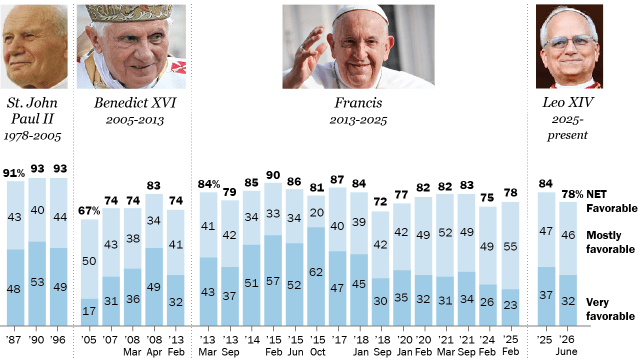
- A commanding 51% of U.S. Catholics believe Donald Trump has been too critical of Pope Leo XIV.
- Only 4% feel Trump has not been critical enough.
- 14% believe Trump is striking the right balance.
- 31% were unsure, had no opinion, or had never heard of Pope Leo XIV.
This stark contrast in opinions underscores a perceived imbalance in the public discourse between the two figures, with a majority of Catholic respondents believing Trump has been overly critical of the Pontiff.
Broad-Based Support for Pope Leo XIV
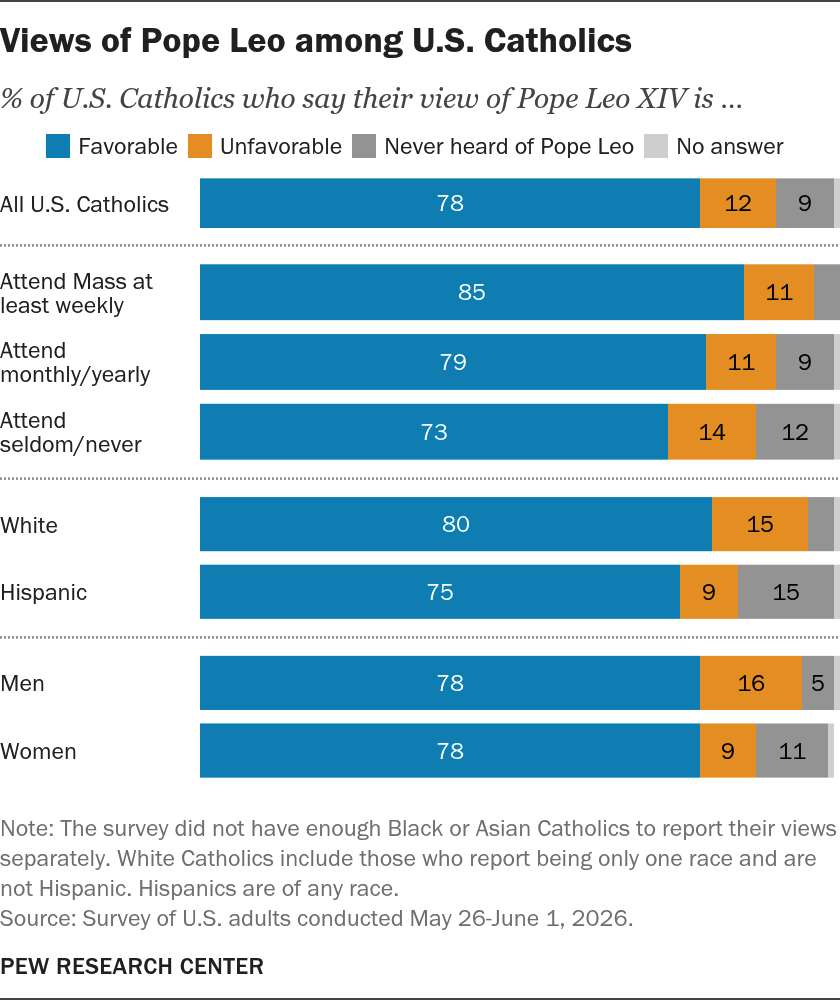
Despite the slight dip in overall favorability and the divisions concerning his political engagement, Pope Leo XIV continues to command widespread support across various segments of the Catholic population. This support remains robust regardless of religious observance or demographic background.
- Weekly Mass-goers: 85% express a favorable view.
- Those attending Mass monthly or yearly: 79% hold a favorable view.
- Those attending Mass seldom or never: 73% still view the Pope favorably.
This data suggests that the core tenets of the Pope’s spiritual leadership resonate deeply, even among those less actively engaged in regular church practice.
Demographic Breakdown of Support:
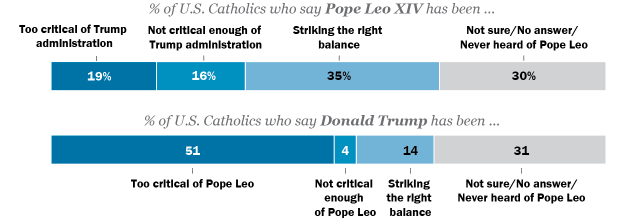
- White Catholics: 80% favorable views.
- Hispanic Catholics: 75% favorable views.
- Catholic Men: 78% favorable views.
- Catholic Women: 78% favorable views.
The survey noted insufficient sample sizes to provide separate breakdowns for Black or Asian Catholics. The data indicates a consistently high level of approval across major demographic groups, highlighting the Pope’s broad appeal within the U.S. Catholic community.
Partisan Divides Emerge in Views of the Pope and Trump
While Pope Leo XIV enjoys significant approval across the political spectrum, the survey reveals discernible differences in how Catholic Democrats and Republicans perceive him and his relationship with the Trump administration.
- Catholic Democrats and independents leaning Democratic generally express more favorable views of Pope Leo XIV than their Republican counterparts.
- In the current survey, 51% of Catholic respondents identify with or lean toward the Democratic Party, while 45% align with or lean toward the Republican Party. This reflects a relatively balanced partisan landscape within the U.S. Catholic electorate in recent years.
Comparative Favorability Ratings:
| Party Affiliation | Favorable View (%) | Unfavorable View (%) |
|---|---|---|
| Republican/Lean Republican | 72% | 22% |
| Democratic/Lean Democratic | 84% | 5% |
This data, reflecting the June 2026 survey, shows a notable gap in favorability, with Catholic Democrats expressing a significantly higher positive regard for Pope Leo XIV. A similar trend was observed during the latter years of Pope Francis’s pontificate.
Divergent Views on Papal-Trump Interactions
The partisan divide becomes even more pronounced when examining perspectives on the public exchanges between Pope Leo XIV and former President Trump.
Catholic Democrats’ Stance:
- A substantial 70% of Catholic Democrats believe Trump has been too critical of Pope Leo XIV.
- Conversely, only 3% believe Pope Leo XIV has been too critical of the Trump administration.
- This leads to a strong overall sentiment: 68% of Catholic Democrats believe Trump has been too critical of Leo, while Leo has not been overly critical of Trump.
Catholic Republicans’ Stance:
- Catholic Republicans present a more divided picture. 32% believe Trump has been too critical of Pope Leo XIV.
- However, a larger segment, 39%, believes Pope Leo XIV has been too critical of the Trump administration.
This divergence highlights a key fault line in how different political affiliations within the Catholic community interpret the Pope’s role in political discourse and the appropriateness of presidential responses.

Broader Implications and Future Outlook
The Pew Research Center’s findings offer a compelling snapshot of U.S. Catholic sentiment towards their spiritual leader and his engagement with the broader political landscape. The slight dip in Pope Leo XIV’s favorability, while statistically modest, may signal the evolving challenges of navigating a highly polarized political environment. The significant majority of Catholics believing Trump has been too critical of the Pope suggests a potential for further strain in relations between segments of the Catholic electorate and the former president.
The consistent high approval ratings across various demographic and religious observance levels indicate the enduring spiritual authority of the Papacy. However, the widening partisan gap in perceptions of papal-presidential interactions underscores the complex interplay between faith, politics, and identity in contemporary America. As the political landscape continues to evolve, the Catholic Church’s role and its leaders’ influence will likely remain subjects of ongoing public scrutiny and analysis. The data suggests that while the Pope’s core message of faith and peace resonates broadly, his engagement with contentious political issues can elicit varied responses within the diverse Catholic community.
The survey’s methodology, relying on the Pew Research Center’s American Trends Panel, provides a robust framework for understanding these trends. The margin of error for the full sample of Catholic respondents is ±3.2 percentage points, lending statistical weight to the reported findings. Further research may be needed to fully comprehend the long-term impact of these dynamics on the Catholic Church in the United States.