A comprehensive new report from the Pew Research Center paints a detailed picture of the multifaceted challenges faced by working parents in the United States, revealing significant disparities in their ability to secure adequate and affordable childcare. The study, released on June 16, 2026, underscores how the ever-present demands of balancing professional responsibilities with familial obligations are shaped by a complex interplay of economic status, work schedules, and the availability of workplace benefits. This extensive research delves into the daily navigation of these dual roles, examining how responsibilities are divided at home and how workplace policies and benefits significantly influence the experiences of millions of American families.
The Imperative for Understanding Working Parents’ Realities
The Pew Research Center, a non-partisan organization dedicated to informing the public, media, and policymakers on crucial societal issues, undertook this research as part of its ongoing commitment to understanding the evolving dynamics of American work and family life. As the nation grapples with changing economic structures and demographic shifts, the pressures on parents, particularly those in the workforce, have intensified. This report aims to provide a data-driven foundation for discussions surrounding parental support, economic policy, and the broader implications for societal well-being. The study’s methodology involved a robust survey of 2,242 U.S. working parents conducted between March 2nd and March 15th, 2026. Participants were drawn from the Pew Research Center’s American Trends Panel, ensuring a representative cross-section of the American working parent population. In addition to the survey data, the report incorporates an analysis of labor force participation using data from the U.S. Census Bureau’s Current Population Survey, offering a broader economic context.
Childcare Costs Emerge as a Paramount Concern
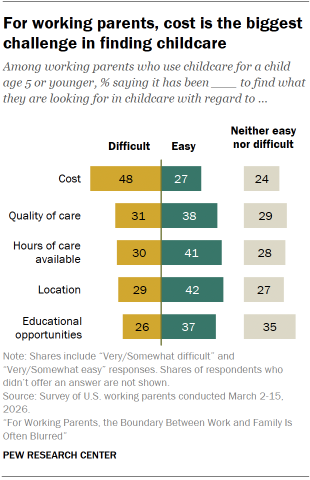
In the current economic climate of 2026, the escalating cost of childcare has become a critical issue, capturing the attention of policymakers across the political spectrum. The Pew report highlights this urgency by focusing a significant portion of its inquiry on the experiences of parents seeking care for their youngest children. A specific segment of the survey questioned 849 working parents with at least one child aged five or younger about their child care search.

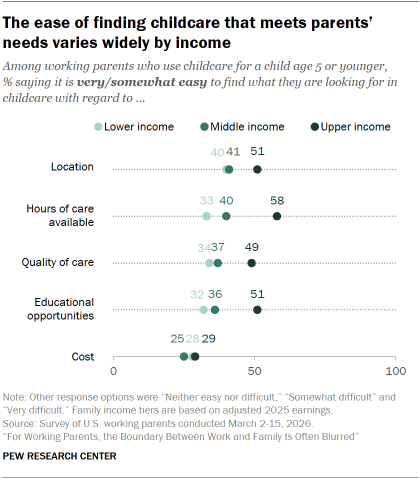
The findings are stark: while parents overwhelmingly prioritize the quality of childcare above all other factors, the cost of securing such care emerges as one of the most significant hurdles across all income levels. Nearly half (48%) of working parents with children aged five or younger reported difficulty finding an arrangement that aligns with their financial expectations. This challenge transcends mere inconvenience; for many, it represents a fundamental barrier to full participation in the workforce.
Beyond quality and cost, parents also consider other crucial elements when selecting childcare. Majorities of parents place substantial importance on the availability of flexible hours, convenient locations, and robust educational opportunities. These factors collectively contribute to a holistic view of what constitutes ideal childcare, a benchmark that many struggle to meet.
Workplace Childcare: A Disconnect Between Desire and Availability
A particularly revealing aspect of the research addresses the provision of workplace childcare, an area where a significant disconnect exists between what parents value and what employers offer. A substantial majority of working parents with children five and younger—59%—indicated that having onsite childcare at their workplace would be extremely or very helpful. This sentiment was even more pronounced among working mothers with children in this age group, with 68% expressing this need. However, the reality for these parents is starkly different, with only a meager 7% reporting that such a benefit is available to them. This disparity suggests a significant unmet need and a potential area for policy intervention and employer innovation.
The complex reality of modern work often necessitates that parents utilize multiple care arrangements to cover their professional hours. The report reveals that approximately four in ten working parents (39%) rely on more than one childcare solution for a single child. This patchwork approach can be logistically challenging and financially taxing, adding another layer of complexity to the already demanding lives of working parents.
These findings are integral to the broader study, which surveyed a total of 2,242 U.S. working parents. The full report, offering a more in-depth exploration of key takeaways, is available for further review.
The Unequal Burden: Income Disparities in Childcare Accessibility
The ability of parents to find childcare arrangements that meet their needs, beyond just affordability, is demonstrably influenced by income. The Pew report highlights significant income-based differences in this regard, revealing that parents with higher family incomes are more likely to report ease in finding suitable childcare.
While the specific data points on ease of finding care across various needs (e.g., hours, location, educational opportunities) were not fully enumerated in the provided text for all income brackets, the overarching trend is clear: financial resources act as a substantial facilitator in navigating the complex childcare landscape. Parents in higher income brackets often have greater flexibility to absorb higher costs, access premium services, or afford multiple arrangements, thereby easing the burden of finding care that meets their specific requirements.
The Impact of Work Schedules on Childcare Stability
A parent’s work schedule also plays a pivotal role in their ability to secure consistent and suitable childcare. The research indicates that parents with highly predictable work schedules report greater ease in finding care that meets their expectations regarding hours of availability. Specifically, 48% of parents with extremely or very predictable work schedules found it easy to secure childcare that met their needs in terms of availability. In contrast, a significantly smaller proportion, just 30%, of parents with somewhat or less predictable work schedules reported the same.
This disparity is further exacerbated by the need for multiple care arrangements. For parents whose work schedules are less predictable, the challenge of finding consistent care often translates into a necessity to cobble together several different arrangements each week. Among parents with somewhat or less predictable work schedules, 45% stated they use more than one care arrangement for the same child. This contrasts with 35% of parents who have a predictable work schedule. The logistical and emotional toll of managing such a fragmented care system can be substantial, impacting parental stress levels and potentially affecting work performance.
Income Stratification in Childcare Choices
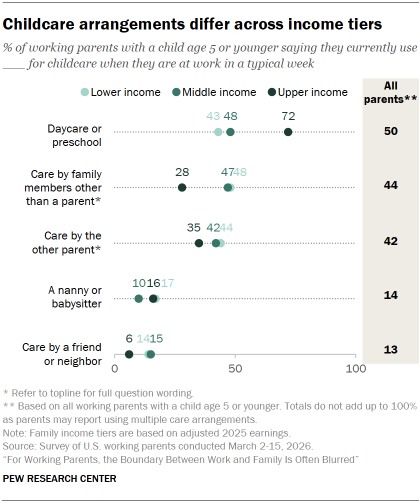
The socioeconomic status of working parents also influences the types of childcare arrangements they primarily utilize. For working parents with upper family incomes, daycare or preschool is the most prevalent form of childcare, employed by 72% of this demographic. These structured educational environments often offer consistent hours and comprehensive programming, aligning well with the needs and financial capacity of higher-income families.
However, for parents with lower or middle family incomes, there is no single dominant childcare arrangement. This suggests a more diversified and potentially less standardized approach to caregiving within these economic strata.
Lower- and middle-income parents are more likely than their upper-income counterparts to rely on childcare provided by:
- Family members or friends: This informal network of support is often crucial for affordability, offering a cost-effective alternative to formal childcare centers.
- Nannies or babysitters: While this can provide more personalized care, it can also be a significant expense, often requiring careful budgeting.
- In-home daycare providers: These smaller, often less regulated settings can offer flexibility and a more intimate environment, but their availability and quality can vary.
This divergence in childcare choices underscores how economic realities shape parental decisions, with lower- and middle-income families often leveraging informal networks or more individualized care solutions to manage their childcare needs.
Navigating the Needs of School-Age Children
The challenges of securing adequate childcare do not diminish with a child’s age; they merely shift in nature. Working parents with school-age children also face considerable difficulties in finding care arrangements that align with their work schedules.
For parents who require childcare for children aged six to twelve, a substantial portion reported facing challenges in securing care during critical periods:
- Before school: 43% of parents found it difficult to arrange care before the school day begins.
- After school: A similar 42% reported difficulties in finding after-school care.
- During the summer: The challenges are most acute during school breaks, with 47% of parents struggling to find suitable summer childcare arrangements.
These figures highlight the ongoing need for flexible and accessible childcare solutions that extend beyond the traditional preschool years, particularly to accommodate the varied schedules of working parents and the structured hours of the school day. The summer months, in particular, present a significant logistical hurdle for many families, often requiring parents to take extended time off work or rely on a complex network of temporary arrangements.
Broader Implications for the American Workforce and Society
The findings from the Pew Research Center’s report have far-reaching implications for the American workforce and society at large. The persistent struggles of working parents to find affordable, quality childcare not only impact individual family well-being but also have broader economic consequences. When parents are forced to reduce their work hours, decline promotions, or leave the workforce altogether due to childcare challenges, it results in a loss of talent and productivity. This can stifle economic growth and exacerbate gender-based wage gaps, as women disproportionately bear the burden of childcare responsibilities.
The disconnect between desired workplace benefits, such as onsite childcare, and their actual availability suggests a missed opportunity for employers to enhance employee satisfaction, retention, and overall productivity. Companies that proactively address the childcare needs of their employees may find themselves with a more engaged and committed workforce.
Furthermore, the disparities in childcare access based on income level underscore the need for targeted policy interventions. Ensuring that all parents, regardless of their economic standing, have access to affordable and high-quality childcare is not just a matter of equity but also an investment in the future of the nation’s children and its economy. As the nation looks towards the future, addressing the complex and evolving needs of working parents will be paramount to fostering a robust and inclusive society. The data presented by the Pew Research Center provides a critical foundation for this ongoing dialogue and for the development of effective solutions.