By Angel Yra Ferreira (Payayá, CS Intern)
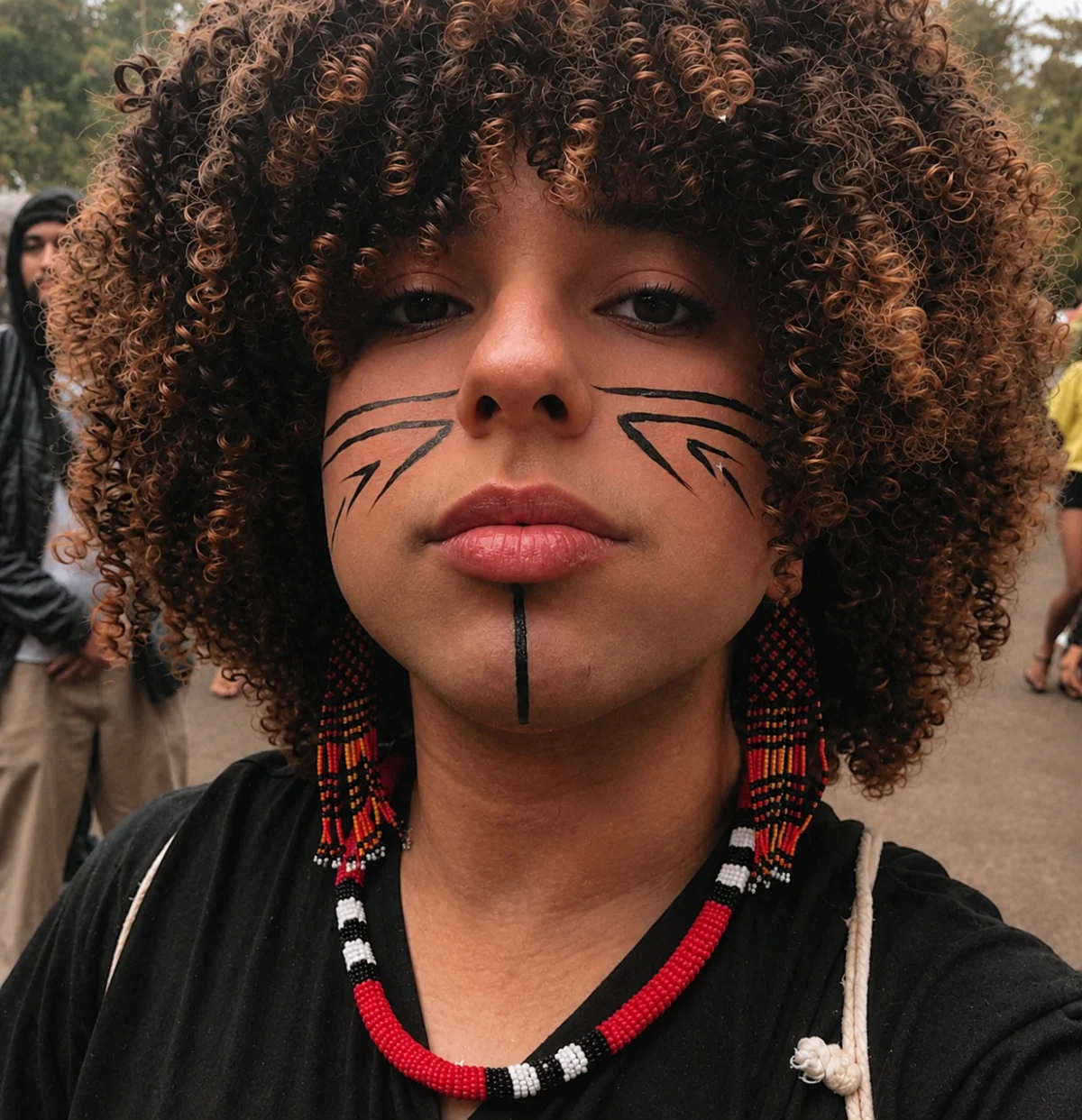
The journey of Lana Potiguara, a 28-year-old trans woman of the Potiguara people, stands as a potent testament to the interconnectedness of identity and existence, challenging the fragmentation imposed by colonial structures. Navigating the coastal landscapes of Paraíba and the bustling urban environment of Rio de Janeiro, she artfully integrates her multifaceted identity through her work as an illustrator, visual artist, and 2D Animation graduate from Estúdio Escola. Lana’s artistic practice is a deliberate act of reclamation, breathing life into ancestral memories that colonial histories have sought to suppress. This powerful impact reverberates in the digital sphere, where she has cultivated a vibrant online community exceeding 50,000 followers across social media platforms under the handle @lanaflowerz. As a pedagogy student at Universidade Federal Fluminense (UFF), Lana co-founded the Indigenous Students’ Collective (CEI-UFF), an initiative born from the necessity to ensure not only access but also sustained presence for Indigenous students within academic institutions. Her current routine is a dynamic balance between her academic pursuits and an internship at the Guarani Para Poty Indigenous School in Mata Verde Bonita Village, Maricá, where she is actively contributing to the development of the school’s new Political-Pedagogical Project. Lana’s aspirations extend to the creation of an animated feature film that authentically celebrates Indigenous cultures and Brazilian folklore, offering a vision for a future where these narratives are not only preserved but also celebrated on a global stage. In an interview with Cultural Survival, she shared profound insights into the complexities of visibility, the vital importance of belonging, and the enduring power of collective action.
Indigenous Pride: A Deeper Connection Beyond Urban Narratives
Cultural Survival: What does it mean to you to feel pride in your Indigenous identity, and how does it differ from more visible or urban 2SLGBTQ+ narratives?
Lana Potiguara: To feel pride in my Indigenous identity is to recognize that I am part of a history larger than myself. It means honoring my ancestors, my Potiguara Peoples, and the knowledge that has resisted despite centuries of erasure. As an Indigenous trans woman, I notice that my experience does not always fit into the most visible 2SLGBTQ+ narratives, which are generally built in urban contexts. My lived experience also involves ancestry, territory, and community belonging. I do not separate my Indigenous identity from my trans identity: when I fight for the rights of one, I am also fighting for the other.
This perspective highlights a crucial distinction: while urban 2SLGBTQ+ narratives often center on individual identity and rights within a modern, often secular, framework, Indigenous 2SLGBTQ+ experiences are intrinsically linked to ancestral lineage, land, and a communal worldview. The historical context of colonization has deeply impacted both Indigenous and 2SLGBTQ+ communities, but the nature of this impact, and the subsequent resistance, carries unique dimensions for those who embody both identities. For Potiguara, the concept of pride is not merely about self-affirmation but about upholding a legacy of resilience and knowledge that has actively defied attempts at eradication.
The Double-Edged Sword of Visibility: Navigating Risk and Responsibility
Cultural Survival: Pride is often discussed in terms of visibility, but visibility can also bring risks. How do you balance the desire to be seen with the need to protect yourself and your community?
Lana Potiguara: I learned that visibility, on its own, is not freedom. In 2020, I was kicked out of my home for being a trans woman and spent days experiencing homelessness during the pandemic. This taught me that existing publicly can bring recognition, but also exposure and violence. Because of this, I believe that visibility must go hand in hand with responsibility. I seek to occupy spaces through art, education, and knowledge production, always thinking about strengthening my community and avoiding unnecessary simplifications or exposure. Not all resistance needs to be under the spotlight to have value.
The personal experience shared by Potiguara underscores the precariousness that often accompanies increased visibility for marginalized individuals. The 2020 incident, occurring during the heightened vulnerability of the COVID-19 pandemic, serves as a stark reminder that public recognition can inadvertently amplify existing societal prejudices, leading to direct harm. This reality necessitates a strategic approach to engagement, where the pursuit of visibility is tempered by a profound sense of responsibility towards the safety and well-being of the collective. Potiguara’s emphasis on art, education, and knowledge production as vehicles for visibility suggests a preference for engagement that is not only impactful but also sustainable and community-centered, prioritizing long-term empowerment over fleeting attention.
Ancestral Wisdom and the Fluidity of Identity
Cultural Survival: What aspects of your culture, language, spirituality, or territory helped you understand your gender identity or sexual orientation more deeply?
Lana Potiguara: I am a trans woman from the Potiguara people. By drawing closer to Indigenous histories, ancestral wisdom, and the relationship with the territory, I understood that human diversity is much greater than the rigid categories imposed by colonization. Today, my experience at the Guarani Para Poty Indigenous School reinforces this perception daily. Learning from the children, the educators, and the community shows me that identity is also about belonging, memory, and relationship with the collective.
This response points to the rich tapestry of Indigenous cosmologies, which often offer more fluid and relational understandings of identity than the binary and rigid Western frameworks. The emphasis on "relationship with the territory" is particularly significant, suggesting that a deep connection to land and nature is intertwined with an understanding of human diversity. Indigenous traditions, predating colonial imposition, frequently incorporated understandings of gender and sexuality that were not confined by European constructs. The ongoing learning experience at the Guarani Para Poty Indigenous School, as highlighted by Potiguara, serves as a living laboratory where these ancestral insights are continually reinforced through daily interactions and communal wisdom.
Deconstructing Colonial Impositions on Gender and Sexuality
Cultural Survival: What colonial ideas do you think still influence how some communities understand gender, sexuality, or diversity?
Lana Potiguara: One of the main colonial legacies is the idea that only two legitimate genders exist, with rigid roles for each of them. There is also a persistent notion that 2SLGBTQ+ people are something "imported" or incompatible with Indigenous cultures. In reality, it was the colonial and religious processes that attempted to erase diverse ways of existing that were already part of the human experience before the European invasion.
The colonial project, in its effort to establish dominance, systematically dismantled and suppressed pre-existing Indigenous social structures, including understandings of gender and sexuality. The imposition of European binary gender norms and heteronormativity was a tool of social control, aimed at aligning Indigenous populations with the colonizers’ moral and social order. Potiguara’s assertion that 2SLGBTQ+ identities are often falsely portrayed as "imported" directly challenges this colonial narrative, highlighting the historical presence of diverse gender expressions and sexual orientations within Indigenous societies long before European contact. This notion of incompatibility is a direct consequence of centuries of cultural assimilation and the systematic erasure of Indigenous knowledge systems.
The Absence of Records is Not the Absence of Existence
Cultural Survival: When you hear the phrase “this did not exist in our cultures before,” how would you respond based on your experience or the memory of your people?
Lana Potiguara: I would respond that the absence of records does not mean the absence of existence. Many Indigenous stories were silenced over the centuries. Furthermore, Indigenous peoples did not always understand identity and sexuality through the same categories used today. The historical erasure caused by colonization cannot be mistaken for nonexistence.
This powerful rebuttal directly confronts the colonial tendency to equate a lack of written or formalized documentation with a lack of historical reality. Indigenous oral traditions, spiritual practices, and community narratives have long served as repositories of knowledge, but these have been systematically undervalued and often destroyed by colonial forces. Potiguara’s statement emphasizes that the silence imposed by colonization is not indicative of absence but rather of suppression. It also acknowledges the evolving nature of identity and the limitations of applying contemporary Western categories to pre-colonial understandings. The historical erasure is a deliberate act of violence, not a reflection of a void.
The Profound Wounds of Forced Choice and the Power of Wholeness
Cultural Survival: What wounds are caused by the need to choose between belonging to your Indigenous community and belonging to the 2SLGBTQ+ community? Is it possible to inhabit both without fragmenting yourself?
Lana Potiguara: The deepest wound is feeling that you cannot exist as a whole. When someone is forced to choose between their Indigenous identity and their 2SLGBTQ+ identity, they receive the message that a part of themselves must be denied. I experienced the consequences of this rejection firsthand when I was kicked out of my home for being trans. I believe it is possible to inhabit both spaces without fragmenting oneself. I am Indigenous, and I am trans. My existence is not a contradiction, but the convergence of these two lived experiences.
The forced choice between intersecting identities creates a profound sense of fragmentation and invalidation, forcing individuals to suppress essential aspects of themselves. This experience, as illustrated by Potiguara’s personal history of displacement, inflicts deep emotional and psychological wounds. The implication is that one identity must be prioritized or sacrificed, leading to a painful internal conflict. However, Potiguara’s assertion that it is possible to inhabit both spaces without fragmentation offers a compelling vision of integration. Her identity as an Indigenous trans woman is not a paradox to be resolved but a rich and complex convergence of lived realities, demonstrating that wholeness is achievable when one’s full identity is affirmed and embraced. This perspective challenges the divisive tactics of marginalization, advocating for an understanding of identity as multifaceted and interconnected.
Everyday Resistance: Beyond the March and the Flag
Cultural Survival: How does Indigenous 2SLGBTQ+ resistance manifest beyond marches, flags, and institutional spaces?
Lana Potiguara: Resistance happens in everyday life: by studying, creating art, strengthening communities, and preserving memories. It was present when I helped found the Indigenous Students’ Collective at UFF, when I participated in building the Political-Pedagogical Project of the Para Poty School, and when I tell Indigenous stories through illustration and animation. Often, resisting is simply continuing to exist.
Potiguara’s articulation of resistance moves beyond performative activism to emphasize the sustained and often quiet acts of resilience that are integral to survival and cultural continuity. This perspective acknowledges that meaningful resistance is embedded in daily practices, intellectual pursuits, artistic creation, and the vital work of community building and memory preservation. The establishment of the Indigenous Students’ Collective and the collaborative development of educational projects are concrete examples of this ongoing struggle. By framing "continuing to exist" as an act of resistance, she highlights the fundamental challenge faced by Indigenous 2SLGBTQ+ individuals: the constant need to affirm their presence and humanity in the face of systemic oppression and erasure. This concept resonates with the broader understanding of Indigenous resistance as a persistent affirmation of life and culture.
Indigenous Languages as Vessels of Diverse Understandings
Cultural Survival: What is the role of Indigenous languages in naming identities, feelings, and bodies that often do not fit into Western categories like “gay,” “lesbian,” “trans,” or “queer”?
Lana Potiguara: Indigenous languages carry their own ways of understanding the world. While Western categories tend to be more rigid, many Indigenous wisdoms emphasize relationships, belonging, and processes. Therefore, valuing Indigenous languages also means valuing other ways of understanding human diversity.
Indigenous languages are not merely tools for communication; they are intricate systems that embody unique worldviews, cultural values, and nuanced understandings of human experience. Potiguara’s insight reveals how these linguistic frameworks can offer alternative conceptualizations of identity and sexuality that are more fluid, relational, and holistic than the often rigid and categorical Western terminology. The emphasis on "relationships, belonging, and processes" suggests that Indigenous languages may provide more comprehensive and context-dependent ways of describing human diversity, moving beyond fixed labels. Valuing and revitalizing Indigenous languages, therefore, becomes a crucial act of decolonization, reasserting distinct cultural perspectives and enriching the global understanding of human identity.
Towards Authentic Allyship: Commitment Over Representation
Cultural Survival: What would you say to organizations, media outlets, or allies who want to support 2SLGBTQ+ Indigenous people but sometimes end up using their stories in a tokenistic or exploitative way?
Lana Potiguara: I would say that true support requires commitment, not just representation. 2SLGBTQ+ Indigenous people need to participate in the decisions and the construction of narratives about their own lives. It is also fundamental to recognize our artistic, intellectual, and community work with respect, autonomy, and fair compensation.
Potiguara’s direct address calls for a fundamental shift in how support is offered to 2SLGBTQ+ Indigenous communities. The critique of "tokenistic or exploitative" engagement highlights the prevalent issue of superficial representation that often prioritizes the ally’s narrative over the lived realities and agency of the individuals being represented. True allyship, as she defines it, necessitates a deeper commitment that involves empowering Indigenous 2SLGBTQ+ individuals to lead in shaping their own stories and decisions. This includes ensuring their active participation in all processes that concern them and providing equitable recognition, compensation, and respect for their contributions. This approach fosters genuine partnership and avoids the perpetuation of colonial dynamics of extraction and appropriation.
Envisioning a Future of True Belonging and Recognition
Cultural Survival: Imagining a truly free future, what would an Indigenous community look like where 2SLGBTQ+ people are not only accepted but also recognized as bearers of knowledge, leadership, and healing?
Lana Potiguara: I imagine a community where no one has to justify their existence. A place where 2SLGBTQ+ people can occupy spaces of leadership, education, art, spirituality, and care without their identity being seen as an obstacle. A truly free future is one where Indigenous children can be who they are without giving up their roots, and where diversity is recognized as part of the community’s collective strength.
Potiguara’s vision of a liberated future paints a compelling picture of a society where Indigenous 2SLGBTQ+ individuals are not merely tolerated but are fully integrated as integral members, contributing their unique knowledge, skills, and perspectives to the collective well-being. The absence of the need to "justify existence" signifies a profound shift away from marginalization towards genuine acceptance and belonging. In this imagined future, identity is not a barrier but a source of strength, enabling individuals to assume leadership roles across all spheres of community life, from education and arts to spirituality and healing. This future prioritizes the holistic development of Indigenous children, allowing them to embrace their multifaceted identities without compromise, thereby recognizing diversity as a fundamental component of the community’s resilience and collective power. This aspiration serves as a powerful call to action, guiding efforts towards building more inclusive and equitable futures for all Indigenous peoples.