A comprehensive analysis by the Pew Research Center reveals that a significant majority of U.S. states have enacted laws prohibiting or restricting betting and wagering on election outcomes. This finding comes at a time when trading volumes on online prediction markets, such as Kalshi and Polymarket, have experienced a substantial surge in recent months. These platforms allow individuals to speculate on real-world events, including elections, by trading contracts based on binary outcomes, a model distinct from traditional betting operations where a central entity sets odds.
The increasing prominence of prediction markets has ignited a complex legal and regulatory debate, pitting state-level prohibitions against federal interpretations of these platforms as financial instruments rather than gambling operations. This dynamic has led to legal challenges and a flurry of legislative activity across the nation as states grapple with how to categorize and control these emerging forms of market participation.
The Shifting Landscape of Election Betting Regulation
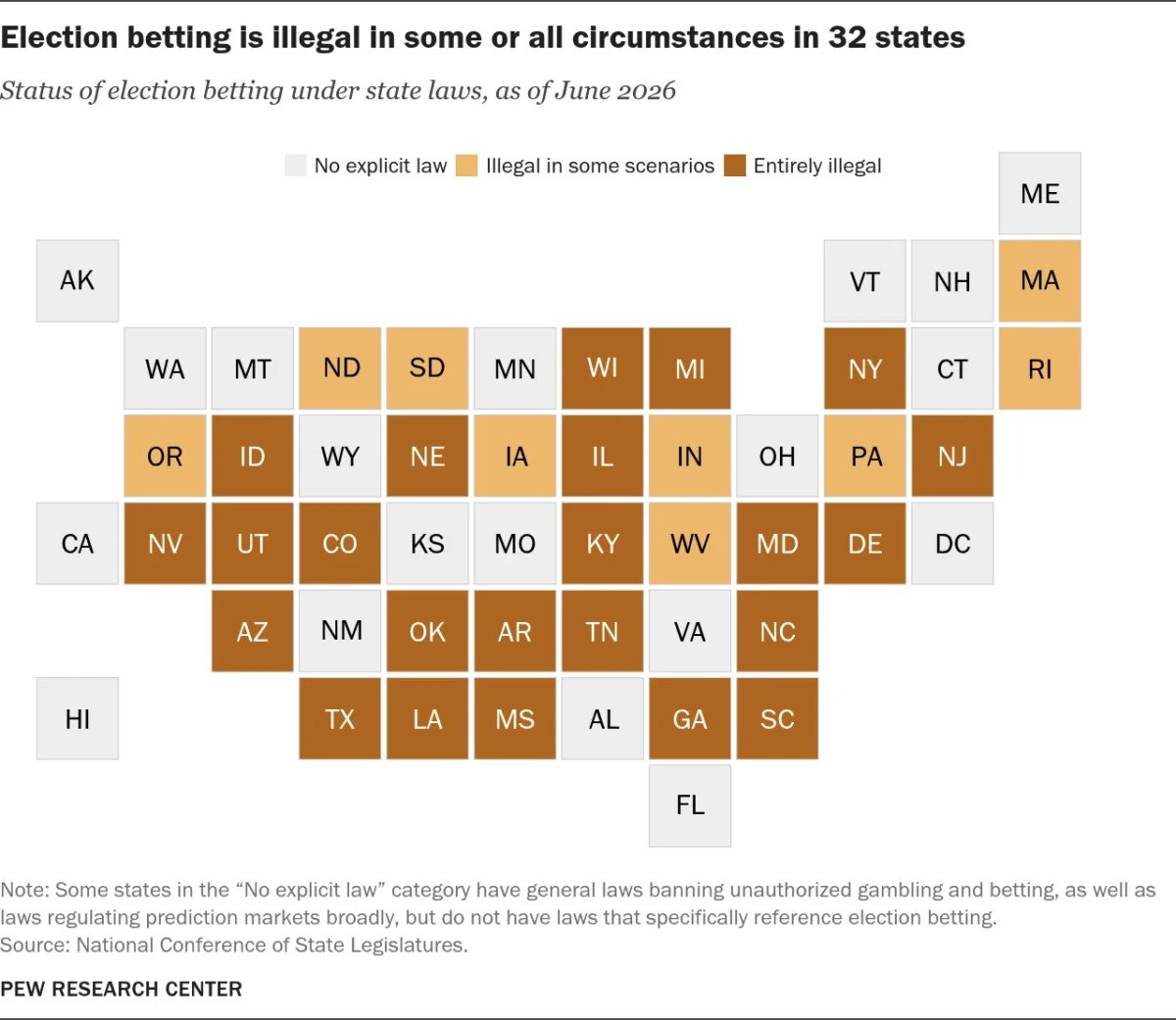
The Pew Research Center’s analysis, drawing data from the National Conference of State Legislatures (NCSL), indicates that more than half of all states have laws in place that, under specific circumstances, forbid betting or wagering on election results. This regulatory landscape is not monolithic; it encompasses a range of approaches, from outright bans to more nuanced restrictions.
Specifically, 23 states have established laws that entirely prohibit election betting. For instance, Arkansas law explicitly states, "no person shall make any bet or wager upon the result of any election" within the state. Kentucky, which has historically maintained a strong stance against such practices, also reinforced its ban this year.
An additional nine states implement regulations that vary in their scope, making election betting illegal only under specific conditions. These variations can include prohibitions targeting individuals in certain positions or focusing on the intent behind the wager.
Deep Dive into State-Level Restrictions
The nuances of state-level regulations are critical in understanding the current legal environment. In Oregon, for example, candidates are explicitly barred from betting on their own electoral contests. South Dakota’s legislation targets election betting that aims to disrupt the voting process or unduly influence voter choices.

Several states, including Iowa, Massachusetts, Pennsylvania, and Rhode Island, focus their legal enforcement on those who organize or facilitate election betting, such as bookmakers and "pool sellers," rather than directly penalizing individuals who place wagers. This approach aims to dismantle the infrastructure of election betting operations.
The penalties associated with violating election betting laws also differ significantly across states. In most jurisdictions where the practice is deemed unlawful, it is classified as a misdemeanor, typically punishable by fines, incarceration, or both. However, some states elevate these offenses to felony status under certain conditions. Illinois and Nebraska, for instance, may prosecute election betting as a felony depending on factors such as the monetary value of the bets or the offender’s prior gambling convictions. Utah takes a particularly stringent approach, classifying it as a felony if a candidate involved in an election is the individual making the bet.
Beyond criminal penalties, certain states impose additional sanctions. Delaware and New York are among those that can revoke the voting rights of individuals convicted of election betting. Wisconsin goes a step further by making it unlawful for individuals who bet on an election to cast a ballot in that specific race, directly linking the act of betting to the integrity of the electoral process itself.
A more common consequence of election betting convictions is the restriction on holding public office or specific positions within the government. Indiana, North Dakota, Pennsylvania, and West Virginia prohibit individuals convicted of election betting from serving as election officials or poll workers. Arkansas extends this ban to encompass holding any state office or being employed by the state, reflecting a broad concern about the potential for compromised individuals to hold positions of trust.
The Rise of Prediction Markets and the Regulatory Challenge
The Pew Research Center’s analysis is particularly timely given the recent surge in trading volume on prediction markets like Kalshi and Polymarket. These platforms distinguish themselves from traditional gambling by operating without a central "house" that sets odds. Instead, they function more akin to stock exchanges, where the market price of a contract reflects the collective belief of its participants regarding the likelihood of a specific event occurring.
This distinction has become a focal point in the ongoing legal battles. Federal regulators, including the U.S. Commodity Futures Trading Commission (CFTC), argue that platforms like Kalshi and Polymarket facilitate the trading of financial products, not illegal bets. Consequently, they contend that these platforms should be exempt from state-level gambling prohibitions. The CFTC has initiated lawsuits against several states in an effort to prevent them from enforcing their gambling laws against these prediction markets.
States Respond: Legislative Action and Executive Orders
In response to the growing popularity and perceived risks of prediction markets, state lawmakers have been actively introducing legislation. According to NCSL data, at least 16 states have proposed bills in the current year aimed at regulating prediction markets in various ways. The majority of these states already have existing laws governing election betting, indicating a coordinated effort to address this evolving market.

Minnesota notably became the first state to enact a statewide prohibition on platforms like Kalshi and Polymarket in May. While this ban targets election-related contracts, it includes exceptions for contracts tied to weather events or those that can function as insurance policies, allowing users to hedge against potential risks. However, this ban has also drawn legal scrutiny, with the federal government suing to block its enforcement.
Other states have also taken legislative action. Kentucky, in addition to its election betting ban, has introduced measures to tax prediction market operators and prohibit certain associations from contracting with these platforms for event contracts. Tennessee passed legislation in May that criminalizes attempts to influence an event’s outcome by individuals who have traded on related prediction markets, framing such actions as a felony.
Currently, at least 12 states have pending legislation related to prediction markets, while similar bills have failed to pass in at least four states. These legislative efforts address a range of concerns, including implementing age restrictions, prohibiting state officials and employees from using these platforms, and establishing regulatory frameworks or licensing requirements.
Furthermore, some state executives have utilized executive orders to address prediction markets. Governors in Maryland and New York have issued directives prohibiting state employees from engaging in insider trading on these platforms, signaling a commitment to maintaining ethical standards within government.
Historical Context and Future Implications
The regulation of election betting is not a new phenomenon. Some existing state statutes trace their origins back to the 19th century. An Idaho statute from 1887, for example, made election betting a misdemeanor, predating the state’s official admission to the Union by three years. This historical precedent underscores a long-standing concern about the potential for betting on elections to undermine their integrity.
The current debate surrounding prediction markets highlights a broader tension between fostering innovation in financial markets and safeguarding the integrity of democratic processes. The legal classification of these platforms—whether as gambling operations subject to state control or as financial instruments regulated by federal agencies—will have significant implications for their future development and accessibility.
The Pew Research Center’s analysis provides a crucial snapshot of the current regulatory landscape, revealing a patchwork of state laws that reflect a diverse range of approaches to election betting. As prediction markets continue to evolve and gain traction, the legal and legislative battles over their regulation are likely to intensify, shaping the intersection of technology, finance, and democracy in the years to come. The ongoing dialogue between state and federal authorities, coupled with legislative initiatives, will be critical in determining the ultimate framework governing these novel forms of market participation.