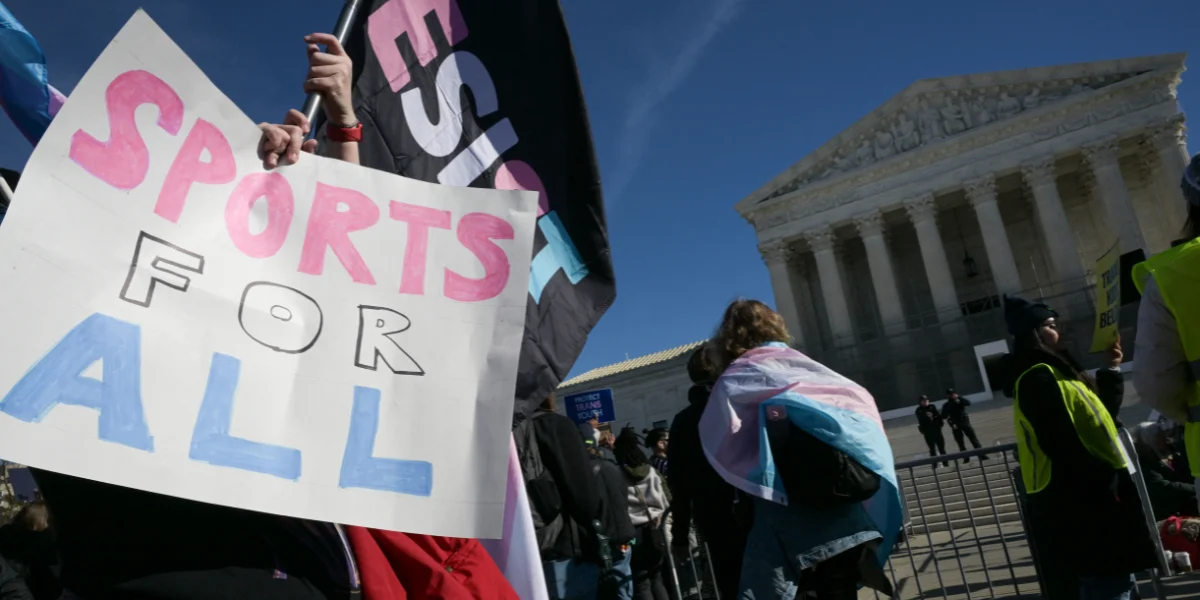
The Supreme Court of the United States has issued a significant ruling upholding state-level bans that prohibit transgender women and girls from participating in female athletic programs. The decision, which addresses two pivotal cases from West Virginia and Idaho, marks a definitive moment in the ongoing national debate regarding the intersection of gender identity, biological sex, and competitive fairness in amateur and collegiate athletics. By declining to overturn these state statutes, the Court has effectively cleared a legal path for other jurisdictions and educational institutions to implement similar exclusionary policies. The ruling impacts a broad spectrum of athletic activity, ranging from elementary school recreational leagues to high-level collegiate competition, and signals a shift in the judicial interpretation of Title IX protections.
The legal challenges centered on the experiences of two student-athletes: Becky Pepper-Jackson, a middle school student from West Virginia, and Lindsay Hecox, a university student from Idaho. In West Virginia, the legislature passed House Bill 3293, a comprehensive measure that bars transgender girls from participating in girls’ sports at the middle school, high school, and college levels. The ban extends to all forms of competition, including intramural and recreational activities. Pepper-Jackson, who had transitioned before the onset of puberty and sought to compete in track and field events such as shot put and discus, was the only known transgender girl in the state seeking to participate in girls’ sports at the time of the bill’s enactment.
The second case involved Idaho’s House Bill 500, titled the Fairness in Women’s Sports Act. This legislation was the first of its kind in the United States to establish a total ban on transgender women and girls in public school athletic programs, spanning from elementary school through the university level. Lindsay Hecox, a runner at Boise State University, challenged the law after seeking to join the women’s cross-country and track teams. While Hecox did not initially make the competitive roster and participated at the club level, the state’s mandate effectively barred her from future qualification for the women’s division. The Supreme Court’s refusal to strike down these laws affirms the states’ arguments that such restrictions do not constitute unconstitutional discrimination under current legal frameworks.
Chronology of Legislative and Judicial Actions
The trajectory of these cases reflects a rapid escalation of legislative activity across the United States. In 2020, Idaho became the first state to pass a law specifically targeting transgender athletes. This move prompted immediate legal challenges from civil rights organizations, leading to a period of judicial injunctions that temporarily halted the law’s enforcement. However, the Idaho model served as a blueprint for other Republican-led legislatures. By 2021, West Virginia followed suit with HB 3293, which was promptly challenged by the American Civil Liberties Union (ACLU) on behalf of Pepper-Jackson.
Between 2021 and 2024, more than 20 states passed similar measures, citing the need to protect the integrity of women’s sports and ensure "fairness" for biological females. During this period, the federal government’s stance shifted significantly. The Biden administration sought to expand the definition of Title IX—the 1972 landmark civil rights law prohibiting sex-based discrimination in education—to include gender identity. This federal pushback created a direct conflict with state laws, leading to a "patchwork" of athletic eligibility across the country.
The cases reached the appellate level in the 4th and 9th Circuit Courts, where conflicting opinions emerged regarding the standard of scrutiny applied to gender-based exclusions. The Supreme Court’s involvement this week provides a degree of finality to these specific state challenges, though legal experts suggest that broader challenges to the Department of Education’s Title IX revisions will continue to permeate the lower courts.
Data and Scientific Perspectives in the Athletic Debate
The debate over transgender participation in sports is often framed through the lens of biological advantage. Proponents of the bans argue that individuals who have gone through male puberty possess physiological traits—such as increased bone density, lung capacity, and muscle mass—that provide an insurmountable advantage over biological females. They contend that these advantages persist even after hormone replacement therapy (HRT).
Conversely, advocacy groups and some medical professionals point to data suggesting that the "advantage" is not uniform and varies significantly depending on the timing of a transition. In the case of Becky Pepper-Jackson, legal representatives argued that because she transitioned before puberty, she never developed the physiological characteristics associated with male biological development. A 2024 study cited in various amicus briefs suggested that for transgender women who suppress testosterone for extended periods, the gap in athletic performance narrows, though some critics maintain that skeletal structure remains a factor.
Furthermore, the impact of these bans on elementary school sports has drawn scrutiny from child development experts. At the elementary level, sports are generally categorized as "participation-based" rather than "performance-based," focusing on motor skill development and social integration. Data from the National Federation of State High School Associations (NFHS) indicates that the primary goal of youth sports is to foster team-building and physical health. Critics of the legislation argue that applying competitive biological standards to children as young as six or seven years old deviates from the educational mission of school-sponsored athletics.
Professional and International Sport Regulatory Responses
The Supreme Court’s decision arrives as professional and international governing bodies are also recalibrating their eligibility requirements. For several decades, the International Olympic Committee (IOC) allowed transgender women to compete if they met specific testosterone suppression requirements. However, in recent years, the IOC shifted its framework, delegating the authority to individual sports federations. This has led to a more restrictive environment.
For example, the International Swimming Federation (World Aquatics) and World Athletics have effectively banned transgender women from elite female categories if they transitioned after the age of 12. Similarly, the United States Tennis Association (USTA) recently updated its eligibility policies, citing federal executive guidance to justify more stringent definitions of sex and gender for recreational and professional leagues. This move mirrored a quiet trend among national governing bodies to prioritize biological sex over gender identity in the interest of "protected category" integrity.
In the realm of global football, FIFA has faced increasing pressure to formalize its policies. While the organization has historically been more inclusive, reports indicate that external political pressure and the precedent set by the IOC may lead to the reintroduction of genetic sex-testing—a practice that had largely been abandoned in the late 20th century due to ethical and scientific concerns.
Official Responses and Legal Implications
The reaction to the Supreme Court’s ruling has been sharply divided along ideological and legal lines. The American Civil Liberties Union, representing the plaintiffs, issued a statement expressing profound disappointment, stating that the ruling "ignores the humanity of student-athletes and undermines the core promise of Title IX to provide equal opportunity for all students." They argued that the decision would lead to the further marginalization of a vulnerable student population.
On the other side, the Alliance Defending Freedom (ADF), which provided legal support for the states of West Virginia and Idaho, lauded the decision. "This is a victory for common sense and for the future of women’s sports," said a spokesperson for the ADF. "By upholding these laws, the Court has ensured that the female category remains a fair and safe space for biological women to compete and excel."
Legal analysts suggest the ruling has broader implications for the interpretation of "sex" in federal law. If the Court continues to lean toward a strictly biological definition of sex, it could impact not only sports but also access to gender-segregated facilities such as locker rooms and bathrooms in schools receiving federal funding.
Broader Impact on the Sports-Industrial Complex
The ruling is expected to catalyze a new wave of policy-making at the local school district level. Without a federal mandate to include transgender athletes, many districts in conservative-leaning states are likely to adopt "biological sex" requirements for all extracurricular activities. This could lead to increased litigation as parents and advocacy groups challenge the privacy implications of "gender verification" processes, which some laws require if an athlete’s sex is disputed.
Furthermore, the decision highlights a growing tension within the advocacy for women’s sports. While there is a unified push for equal pay, increased media coverage, and better resourcing for female athletes, the issue of transgender inclusion remains a point of contention. Some advocates argue that the focus on transgender athletes distracts from more systemic issues facing women’s sports, such as the lack of female coaches, sexual harassment, and the significant funding gap compared to men’s programs.
As the 2024-2025 academic year approaches, the landscape of American school sports stands at a crossroads. The Supreme Court’s decision provides the legal foundation for a dual-track system of athletic participation in the United States, where the rights and opportunities of transgender students will depend largely on their geographic location. The ruling ensures that the debate over fairness, identity, and the purpose of competition will remain a central fixture of the American legal and cultural discourse for years to come.