A comprehensive new study by the Pew-Knight Initiative reveals a significant correlation between Americans’ engagement in public life and their attitudes toward politics, news consumption, and their perception of societal and community well-being. The report, drawing on extensive national surveys, categorizes U.S. adults into four distinct "engagement groups" and explores how their levels of participation shape their views.

The research, conducted from July 9 to December 5, 2025, utilized the Cross-Sectional Engagement Survey, which involved 5,393 U.S. adults. A subsequent analysis using data from Wave 179 of the American Trends Panel (ATP), comprising 5,195 respondents surveyed from September 8-14, 2025, allowed for a deeper examination of demographics, attitudes, and civic knowledge within these engagement groups. The study’s methodology was designed to capture a nuanced understanding of public engagement by analyzing a range of activities, including political participation, civic and community involvement, news consumption, and religious practices.
"People participate in public life in different ways—from voting and volunteering to following the news and taking part in religious or community activities," the report states, highlighting the study’s impetus. "But these behaviors are often studied separately, making it difficult to see how they come together in people’s day-to-day lives. We conducted this study to provide a more integrated picture of how the public engages across these different domains." A key methodological consideration was ensuring the survey’s ability to reach individuals less inclined to participate in public life, who might also be less likely to engage in surveys.
The Spectrum of Engagement: Four Distinct American Groups
The Pew-Knight Initiative’s analysis identified four distinct groups based on a cluster analysis of 19 measures of participation:
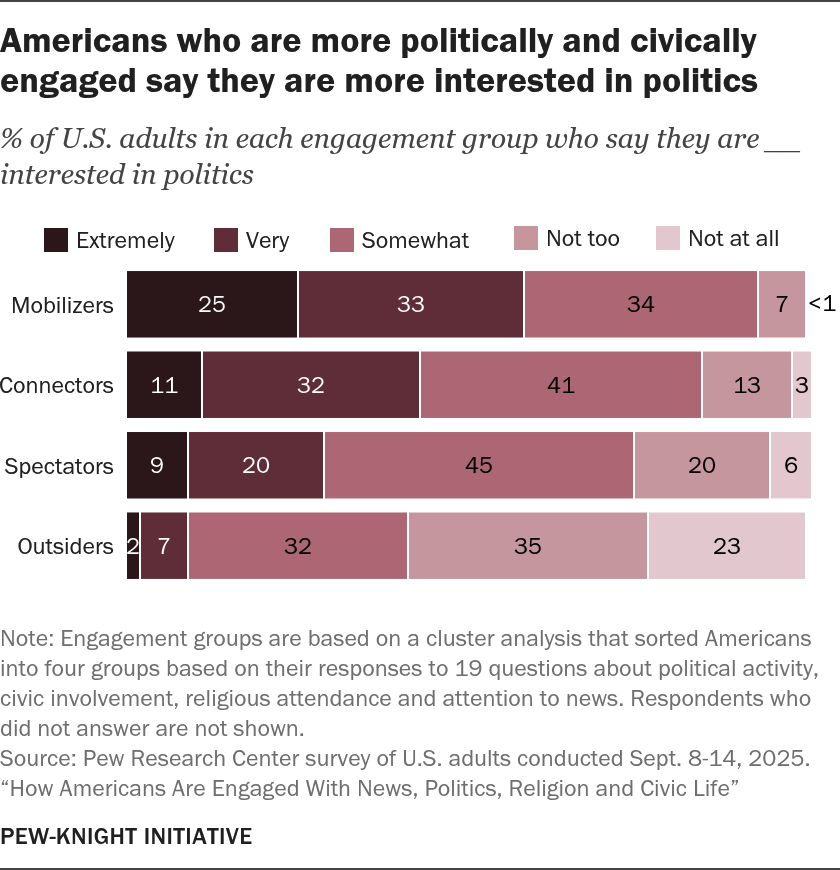
- Mobilizers: This smallest group represents the most active segment of the population, demonstrating high levels of engagement across political, civic, news, and religious spheres. A significant majority (58%) of Mobilizers report being "extremely" or "very" interested in politics.
- Connectors: A larger group than Mobilizers, Connectors are also highly involved in various activities, including joining groups and making donations. However, they are notably less politically active than Mobilizers. Forty-three percent of Connectors express high interest in politics.
- Spectators: This group primarily engages by following the news at high rates but participates less directly in other civic or political activities. Only 28% of Spectators report a strong interest in politics.
- Outsiders: This group represents the least engaged segment of the U.S. public, showing lower participation in most activities, including voting and following the news. A stark minority (9%) of Outsiders express high interest in politics, with a majority stating they are "not too interested" or "not at all interested."
The report’s findings underscore a direct relationship between political engagement and interest in politics. Mobilizers exhibit the highest levels of political interest, while Outsiders demonstrate the lowest. This pattern holds true across party lines, with similar levels of political interest reported within each engagement group among Democrats and Republicans.

Engagement and Perceptions of the Nation and Local Communities
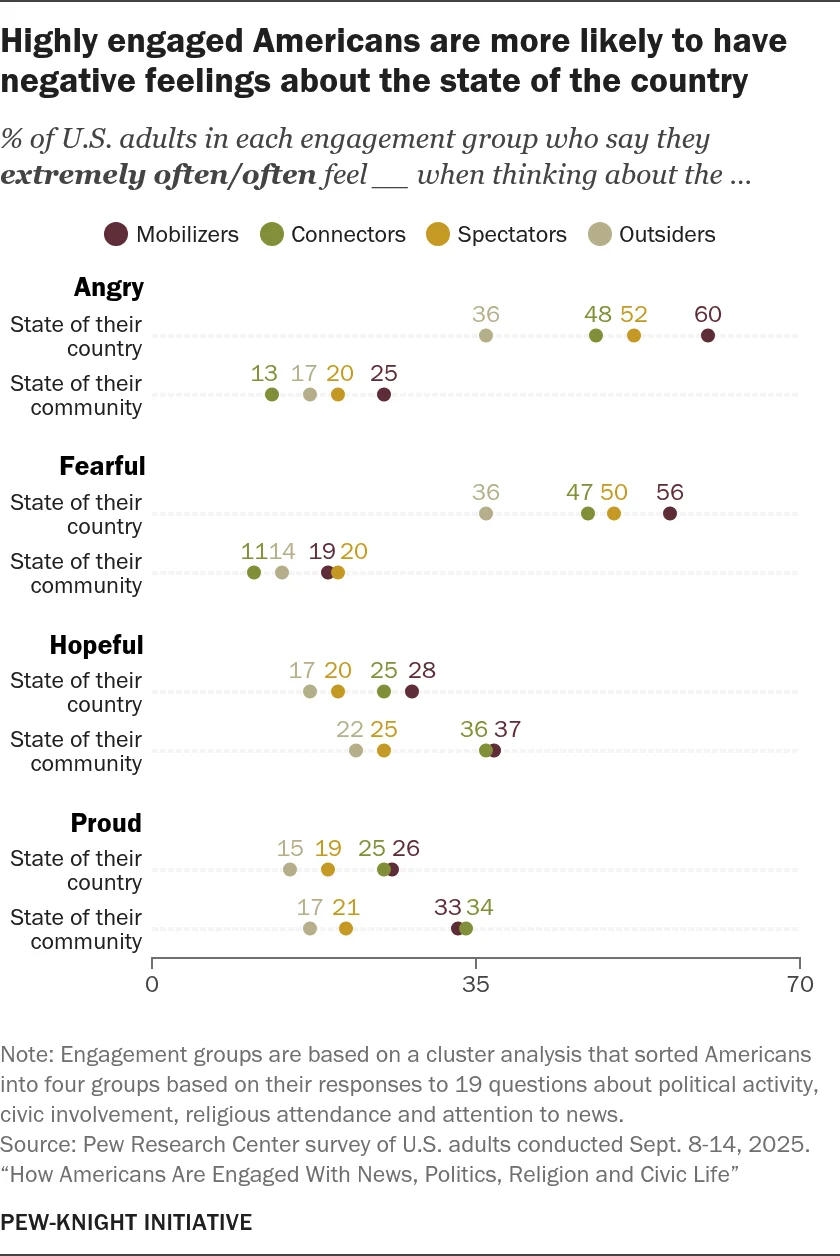
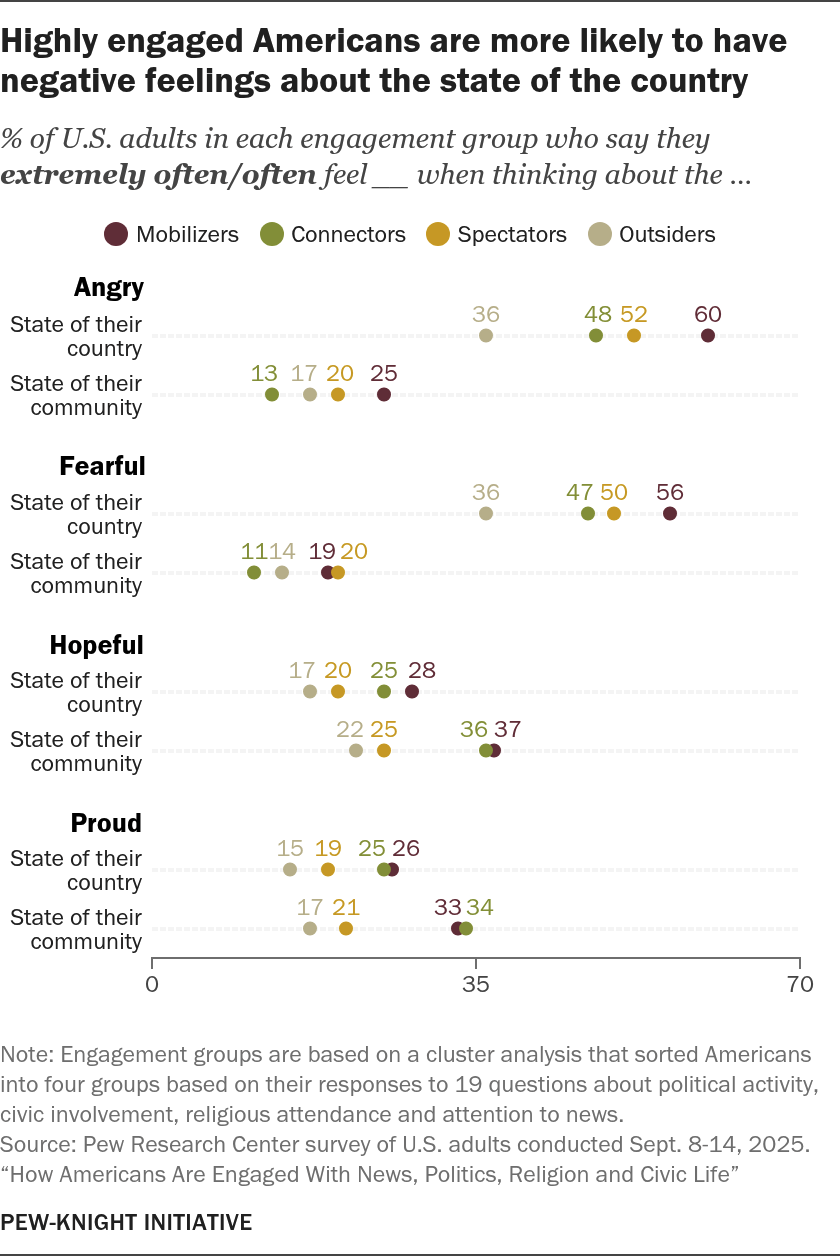
The study also probed Americans’ feelings about the state of their country and local communities. A consistent theme emerged: more engaged Americans tend to express more negative sentiments about the nation’s overall condition.
"No matter how engaged they are, Americans are more likely to report feeling angry and fearful than hopeful or proud when thinking about the state of the country," the report notes. For instance, 60% of Mobilizers reported feeling angry about the state of the country, compared to 36% of Outsiders. Fear also registered high among the most engaged, with 56% of Mobilizers expressing fear about the nation’s state, versus 36% of Outsiders.

However, sentiments regarding local communities were more positive across the board. A majority of Mobilizers (37%) and Connectors (36%) reported feeling hopeful about their local communities, compared to 25% of Spectators and 22% of Outsiders. Similarly, pride in local communities was higher, with 33% of Mobilizers and 34% of Connectors expressing this sentiment, compared to 21% of Spectators and 17% of Outsiders. This suggests that while national-level concerns may fuel political engagement, a sense of local connection and positivity can coexist.
Interestingly, the least active group, Outsiders, were paradoxically less likely to express negative feelings about the state of the country. This could indicate a detachment from national discourse or a different set of priorities influencing their outlook.

Trust in Institutions: Federal Government vs. News Media
A significant finding of the Pew-Knight Initiative study is the uniformly low level of trust in the federal government across all engagement groups. Approximately one in five adults in each group reported trusting the federal government "just about always" or "most of the time." This suggests a broad disillusionment with federal institutions that transcends individual levels of civic participation. Republicans, who held power in the executive and legislative branches at the time of the survey, showed slightly higher trust, but the overall figures remained low.
In contrast, trust in news and information sources showed more distinct variations by engagement level, particularly for the Outsiders group. While a majority of Mobilizers (62%), Connectors (64%), and Spectators (57%) expressed some level of trust in national news organizations, only 45% of Outsiders did. Furthermore, 18% of Outsiders reported having "no trust at all" in national news.

Trust in local news organizations was generally higher across all groups, but a similar pattern persisted, with Outsiders being less likely to express trust. Trust in social media also varied, with Mobilizers (51%) and Spectators (48%) expressing more confidence than Connectors (32%) and Outsiders (28%).
The report also highlighted that age, while a factor in news trust, was not the sole determinant. The stark differences in trust between Mobilizers and Outsiders, two groups with similar age compositions, suggest that engagement itself plays a crucial role in shaping how Americans perceive information sources.
Skepticism Towards News Media Fairness Persists
Despite variations in trust, a common thread runs through all engagement groups: widespread skepticism about the fairness of news media. A significant majority of Americans, irrespective of their level of civic participation, believe that news organizations tend to favor one side when covering political and social issues. The Connectors group showed the highest proportion (82%) holding this view.
This sentiment was also polarized by party affiliation, with Republicans more likely than Democrats to believe news organizations exhibit bias. However, even among Democrats, majorities across all engagement groups expressed this concern.

The study also found that views on the news media’s "watchdog" role were relatively consistent across engagement levels. Most Americans, across all groups, believe that media scrutiny helps prevent political leaders from engaging in misconduct. The Outsiders group was slightly less likely to endorse this view, but the overall consensus pointed to a belief in the media’s oversight function.
The Pew-Knight Initiative’s research provides a valuable lens through which to understand the complex interplay between individual engagement and societal perceptions. By segmenting the public into distinct engagement groups, the study offers a more nuanced picture of how different Americans navigate their civic and political landscapes, consume information, and form opinions about the world around them. The findings underscore the importance of continued research into these patterns to foster a more informed and engaged citizenry.