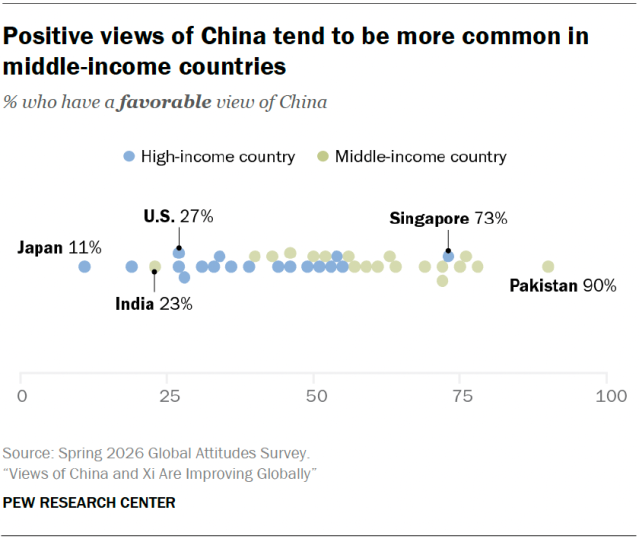
A comprehensive new report from the Pew Research Center reveals a significant global divide in how China and its leadership are perceived, with national economic standing emerging as a primary determinant of public opinion. Across 37 surveyed countries, a clear pattern emerges: citizens of high-income nations generally hold less favorable views of China, while those in middle-income countries tend to express more positive sentiments. This divergence extends to opinions on Chinese President Xi Jinping, evaluations of China’s respect for personal freedoms, and concerns about its international conduct.
The findings, released in July 2026, are based on extensive surveys conducted between February 8 and May 13, 2026, encompassing 45,658 respondents. This research builds upon years of Pew’s ongoing work to understand global perceptions of China, including previous reports that examined China’s foreign policy approaches and shifts in global opinion during Xi Jinping’s presidency. The Center’s stated mission is to provide data and analysis that aids public understanding and informs decision-makers on critical global issues.
Methodology and Scope of the Study
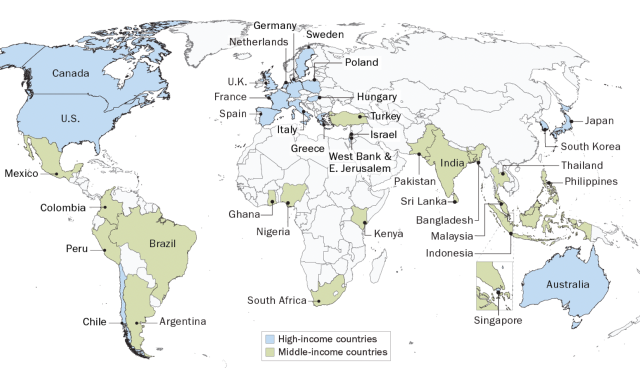
The 2026 survey covered a broad geographical and economic spectrum, including 18 high-income countries and 18 middle-income countries, as classified by the World Bank. The high-income nations included Australia, Canada, Chile, France, Germany, Greece, Hungary, Israel, Italy, Japan, the Netherlands, Poland, Singapore, South Korea, Spain, Sweden, the United Kingdom, and the United States. The middle-income group comprised Argentina, Bangladesh, Brazil, Colombia, Ghana, India, Indonesia, Kenya, Malaysia, Mexico, Nigeria, Pakistan, Peru, the Philippines, South Africa, Sri Lanka, Thailand, and Turkey. For analytical purposes, the West Bank and East Jerusalem were included in the middle-income category, though their specific World Bank classification pertains to the West Bank and Gaza. Survey operations in Gaza were not feasible.
A key methodological distinction, as noted by Pew researchers, lies in the survey administration. In most middle-income countries, face-to-face interviews were conducted, allowing for more in-depth exploration of complex topics. In contrast, respondents in high-income countries were primarily surveyed via telephone or online platforms. This difference in approach, while standard for global polling, can sometimes influence response patterns and the depth of engagement with survey questions. The full list of survey questions and the detailed methodology are publicly available, providing transparency for the research findings.

Favorability of China: A Tale of Two Economies
The report highlights a striking correlation between a nation’s income level and its population’s favorability towards China. In a majority of the surveyed middle-income countries, at least half of the adult population expressed a positive view of China. This positive sentiment was particularly strong in Indonesia, Kenya, Malaysia, Nigeria, Pakistan, and Sri Lanka, where three-quarters or more of respondents held favorable opinions.
Conversely, a different picture emerged from high-income nations. In many of these countries, a majority of citizens held unfavorable views of China. This trend was pronounced in Japan, Israel, the United States, South Korea, and Sweden, where seven-in-ten or more respondents reported negative perceptions. This stark contrast underscores how economic development and differing national interests may shape public perceptions of China’s global role and influence.
Confidence in Xi Jinping: A Leadership Divided
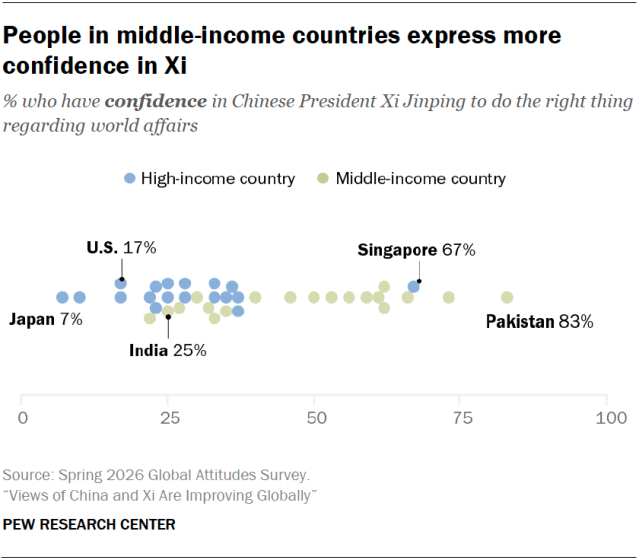
The disparity in views extends directly to President Xi Jinping, with his leadership being viewed more favorably in middle-income countries compared to high-income ones. Majorities in several middle-income nations expressed confidence in Xi, with Pakistan and Kenya showing particularly high levels of trust, around three-quarters or more of their respective populations.
However, in almost all high-income countries surveyed, a majority of respondents indicated a lack of confidence in Xi Jinping. This sentiment was particularly acute in Australia, France, Japan, Israel, South Korea, and Sweden, where around three-quarters or more held this view. Japan, in particular, registered the lowest confidence levels globally, with an overwhelming 92% of respondents stating they do not have confidence in Xi Jinping. This suggests that Xi’s domestic policies and assertive foreign policy stance resonate more positively in developing economies, potentially due to perceived benefits from economic ties or alignment on certain geopolitical issues, while facing significant skepticism in more established Western and East Asian democracies.
Personal Freedoms: A Contentious Issue
The perception of China’s respect for personal freedoms reveals another significant fault line in global opinion. In approximately half of the middle-income countries surveyed, majorities believe that the Chinese government respects the personal freedoms of its citizens. This belief was particularly strong in Pakistan, Sri Lanka, Bangladesh, Nigeria, and Ghana, where around seven-in-ten or more held this view. However, a notable exception was observed in Latin American countries, where support for this notion was considerably lower.
In sharp contrast, majorities in every high-income country surveyed expressed the opinion that China does not respect its people’s freedoms. This sentiment was exceptionally high in Japan, Sweden, Germany, South Korea, and Australia, where approximately nine-in-ten respondents shared this concern. This divergence in views on human rights and civil liberties likely reflects differing political systems, cultural values, and the impact of international media narratives.
Geopolitical Considerations in the Asia-Pacific Region
Within the Asia-Pacific region, where the Pew Research Center conducted additional focused inquiries, the relationship with China appears to be viewed through a lens of national security and economic interdependence. Adults in high-income Asia-Pacific countries were more inclined to perceive China as a threat, whereas those in middle-income countries were more likely to describe China as an ally. Furthermore, concerns about territorial disputes with China were generally higher among respondents in high-income nations in the region. It is important to note that, with the exception of South Korea, the data for high-income countries in this region was collected in 2025, representing a slightly different data collection period compared to the rest of the global survey.
The Philippines stands out as a significant exception among the middle-income Asia-Pacific nations. A substantial 86% of Filipinos expressed concern about territorial disputes with China, and Filipinos were more likely than any other surveyed population to characterize China as a threat to their country. This finding highlights the complex and often contentious nature of China’s maritime claims and their impact on neighboring nations.
Background and Context of the Research
The Pew Research Center’s commitment to understanding global perspectives on China is a long-standing endeavor. This 2026 report builds upon a foundation of previous research, including analyses of China’s foreign policy strategies and the evolution of global public opinion under President Xi Jinping’s leadership. These recurring surveys aim to provide a continuous and nuanced understanding of how China’s growing global influence is perceived across different cultures and economic strata.
The decision to conduct this research stems from the increasing global prominence of China as an economic and geopolitical power. Understanding how its actions and policies are viewed by diverse populations worldwide is crucial for international diplomacy, economic relations, and global stability. The report’s methodology, which involves surveying a wide array of countries with varying political systems and economic development levels, is designed to capture a broad spectrum of global sentiment.
Analysis of Implications
The findings of the 2026 Pew Research Center report carry significant implications for understanding China’s global standing and the challenges it faces in shaping international perceptions. The deep division between high-income and middle-income countries suggests that China’s narrative and its appeal may be more effective in nations with developing economies, potentially due to shared development aspirations, economic partnerships, or a perceived alignment of interests against established Western powers.
For high-income countries, the consistently unfavorable views, particularly concerning personal freedoms and confidence in leadership, indicate persistent skepticism and concern regarding China’s political system and international behavior. This sentiment may influence policy decisions related to trade, security, and diplomatic engagement.
The regional dynamics within the Asia-Pacific further illustrate the complexity of China’s relationships. While some middle-income neighbors may view China as an ally, the strong concerns expressed by the Philippines underscore the potent impact of territorial disputes and geopolitical tensions.
The research provides a vital data point for policymakers, academics, and the public, offering a granular view of how China is perceived on a global scale. As China continues to assert its influence on the world stage, understanding these varied perceptions is paramount to navigating the evolving international landscape. The consistency of these patterns across multiple survey waves suggests that these are not fleeting opinions but rather deeply entrenched views shaped by economic realities, political systems, and geopolitical experiences.
The Pew Research Center’s ongoing commitment to such extensive international polling ensures that a factual basis is available for discussions about China’s global role, offering a critical counterpoint to official narratives and providing essential context for global affairs. The detailed survey methodology and publicly accessible questions allow for scrutiny and further analysis, reinforcing the report’s value as a significant contribution to public understanding.