
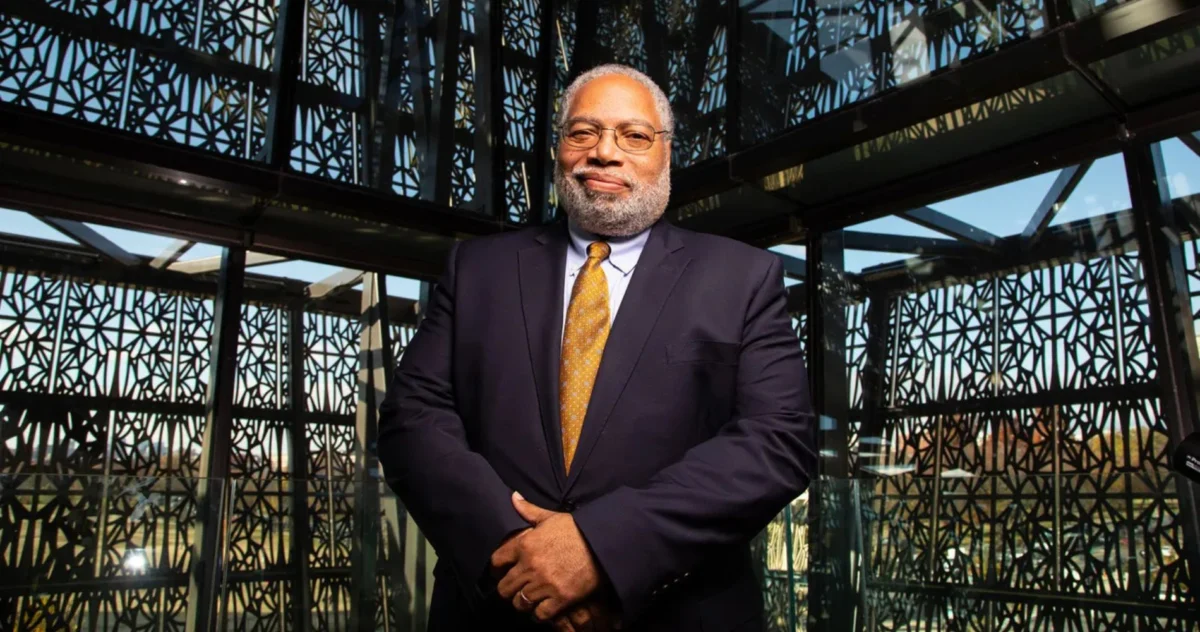
Lonnie G. Bunch III, the 14th Secretary of the Smithsonian Institution, announced this week that he will step down from his post at the end of the year, marking the conclusion of a seven-year tenure defined by both historic institutional growth and an increasingly fraught relationship with the federal government. His departure arrives at a critical juncture for the world’s largest museum and research complex, which has spent the last year navigating an unprecedented campaign of executive oversight and ideological critique initiated by the Trump administration.
Mr. Bunch, 73, leaves behind a legacy that spans nearly four decades of service to the Smithsonian. As the first African American and the first historian to lead the institution, he has been widely credited with modernizing the Smithsonian’s approach to curating the American experience. However, his final year in office was defined by a stark contrast: a commitment to historical rigor versus a federal mandate to reshape the national narrative.
A Career Defined by Institutional Expansion
The trajectory of Mr. Bunch’s career is synonymous with the evolution of the Smithsonian itself. His journey began in 1978 after he earned his Ph.D. in American and African American history. Initially hired as an education specialist at the National Air and Space Museum, he steadily climbed the institutional ranks. His early career included a pivotal six-year stint as the founding curator of the California African American Museum in Los Angeles, an experience that honed his ability to build cultural institutions from the ground up.
Upon returning to the Smithsonian, he served as associate director for curatorial affairs at the National Museum of American History. During this period, he played a central role in acquiring significant artifacts, including the Greensboro Lunch Counter, and co-curating the landmark exhibition, "The American Presidency: A Glorious Burden."
However, his most transformative contribution remains his work as the founding director of the National Museum of African American History and Culture. Tasked with the monumental challenge of creating a national museum on the National Mall, Mr. Bunch successfully navigated the complexities of congressional funding, private philanthropy, and bipartisan skepticism. When the museum opened its doors in 2016, it became a cultural touchstone, drawing 1.6 million visitors last year alone and cementing the idea that Black history is inseparable from the broader American story.
Chronology of a Mounting Conflict
The friction between the Smithsonian and the White House reached a fever pitch in 2025. The conflict follows a timeline of escalating administrative interventions:
- March 2025: The White House issued an executive order titled "Restoring Truth and Sanity to American History," which explicitly targeted museums receiving federal funding. The order accused the Smithsonian of propagating narratives that characterize Western values as "inherently harmful."
- August 2025: President Trump publicly criticized the Smithsonian’s curatorial focus on slavery, labeling the institution "out of control" and demanding a "comprehensive internal review" aimed at reorienting exhibits to focus on "American exceptionalism."
- July 2026: The administration released a formal report condemning the National Museum of American History for what it termed "extreme political activism," prompting widespread outcry from professional historical societies.
- September 2026: Mr. Bunch announced his retirement, citing the strain of the administrative pressure while reaffirming his commitment to scholarly accuracy.
The Landscape of Public Trust and Federal Funding
Despite the political tension, the Smithsonian remains one of the most trusted entities in the United States. Data from recent YouGov and independent institutional surveys indicate that 37% of Americans have visited a Smithsonian museum. Perhaps more significantly, the public views museums as highly reliable sources of information, ranking them at a 7.3 on a trust index, compared to a 4.5 for the federal government.
This disconnect between public sentiment and administrative policy is central to the current crisis. A vast majority of Americans—84%—believe that museums have a responsibility to accurately represent the entirety of history, including episodes of systemic injustice. Furthermore, polling data from 2025 suggests that the American public generally rejects the idea of government interference in museum exhibits. "People generally do not want political interference in museum content," noted Susie Wilkening, a leading researcher in museum engagement.
The administration’s pressure campaign has not been confined to the Smithsonian. It represents a broader effort to standardize historical interpretation across federal agencies. The National Park Service has faced directives to remove exhibits related to the history of slavery, while the Department of Defense has moved to restore Confederate nomenclature to military installations and sanitize historical plaques at Arlington National Cemetery.
Official Responses and Scholarly Defense
The academic community has rallied behind Mr. Bunch, viewing his resignation as a bellwether for the future of independent research in the United States. Sarah Weicksel, executive director of the American Historical Association, noted that concerns regarding the Smithsonian’s future are a "testament to Bunch’s commitment to protecting the Smithsonian’s independence."
In a letter to his staff, Mr. Bunch characterized the Smithsonian as "one of the great loves of my life," while defending the institution’s mandate. In an internal email obtained by NPR in July, he wrote: "At the Smithsonian, our work is driven by scholarship, accuracy and an uncompromising commitment to tell the fullness of America’s story."
Chief Justice John G. Roberts Jr., acting in his capacity as the Smithsonian’s chancellor, praised Mr. Bunch’s leadership, stating that the institution had "benefited greatly from his wisdom, vision and leadership."
Broader Implications for American Cultural Institutions
The departure of Mr. Bunch leaves a leadership vacuum at a time when the Smithsonian faces a "wind and tide" of political scrutiny. The implications of this power struggle are profound. If the federal government successfully exerts control over the curation of national history, it risks undermining the credibility of the Smithsonian as a repository of empirical, rather than ideological, truth.
Filmmaker Ava DuVernay articulated the gravity of the moment, describing Mr. Bunch’s exit as a "profound loss for those who care about America’s history, not its fantasy." The controversy centers on the fundamental question of whether a federally funded institution can maintain its autonomy when its historical findings contradict the preferred narrative of the executive branch.
As Mr. Bunch prepares to depart, his final messages to the public have been characterized by a call for resilience. "Americans are an amazingly brave people," he told The New York Times. "They’ve got to be brave enough to face their own history."
The Smithsonian’s board of regents now faces the daunting task of selecting a successor capable of navigating this polarized landscape. The choice will be viewed by observers as a signal of whether the Smithsonian will continue its trajectory toward inclusive, scholarly investigation or whether it will be forced to adapt to the new mandates of the political climate.
For now, the Smithsonian remains a sprawling network of 21 museums, the National Zoo, and numerous research centers. Its ability to serve as a "reservoir of science, history, art and culture"—as Mr. Bunch described it—depends on its capacity to withstand the current political pressure. As the institution prepares for a leadership transition, the broader historical community remains vigilant, watching to see if the "fullness of America’s story" can be preserved in an era of heightened ideological competition. Mr. Bunch’s pledge to "stand against wind and tide" to prevent history from being "erased, softened and made palatable" serves as both a final defense of his tenure and a challenge to his successors.




