
In an era defined by rapid technological disruption, geopolitical instability, and the lingering socioeconomic shifts following the global pandemic, organizational leaders are facing increasingly complex decision-making environments. While corporate discourse on diversity, equity, and inclusion (DEI) has historically centered on demographic parity—specifically gender, race, and ethnicity—a growing body of research suggests that a vital component of organizational success remains significantly underdeveloped: cognitive diversity. As modern enterprises grapple with "wicked problems" that defy conventional solutions, the strategic integration of varied information-processing styles and perspective-facilitation techniques has emerged as a primary differentiator between stagnant organizations and those capable of navigating systemic uncertainty.
The Evolution of Diversity in Corporate Strategy
The formalization of DEI programs in the early 21st century primarily addressed representation gaps. By the mid-2010s, organizations began publishing annual sustainability and diversity reports, largely influenced by the "business case for diversity," which argued that diverse boards lead to higher profitability. Studies by firms such as McKinsey & Company consistently indicated that companies in the top quartile for ethnic and cultural diversity outperformed those in the bottom quartile by 36% in terms of profitability.
However, as the 2020s began, researchers started to distinguish between "surface-level diversity"—the visible demographics—and "deep-level diversity," which encompasses cognitive frameworks, personality traits, and mental models. The shift in focus toward cognitive diversity does not negate the importance of representation; rather, it posits that demographic diversity is the prerequisite for, but not the entirety of, an effective team dynamic. Without an intentional focus on how team members process information and facilitate expertise, organizations risk falling into the trap of "homogenous thinking," where a diverse team might still arrive at the same suboptimal conclusion due to shared social or educational conditioning.
Decoding Cognitive Diversity: Information Processing and Expertise
Research conducted by Alison Reynolds and David Lewis, who have spent decades investigating problem-solving efficiency in high-stakes environments, highlights that the most effective teams are defined by their cognitive heterogeneity. Their methodology, largely built upon diagnostic tools developed by psychiatrist Peter Robertson, categorizes cognitive diversity into two primary dimensions.
The first dimension involves "Knowledge and Information Processing." This axis measures whether an individual leans toward consolidating and implementing existing, proven frameworks or prefers the generative process of creating entirely new knowledge. The second dimension, "Perspective and Expertise Facilitation," examines whether a team member prioritizes the application of their own specialized domain knowledge or prefers to act as an orchestrator, synthesizing the ideas and expertise of others.
The implication for leadership is significant: a team composed entirely of expert "consolidators" may be highly efficient in stable environments but will fail to pivot during a crisis. Conversely, a team of pure "generative orchestrators" might struggle to implement a cohesive strategy. The most resilient teams possess a high degree of variance across both dimensions, ensuring that the organization can simultaneously exploit current strengths and explore future possibilities.
The Role of Psychological Safety in Cognitive Integration
The presence of cognitive diversity is necessary but insufficient on its own. For such diversity to translate into innovation, it must be mediated by psychological safety—a concept popularized by Amy Edmondson of Harvard Business School. Without an environment where team members feel secure enough to challenge the status quo without fear of retribution, cognitive diversity often devolves into groupthink or, conversely, unproductive interpersonal conflict.
Chronologically, the discourse surrounding psychological safety gained mainstream prominence in 2015, when Google released the results of "Project Aristotle." After analyzing 180 teams, Google researchers discovered that the highest-performing teams were not necessarily those with the smartest individuals, but those that fostered a culture of emotional safety. This allowed for constructive dissent, which is essential when the team is cognitively diverse. When members think differently, the risk of "cognitive friction" is high; psychological safety provides the mechanism for that friction to become productive rather than destructive.
Data and Organizational Implications
Recent data from Deloitte Australia underscores the tangible impact of inclusive leadership on employee sentiment. Their research indicates that inclusive leadership behaviors can account for a 70-percentage-point difference in the proportion of employees who report feeling highly included. The implications for retention and productivity are profound: when individuals feel that their unique cognitive contribution is not only welcomed but sought after, engagement metrics typically rise.
However, a recurring theme in management consulting is the "execution gap." While executive-level advocacy for inclusion has reached record highs, the cascading of these values to middle management remains inconsistent. Many mid-level managers report feeling "ill-equipped" to lead diverse teams, citing a lack of practical frameworks to navigate the complexities of inclusive facilitation. This creates a bottleneck: the C-suite sets the vision, but the daily cultural reality is defined by the immediate supervisor.
Bridging the Gap: The Action-Oriented Approach
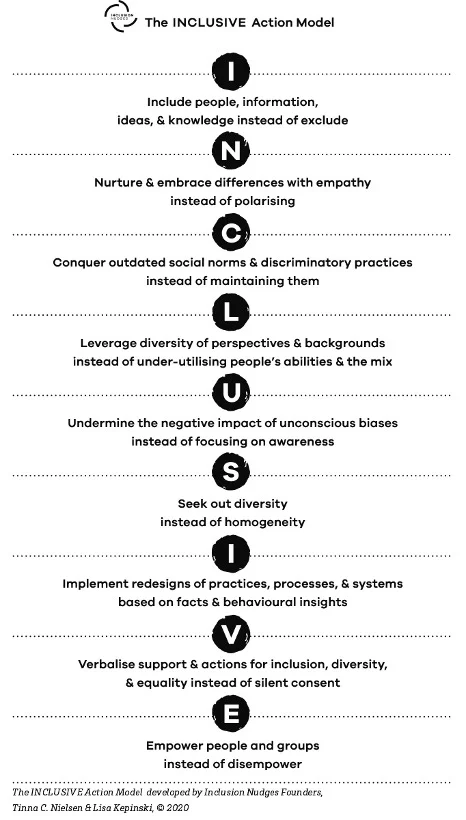
To address the disconnect between intent and implementation, practitioners such as Tinna Nielsen and Lisa Kepinski have championed the "Inclusion Nudges" framework. This approach moves away from abstract DEI training and toward behavioral design—systematic adjustments to organizational processes that make inclusive behavior the path of least resistance.
For instance, rather than relying on a manager’s subjective willingness to invite diverse perspectives, an organization might implement a "rotating facilitator" protocol for meetings. This ensures that the expertise-facilitation role is distributed, preventing the dominant personality from suppressing the cognitive contributions of others. Such "nudges" are designed to be low-cost and high-impact, allowing leaders to gain confidence through iterative, small-scale successes.
The broader impact of this shift is a move toward "inclusive resilience." In a business climate where the only constant is change, the ability to rapidly aggregate diverse data points, process them through varied cognitive lenses, and execute a decision with buy-in from all stakeholders is the ultimate competitive advantage.
Future Outlook
As organizations continue to integrate cognitive diversity into their broader DEI strategies, the focus is expected to transition from "awareness" to "architecture." This means re-engineering recruitment processes to look for cognitive variety rather than just "culture fit," and redesigning meeting structures to maximize the utility of diverse thinking styles.
The evidence is clear: the challenges of the 21st century—be they pandemic-related, climate-driven, or market-based—are too multifaceted to be solved by a monolithic cognitive approach. By balancing the need for demographic representation with the tactical application of cognitive diversity, organizations can transform their internal friction into an engine for innovation. For leaders, the directive is to stop viewing diversity as a compliance requirement and start viewing it as an essential information-processing capability. The companies that succeed in the next decade will be those that have mastered the art of thinking together, rather than merely working alongside one another.




