A comprehensive new report from the Pew-Knight Initiative reveals a nuanced picture of civic and political engagement in the United States, demonstrating that while partisan identities often define policy preferences, the patterns of how Americans participate in public life—across politics, community, religion, and news consumption—show striking similarities between Democrats and Republicans. The study, which categorizes individuals into four distinct "engagement groups," highlights that the most significant divides in participation often lie between these groups, rather than solely along party affiliation.
The research, conducted through nationally representative surveys of U.S. adults from July 9 to December 5, 2025, aimed to provide a more integrated understanding of how various forms of engagement coalesce in people’s lives. Historically, these behaviors have been studied in isolation, making it challenging to grasp the full spectrum of an individual’s or a group’s involvement in public life. By analyzing responses to 19 distinct measures of participation, the Pew-Knight Initiative has identified four key segments of the American populace: Mobilizers, Connectors, Spectators, and Outsiders.
Understanding the Engagement Groups

The four engagement groups, defined by their levels and types of participation, offer a new lens through which to view American civic life:
- Mobilizers: This group represents the most active segment of the population, exhibiting high levels of engagement across politics, civic activities, religious participation, and news consumption. They are the most likely to be involved in virtually every aspect of public life studied.
- Connectors: While still highly engaged, Connectors are characterized by a strong involvement in community and religious activities, alongside news consumption, but are less politically driven than Mobilizers. They are active participants but may not be at the forefront of political action.
- Spectators: This group primarily engages with public life through the consumption of news. They follow current events closely but are significantly less likely to participate in direct political action, volunteering, or religious services compared to the more engaged groups.
- Outsiders: Representing the least engaged segment, Outsiders report minimal participation in most of the activities measured. This includes lower rates of voting, volunteering, attending religious services, and actively following the news.
Partisanship and Engagement: A Complex Relationship
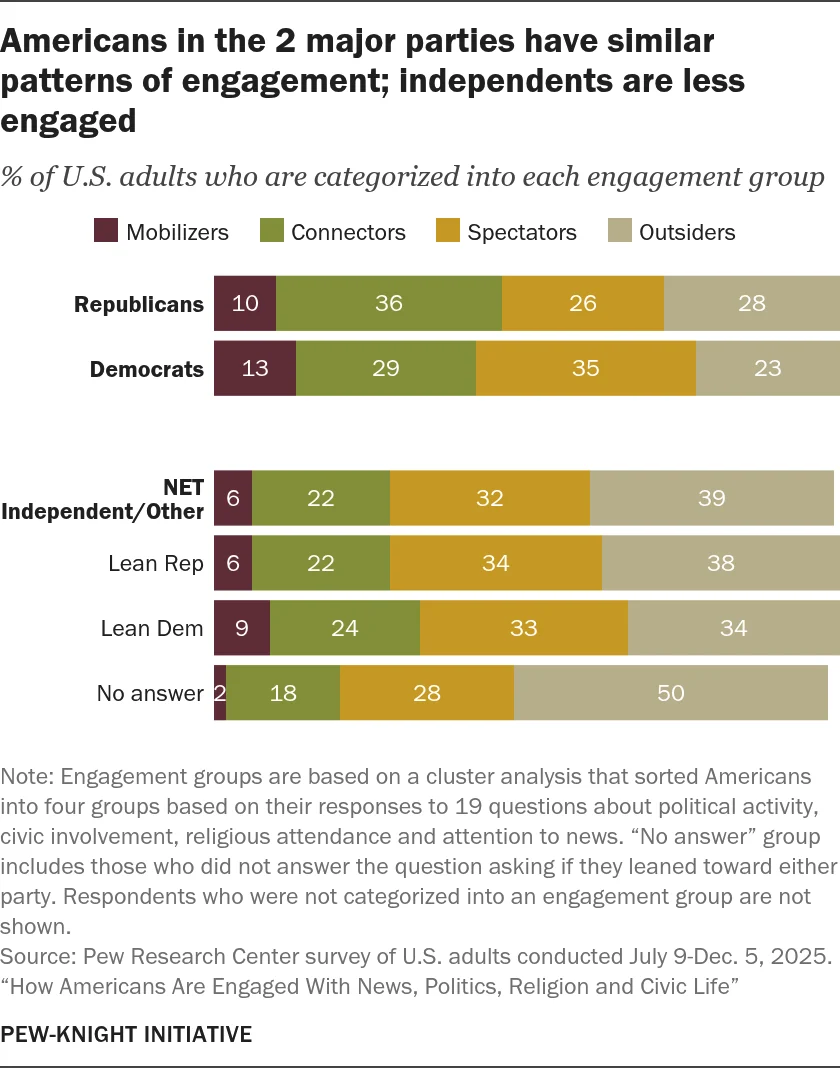
Contrary to expectations that strong partisan divides would translate into vastly different engagement patterns, the Pew-Knight Initiative’s findings indicate a considerable overlap. The report highlights that both the Republican and Democratic parties encompass individuals who are deeply involved in public life, as well as those who are largely disengaged.
"People participate in public life in different ways—from voting and volunteering to following the news and taking part in religious or community activities. But these behaviors are often studied separately, making it difficult to see how they come together in people’s day-to-day lives," the report states, underscoring the motivation behind the study.
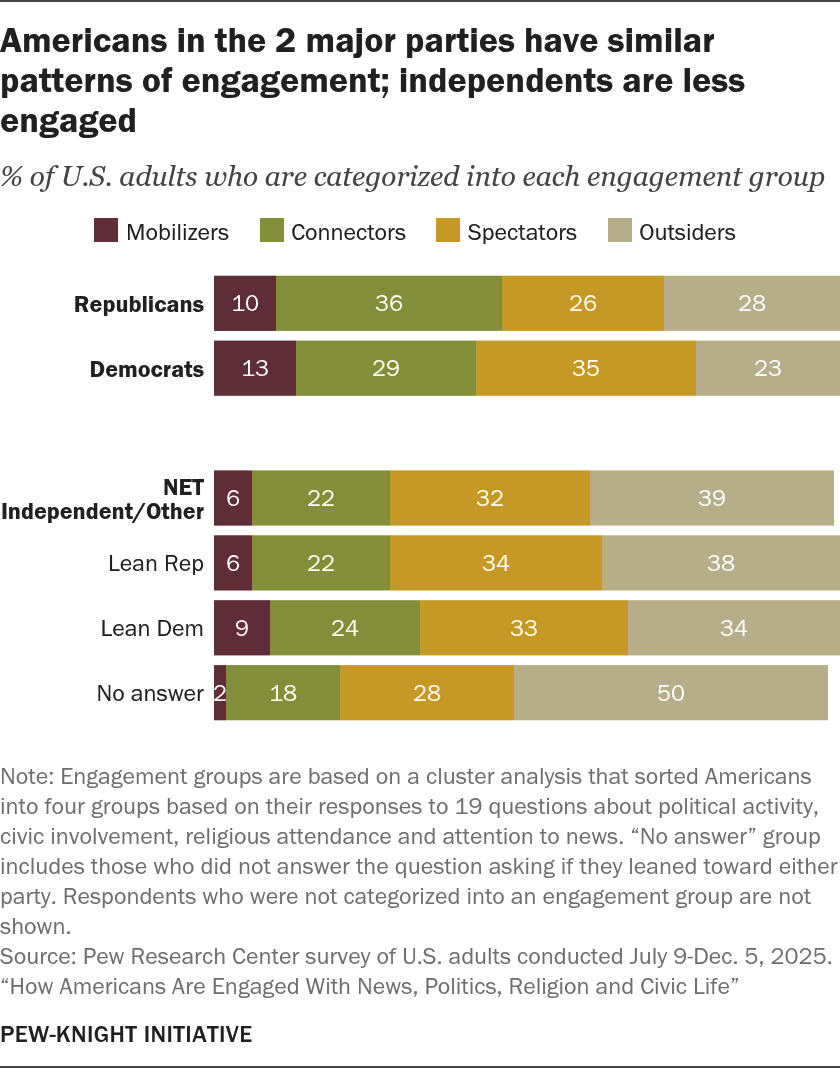
While overall engagement patterns are similar, some subtle distinctions emerge. Republicans show a slightly higher propensity to be classified as Connectors, whereas Democrats are marginally more likely to be Spectators. Mobilizers, the most active group, are the least likely to identify their political views as moderate, suggesting a tendency towards stronger ideological stances within this highly engaged segment.
It is crucial to note the timing of the survey. Conducted in the fall of 2025, with questions focusing on activities over the preceding 12 months, the period included the highly charged 2024 presidential election. This context might influence reported political activities. The report acknowledges that the political environment, particularly the party controlling the White House and Congress, can affect the propensity for certain actions, especially for those aligned with the party out of power.
Demographics and Ideology Across Engagement Groups
The study’s analysis extends to the demographic and ideological characteristics of each engagement group. Independents, particularly those not leaning toward either major party, are disproportionately represented among the Outsiders. In fact, a significant majority of those identifying as neither Republican nor Democrat (50%) fall into the Outsider category, with only a meager 2% identified as Mobilizers. This suggests a substantial segment of the U.S. population that remains largely on the periphery of public and political life.

When examining political ideology, a clear divergence emerges. The Spectator and Outsider groups are more likely to self-identify as politically moderate. Specifically, 48% of Outsiders and 43% of Spectators describe their views as moderate, in contrast to 35% of Connectors and only 26% of Mobilizers.
The more politically active groups, Mobilizers and Connectors, exhibit different ideological leanings. Mobilizers are evenly split between conservative and liberal self-identification (37% each), with a smaller percentage (26%) identifying as moderate. Connectors, on the other hand, show a stronger conservative skew, with 42% identifying as conservative compared to 21% as liberal, and 35% as moderate. Spectators and Outsiders, while more likely to be moderate, also show distinct patterns: Spectators have roughly equal proportions of conservatives (27%) and liberals (26%), while Outsiders lean more conservative (27% conservative vs. 16% liberal).
Voting Behavior in the 2024 Election
The survey also delved into self-reported voting patterns in the 2024 U.S. presidential election, revealing varied distributions across the engagement groups. Mobilizers showed a clear preference for Kamala Harris, with 51% reporting voting for her, compared to 34% for Donald Trump. Connectors displayed a more divided preference, leaning slightly towards Donald Trump (44%) over Kamala Harris (38%). The Outsider group also showed a preference for Trump (22%) over Harris (15%), though a substantial portion reported not voting.

A significant finding is the low reported voting rates among Spectators and Outsiders. Approximately half of Spectators (49%) and a majority of Outsiders (56%) indicated they did not vote in the 2024 election. The report notes that the decision of whether or not an individual voted was itself a factor in their classification into these engagement groups, highlighting the interconnectedness of these behaviors.
Methodology and Scope of the Research
The Pew-Knight Initiative’s robust methodology underpins these findings. The primary data source was the Cross-Sectional Engagement Survey, administered to 5,393 U.S. adults between July 9 and December 5, 2025. This survey employed a multi-modal approach, allowing for online, paper, and telephone responses, with multiple outreach attempts to maximize participation. Crucially, the survey design specifically aimed to overcome common challenges in reaching individuals who are less likely to participate in public life, as these individuals may also be less inclined to participate in surveys.
Complementary data came from Wave 179 of the American Trends Panel (ATP), a nationally representative panel of 5,195 U.S. adults surveyed from September 8-14, 2025. The ATP data was used to examine the demographic characteristics, attitudes, and levels of civic knowledge within the engagement groups identified through cluster analysis of the Cross-Sectional Engagement Survey. The analysis of 19 distinct measures of participation across political activity, civic involvement, religious attendance, and news consumption allowed for the sophisticated categorization of respondents.

Broader Implications and Future Research
The findings of the Pew-Knight Initiative’s report offer a critical perspective on how Americans engage with their society. The similarity in engagement patterns between Democrats and Republicans challenges simplistic narratives that pit partisans against each other in all aspects of public life. Instead, it suggests that the mechanisms and motivations for participation might be more broadly shared across the political spectrum than previously understood, with the degree of engagement being a more defining characteristic than party affiliation alone.
This research has significant implications for understanding political polarization, civic health, and the effectiveness of outreach efforts by political campaigns, advocacy groups, and community organizations. By identifying distinct engagement groups, stakeholders can tailor their strategies more effectively to reach specific audiences. For instance, efforts aimed at increasing political participation might need to focus on different approaches for Mobilizers versus Spectators, who are primarily news consumers.
The study also underscores the challenge of engaging the "Outsider" segment of the population. Their low levels of participation across the board indicate a significant segment of the electorate that may feel disconnected from civic and political processes. Understanding the reasons behind this disengagement—whether due to apathy, perceived lack of efficacy, or other factors—will be crucial for fostering a more inclusive and participatory democracy.

The Pew-Knight Initiative’s work provides a valuable framework for future research into the complex dynamics of American civic life. By moving beyond traditional measures of engagement and adopting a cluster-based approach, the report offers a more granular and insightful understanding of how different segments of the population interact with their communities and the broader public sphere. The detailed methodology and openly shared survey data and questions further contribute to the transparency and replicability of this important research.