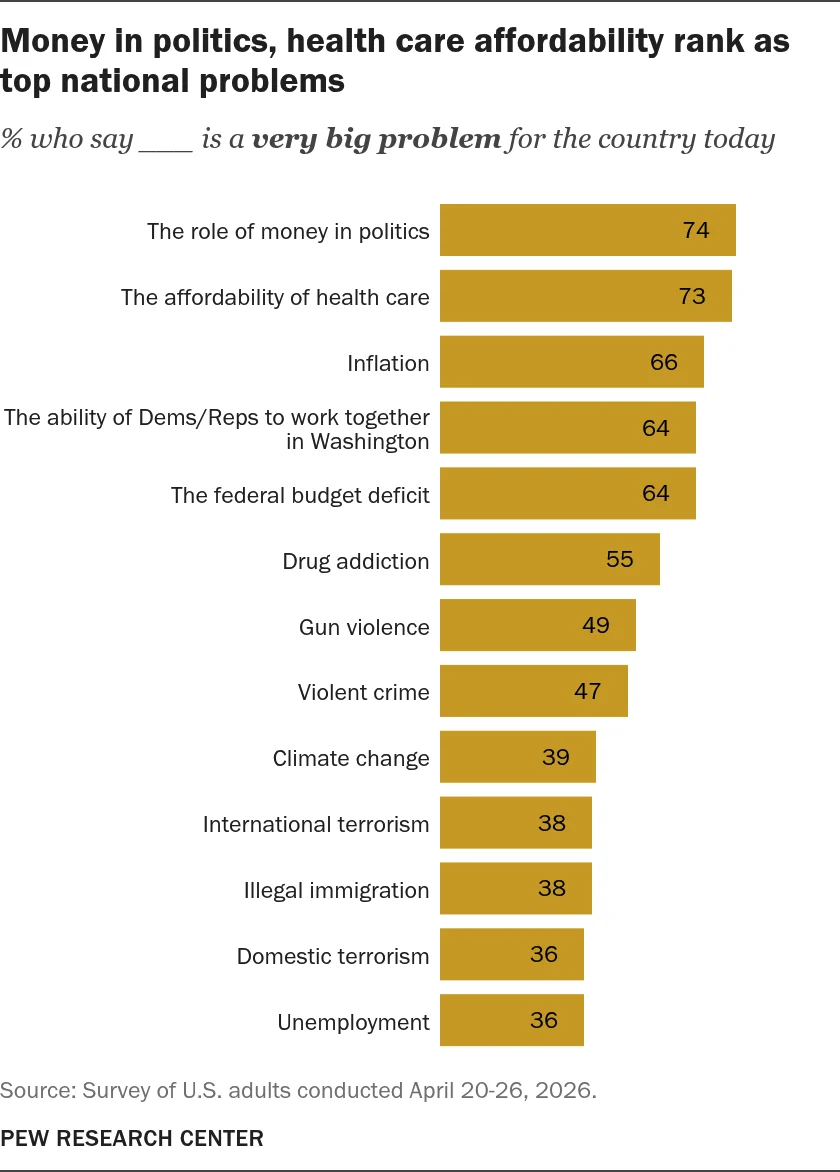
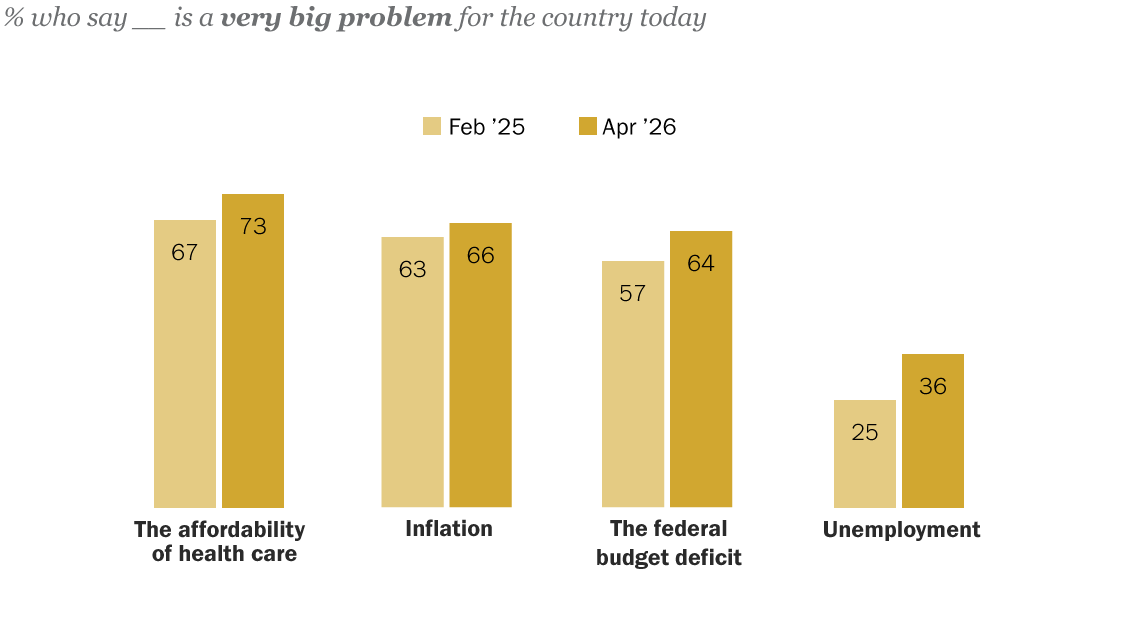
A comprehensive survey of U.S. adults conducted from April 20-26, 2026, by the Pew Research Center reveals a nation grappling with persistent economic anxieties, with the affordability of healthcare, the federal budget deficit, and inflation emerging as the most significant challenges facing the country. These issues are not only top-of-mind for the general populace but also demonstrate a significant and sustained concern across the political spectrum.
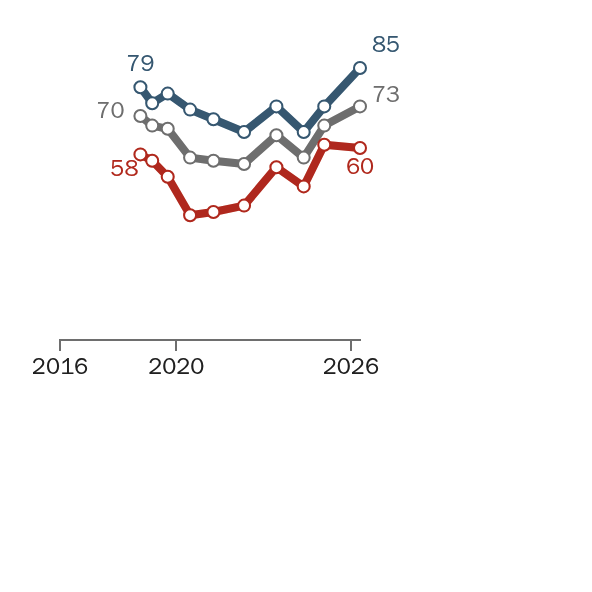
The data indicates a deeply ingrained public perception of these economic pressures as "very big problems." The affordability of healthcare, a perennial concern, stands out with 73% of all adults identifying it as a major issue. This sentiment is shared broadly, with 60% of Republican-leaning individuals and a commanding 85% of Democratic-leaning individuals expressing this view. This widespread agreement underscores the pervasive nature of healthcare cost concerns, affecting individuals regardless of their political affiliation.

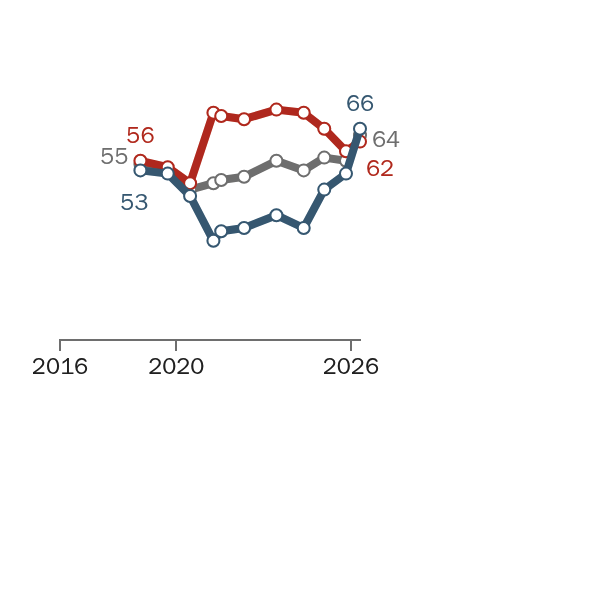
Following closely, the federal budget deficit is viewed as a very big problem by 64% of Americans. While there is a slight partisan divergence, with 62% of Republicans and 66% of Democrats highlighting its significance, the overall consensus points to a shared apprehension about the nation’s fiscal health. Inflation, another key economic indicator, is also a significant concern for 66% of respondents. Interestingly, a notable difference emerges in how political affiliations perceive inflation: 55% of Republicans and 74% of Democrats consider it a very big problem, suggesting differing levels of perceived impact or urgency between the two major parties.
These findings paint a picture of a nation where economic stability and the cost of living are primary drivers of public concern, often eclipsing other pressing issues. The sustained prominence of these issues in public discourse and polling data suggests that current economic conditions are having a tangible and widespread impact on the daily lives and future outlook of American citizens.
Trends and Historical Context
The recent survey data reflects a trend of escalating concern over these economic issues in recent years. Looking back at Pew Research Center data, the affordability of healthcare has consistently ranked as a top concern. In May 2022, 65% of Americans considered it a very big problem, a figure that has seen a steady increase to 73% by April 2026. Similarly, concerns about the federal budget deficit have fluctuated but have remained a significant issue, particularly among Republicans. In May 2022, only 35% of Democrats viewed it as a very big problem, a figure that has risen to 66% by April 2026, indicating a growing concern among this demographic.
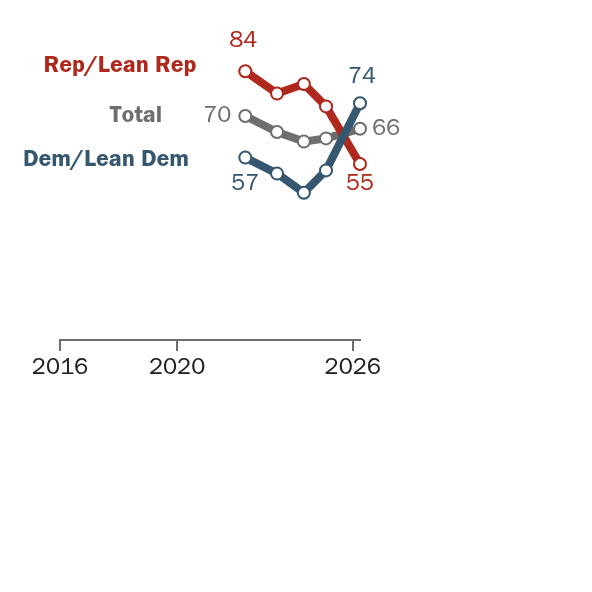
Inflation, which saw a surge in public concern in 2022 with 70% of Americans identifying it as a very big problem, has remained a high-priority issue, though its intensity has slightly moderated. In April 2026, 66% of respondents still see it as a significant challenge, with a notable partisan divide. Republicans expressed more concern about inflation in earlier periods, with 84% identifying it as a very big problem in May 2022, a figure that has since decreased to 55% by April 2026, while Democratic concern has remained relatively high, albeit with fluctuations.
The data also reveals shifts in the perceived importance of other national issues. For instance, unemployment, a dominant concern during economic downturns, has seen a significant decrease in public worry. In June 2020, 50% of Americans considered unemployment a very big problem. By April 2026, this figure has dropped to 36%, indicating a degree of economic recovery or a shift in focus to other pressing matters. Conversely, issues such as gun violence and violent crime have seen periods of heightened concern, with gun violence peaking at 60% in June 2023 and violent crime at 61% in July 2021, though both have seen a slight decline in recent surveys.
Deep Dive into Key Concerns
The Affordability of Healthcare:
The persistent concern over healthcare costs is a complex issue with multiple contributing factors. Rising premiums, deductibles, and prescription drug prices continue to strain household budgets. The aging population, advancements in medical technology, and the ongoing debate surrounding healthcare reform all play a role in shaping public perception. The bipartisan agreement on the severity of this issue suggests a shared understanding that the current healthcare system is not meeting the needs of a significant portion of the population, particularly concerning financial accessibility. Future policy discussions will likely continue to revolve around finding sustainable solutions that balance cost containment with quality of care and access.
The Federal Budget Deficit:
Concerns about the national debt and the budget deficit reflect a broader anxiety about the nation’s long-term fiscal stability. The increasing national debt, driven by government spending and tax policies, raises questions about future economic growth, potential tax increases, and the burden on future generations. The differing levels of concern between Republicans and Democrats on this issue often stem from contrasting fiscal philosophies, with Republicans generally advocating for reduced government spending and Democrats often prioritizing social programs and investments that can contribute to deficits. The recent rise in Democratic concern suggests a growing awareness of the fiscal implications of government actions, regardless of partisan alignment.
Inflation:
Inflationary pressures have a direct and immediate impact on consumers’ purchasing power, affecting the cost of everyday goods and services, from groceries and gasoline to housing and utilities. The recent period of elevated inflation has been attributed to a combination of factors, including supply chain disruptions, increased consumer demand, and global economic events. The partisan divide in concern over inflation may reflect differing views on its causes and the most effective policy responses. Republicans often emphasize controlling government spending and monetary policy, while Democrats may focus on supply-side solutions and addressing corporate pricing practices.
Broader National Concerns
While economic issues dominate the current landscape, other significant challenges continue to occupy public attention. The ability of Democrats and Republicans to work together in Washington remains a major concern for 64% of Americans, underscoring a persistent sentiment of political gridlock and a desire for greater bipartisan cooperation. This issue has seen consistent high levels of concern since at least 2018, reflecting a long-standing frustration with the efficacy of the federal government.
The role of money in politics is also a substantial concern, with 74% of Americans viewing it as a very big problem. This sentiment has remained remarkably high over the years, indicating a deep-seated belief that campaign finance and lobbying efforts exert undue influence on policy decisions.
Issues such as drug addiction (55% of Americans), gun violence (49%), and violent crime (47%) continue to be viewed as serious problems, though their prominence has seen some fluctuation. Climate change, while a significant concern for 39% of Americans, shows a notable partisan divide, with only 14% of Republicans and a substantial 63% of Democrats identifying it as a very big problem. This stark difference highlights the ongoing political polarization surrounding environmental issues.
International terrorism (38%) and domestic terrorism (36%) are also recognized as national challenges, though their perceived urgency has somewhat diminished from peaks seen in previous years, potentially reflecting a shift in the immediate threat landscape or a greater focus on domestic economic and social issues. Illegal immigration remains a significant concern, particularly for Republicans (60%), with 38% of all Americans viewing it as a very big problem.
Implications and Outlook
The survey data from the Pew Research Center provides a clear snapshot of the prevailing concerns of the American public. The consistent prominence of healthcare costs, the budget deficit, and inflation suggests that these economic challenges will continue to be central to political debates and policy-making in the foreseeable future.
The broad consensus across partisan lines on the severity of healthcare affordability issues presents an opportunity for bipartisan action. However, the divergent views on inflation and the budget deficit indicate that finding common ground on economic policy will remain a complex endeavor. The persistent concern over political polarization and the influence of money in politics further complicates the landscape, suggesting that underlying structural issues within the political system may be hindering effective problem-solving.
As the nation navigates these complex challenges, the insights from this research underscore the need for policymakers to address the tangible economic anxieties of citizens. The data serves as a critical barometer for understanding the public mood and the priorities that will likely shape electoral outcomes and the national agenda. The ongoing monitoring of these concerns will be essential for understanding the trajectory of the nation’s economic and social well-being.