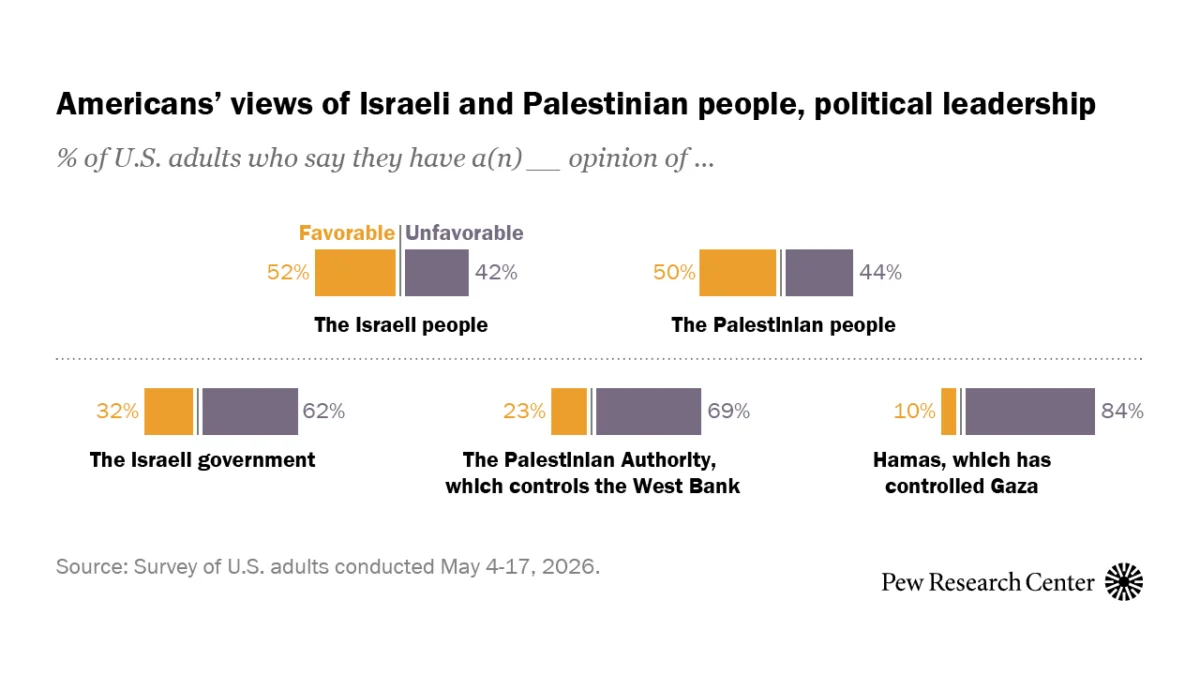
The American public’s perception of both the Israeli people and the Israeli government has undergone a significant negative shift in recent years. This change, detailed in a new Pew Research Center survey, contrasts with views of the Palestinian people, the Palestinian Authority, and Hamas, which have remained relatively stable. The findings emerge in the wake of complex geopolitical events and escalating regional tensions, offering a granular look at evolving American sentiment.
As recently as 2022, a discernible gap existed in American favorability towards Israelis compared to Palestinians. However, the Hamas attack on Israel in October 2023 and the subsequent military operations in Gaza have profoundly impacted U.S. public opinion. The survey indicates a growing negativity toward Israelis, while perceptions of Palestinians have largely held steady. This convergence has led to a situation where Americans now view the Palestinian people nearly as favorably as they view the Israeli people.
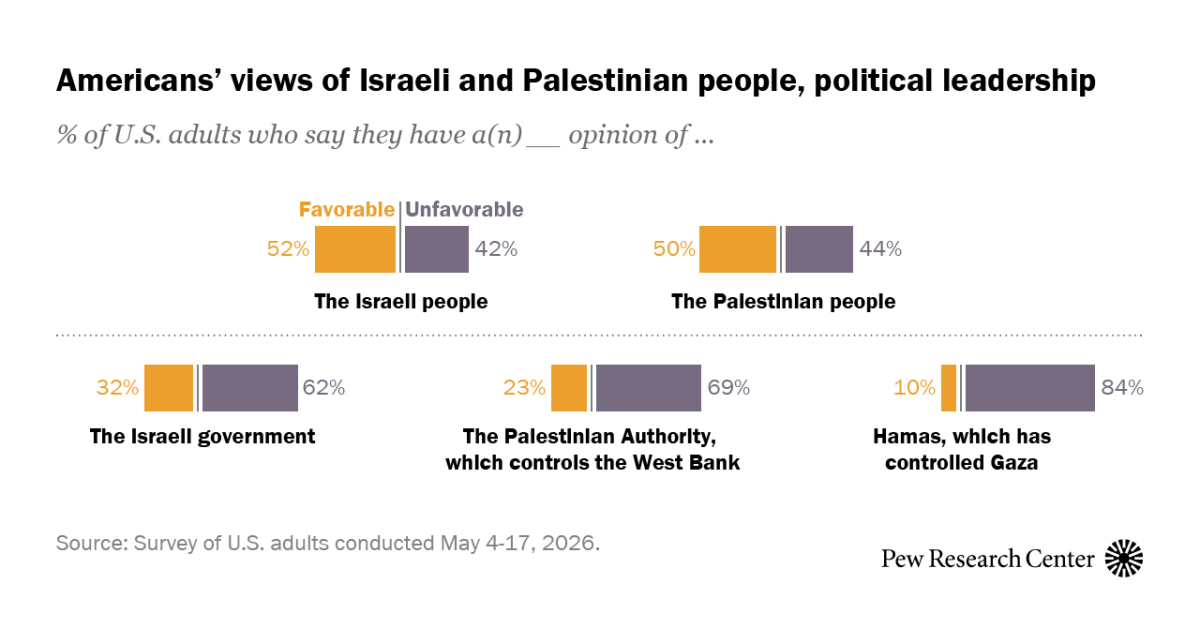
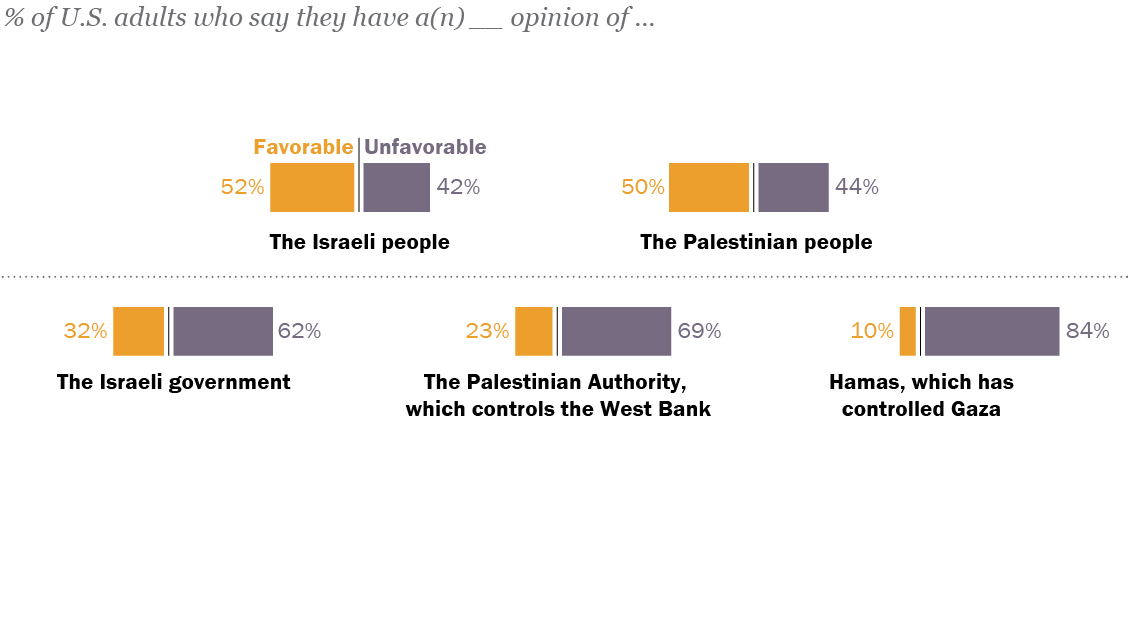
Concurrently, the survey highlights a consistent trend: Americans consistently hold more negative views of Israeli and Palestinian political leadership than they do of the general populations. Majorities of U.S. adults express an unfavorable opinion of the Israeli government, the Palestinian Authority (which governs the West Bank), and Hamas (the de facto authority in Gaza). Negative sentiment towards the Israeli government has seen a sharp increase in recent years, whereas opinions regarding the Palestinian Authority and Hamas have experienced minimal change.
It is crucial to note that the survey was conducted prior to Hamas’s announcement that it was dissolving its government in Gaza, a development that occurred after the data collection period. This announcement, if it signals a substantive shift in governance, could influence future public opinion dynamics.
A striking observation from the Pew Research Center’s findings is the widespread nature of the negative shift in views concerning Israel. This decline in favorability has been observed across both major U.S. political parties, impacting various age demographics, and a majority of religious categories. This suggests a broad societal recalibration of attitudes rather than a phenomenon confined to specific segments of the population.
The data underscores a complex and evolving landscape of American perspectives on the Israeli-Palestinian conflict. The shift away from a more consistently favorable view of Israelis, particularly in contrast to Palestinians, signals a potential recalibration of U.S. foreign policy considerations and public engagement with the issue.
Shifting Sands: A Timeline of American Perceptions
Understanding the current sentiment requires a look at the trajectory of American views over time. The Pew Research Center’s data provides a crucial chronological perspective:
- 2019: A period where favorable views of the Israeli people stood at 64%, with unfavorable views at 28%. The Palestinian people garnered a 46% favorable rating and a 45% unfavorable rating. The Israeli government was viewed favorably by 41% and unfavorably by 51%.
- 2022: A slight uptick in favorability for Israelis (67% favorable, 25% unfavorable), and a more pronounced positive shift for Palestinians (53% favorable, 39% unfavorable). Views of the Israeli government remained largely similar (47% favorable, 43% unfavorable).
- 2024: The year following the October 2023 Hamas attacks and the commencement of the war in Gaza. Views of the Israeli people began to show a slight decline in favorability (64% favorable, 28% unfavorable), while unfavorable views of the Israeli government increased (41% favorable, 51% unfavorable). Palestinian favorability saw a minor dip (50% favorable, 41% unfavorable).
- 2025: A continued downward trend in favorability for Israelis (56% favorable, 38% unfavorable) and a further decline for the Israeli government (35% favorable, 59% unfavorable). Palestinian views remained relatively stable (52% favorable, 41% unfavorable).
- 2026 (May Survey): The latest data reveals a significant shift. Favorable views of the Israeli people dropped to 52%, with unfavorable views rising to 42%. The Israeli government’s favorability fell to 32%, with unfavorable views climbing to 62%. In stark contrast, favorable views of the Palestinian people held steady at 50%, with unfavorable views at 44%.
This timeline clearly illustrates a growing divergence in American sentiment, with Israelis and the Israeli government experiencing a marked decline in favorability, while perceptions of Palestinians have remained comparatively resilient.
Partisan Divides and Generational Gaps
The Pew Research Center’s analysis further dissects these trends by political affiliation and age, revealing significant cleavages in American public opinion:
Political Affiliation:
Republicans and Republican-leaning independents consistently express more favorable views of both the Israeli people and the Israeli government compared to Democrats and Democratic-leaning independents. Conversely, Democrats tend to hold more favorable views of the Palestinian people, the Palestinian Authority, and Hamas, though favorable views of Hamas remain low across the political spectrum.
The survey highlights that while negative views of the Israeli people and government have increased among both Republicans and Democrats, the decline has been steeper among Democrats. This has resulted in a widening partisan gap in these perceptions since 2022. Similarly, views of the Palestinian people have diverged, with Democratic opinions remaining stable and Republican opinions becoming more negative.
Age Demographics:
A striking generational divide is evident, particularly among younger Americans. Adults under 30 years old demonstrate significantly more favorable views toward the Palestinian people (58%) than toward the Israeli people (32%). This trend is largely amplified by young Democrats, who express a much higher likelihood of viewing Palestinians favorably (72%) compared to Israelis (26%). This contrasts sharply with older generations, who generally maintain more favorable views of Israelis.
Conversely, Americans aged 50 and older tend to hold considerably more positive views of the Israeli people than of the Palestinian people. This sentiment is particularly pronounced among older Republicans, who exhibit a strong preference for Israelis. Older Democrats, while still favoring Israelis over Palestinians, do so by a narrower margin.
Views on Political Leadership: A Consistent Disfavor
Across all demographics, a consistent theme emerges: a widespread unfavorable view of political leadership on both sides of the Israeli-Palestinian conflict.
- Israeli Government: A majority of Americans consistently express an unfavorable view of the Israeli government. This sentiment has intensified in recent years, particularly among Democrats, where favorability has dropped significantly.
- Palestinian Authority: While the Palestinian Authority holds a more favorable position than Hamas, a majority of Americans still view it unfavorably. Views have remained relatively stable over time, though Democrats show a more favorable inclination compared to Republicans.
- Hamas: Hamas consistently garners the lowest favorability ratings among all groups surveyed. Overwhelming majorities of Americans, regardless of political affiliation or age, hold unfavorable views of Hamas.
Religious Affiliations and Their Influence
Religious affiliation also plays a role in shaping views, though often intertwined with political identity.
- White Evangelical Protestants: This group consistently exhibits the most favorable views of the Israeli people and the Israeli government among all religious denominations. A significant majority (57%) hold a favorable view of the Israeli government, a stance not mirrored by any other religious group.
- Jews: While maintaining highly favorable views of the Israeli people and government, a notable shift has occurred among Jewish adults under 50. They are less likely than their older counterparts to express favorable views of the Israeli people and the Israeli government. This suggests a generational evolution of sentiment even within this demographic.
- Muslims, Black Protestants, and the Religiously Unaffiliated: These groups tend to hold more favorable views of the Palestinian people and the Palestinian Authority. Muslims, in particular, show a strong inclination towards viewing Palestinians favorably, with a significant portion also holding favorable views of Hamas.
The Broader Context: Events and Implications
The shifts in American public opinion are inextricably linked to the escalating conflict and broader geopolitical events in the Middle East. The October 2023 Hamas attacks on Israel, which resulted in the deaths of approximately 1,200 people and the taking of around 250 hostages, catalyzed a period of intense international focus and condemnation. Israel’s subsequent military response in Gaza has led to a devastating humanitarian crisis, with tens of thousands of Palestinian casualties and widespread destruction.
These events have been extensively covered by global media, shaping narratives and influencing public discourse in the United States. The scale of the humanitarian crisis in Gaza, coupled with ongoing reports of civilian casualties and the displacement of hundreds of thousands, has likely contributed to the growing negativity toward the Israeli government’s actions.
The Pew Research Center’s findings suggest several implications:
- Policy Repercussions: A sustained negative shift in public opinion could place increased pressure on U.S. policymakers to re-evaluate their approach to the conflict, potentially leading to greater scrutiny of military aid to Israel or a more active role in diplomatic resolutions.
- Evolving U.S. Diplomacy: The growing favorability towards Palestinians, particularly among younger demographics and Democrats, may influence the tenor and focus of U.S. diplomatic efforts, pushing for greater consideration of Palestinian rights and aspirations.
- Internal Political Dynamics: The widening partisan divides underscore the deeply polarized nature of foreign policy debates within the United States. This polarization can complicate consensus-building and the implementation of consistent foreign policy strategies.
- Generational Divide on Foreign Policy: The stark generational differences in attitudes toward the Israeli-Palestinian conflict point to a potential long-term shift in American foreign policy perspectives, with younger generations potentially more critical of Israeli policies and more sympathetic to the Palestinian cause.
The comprehensive data from the Pew Research Center provides an invaluable snapshot of a public grappling with complex realities. As the situation in the Middle East continues to evolve, ongoing monitoring of American public opinion will be crucial for understanding the domestic underpinnings of U.S. foreign policy in this critical region. The trends indicate a public re-evaluation, driven by events, demographics, and deeply held values, that will likely continue to shape the discourse around the Israeli-Palestinian conflict for years to come.