
From September 24 to 27, 2026, the global conversation on food systems, biodiversity, and cultural preservation converged in Turin, Italy, for the biennial Terra Madre Salone del Gusto. Among the prominent international organizations participating in the landmark event was Cultural Survival, an advocacy group dedicated to defending Indigenous Peoples’ rights and cultures. Co-organized by Slow Food International, the City of Turin (Città di Torino), and the Piedmont Region (Regione Piemonte), Terra Madre 2026 served as a vital international forum. It successfully convened more than 1,500 delegates hailing from 125 countries, fostering a collaborative environment aimed at celebrating global biodiversity, sharing regional success stories, and reaffirming the fundamental power of food to build bridges across diverse communities, cultures, and geopolitical borders.
Terra Madre Salone del Gusto has evolved since its inception into one of the world’s most influential gatherings for sustainable food policy, artisanal agriculture, and environmental activism. Established by Slow Food, the event acts as a counterweight to industrialized food systems, championing agroecology, local food economies, and the protection of traditional culinary heritages. The 2026 edition placed an unprecedented, urgent emphasis on biodiversity, recognizing that the health of the planet is inextricably linked to the preservation of both ecological and cultural diversity. Against a backdrop of accelerating climate change, biodiversity loss, and threats to traditional territories, this year’s summit provided a timely platform to examine how ancestral knowledge systems hold the key to sustainable environmental stewardship and global food security.
At the core of the biodiversity discussion at Terra Madre 2026 was the indispensable, frontline role played by Indigenous Peoples as the original stewards of the earth’s ecosystems. Statistical data underscores the monumental disproportion between the demographic footprint of Indigenous populations and their staggering environmental contributions. According to demographic and environmental studies, approximately 476.6 million Indigenous people make up a mere 6.2 percent of the global human population. Yet, through collective land tenure and traditional management practices, they successfully manage and protect an estimated 25 percent of the Earth’s total land surface. Furthermore, data from the World Resources Institute highlights that Indigenous territories encompass over 40 percent of all designated Key Biodiversity Areas on the planet. Beyond conservation, the global pantry relies heavily on Indigenous innovation; more than 60 percent of the global food supply originates from agricultural crops that were first domesticated, developed, and cultivated by Indigenous Peoples in the Americas, including staple crops such as potatoes, maize, tomatoes, and beans.
Reflecting on these profound contributions, Slow Food leadership released a statement emphasizing the holistic nature of Indigenous agricultural systems: "From seed guardians in Latin America and Indigenous communities safeguarding ancestral knowledge to young leaders strengthening food systems in Somalia, their stories remind us that biodiversity is not only about what we grow. It’s about who we are, what we carry forward, and how we choose to live together." This sentiment resonated throughout the four-day event, framing food not merely as a commodity for consumption, but as a living archive of identity, resistance, and ecological wisdom passed down through centuries.
Chronology and Structural Engagement of the Indigenous Peoples’ Network
The four-day summit operated on a rigorous schedule of assemblies, plenary sessions, Advisory Council meetings, and cross-regional dialogues, primarily facilitated through the Slow Food Indigenous Peoples’ Network.
The chronology of Cultural Survival’s engagement across the four-day event reflected a structured approach to advocacy, cultural exhibition, and media production:
September 24, 2026 (Opening Day): Delegates arrived in Turin for the grand opening ceremonies, setting the tone for discussions centered on climate resilience, seed sovereignty, and the legal defense of ancestral lands. Cultural Survival delegates participated in initial regional assemblies, establishing dialogue channels between Latin American seed guardians, African youth leaders, and North American land defenders.
September 25, 2026 (Thematic Assemblies and Indigenous Art Showcase): The second day focused deeply on structural challenges facing traditional food systems. Advisory Council meetings addressed policy frameworks needed to protect Indigenous intellectual property related to traditional ecological knowledge. Concurrently, the Cultural Survival Bazaars officially opened their exhibition spaces, drawing widespread public interest to the fine crafts and textiles of featured global artists.
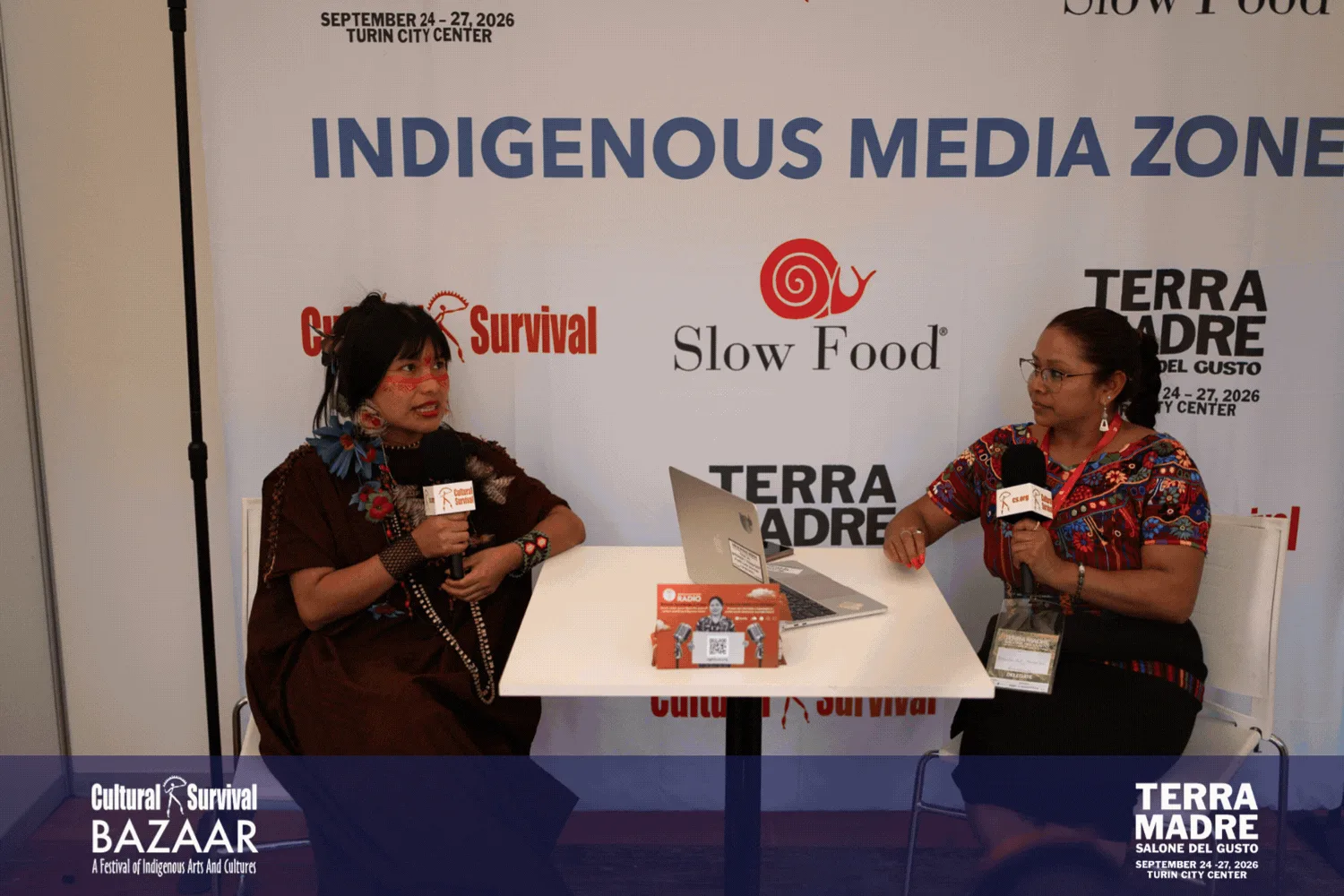
September 26, 2026 (Media Production and Cross-Cultural Dialogues): Mid-event programming saw the full deployment of the Cultural Survival Indigenous Media Zone. Over the course of the day, media teams conducted a comprehensive series of interviews with international delegates, documenting localized struggles and triumphs regarding food sovereignty. These conversations spanned multiple languages, highlighting the global scale of Indigenous advocacy.
September 27, 2026 (Synthesis and Closing Resolutions): The final day was dedicated to synthesizing the insights gathered throughout the summit. Delegates formulated actionable takeaways for the Slow Food Indigenous Peoples’ Network, drafting collective resolutions aimed at strengthening community-led food systems ahead of future international climate and biodiversity conferences.
Through these organized platforms, community members shared lived experiences, ecological practices refined over generations, and grassroots solutions tailored to their specific territories. The network creates crucial opportunities for Indigenous leaders to learn from one another, confront shared systemic challenges—such as land grabbing, industrial encroachment, and climate displacement—while celebrating victories in territorial defense. As articulated by event participants, genuine food sovereignty cannot be achieved without empowering the people who actively safeguard the land, preserve ancestral wisdom, and nurture their local communities.
Showcasing Indigenous Artistry and Global Heritage
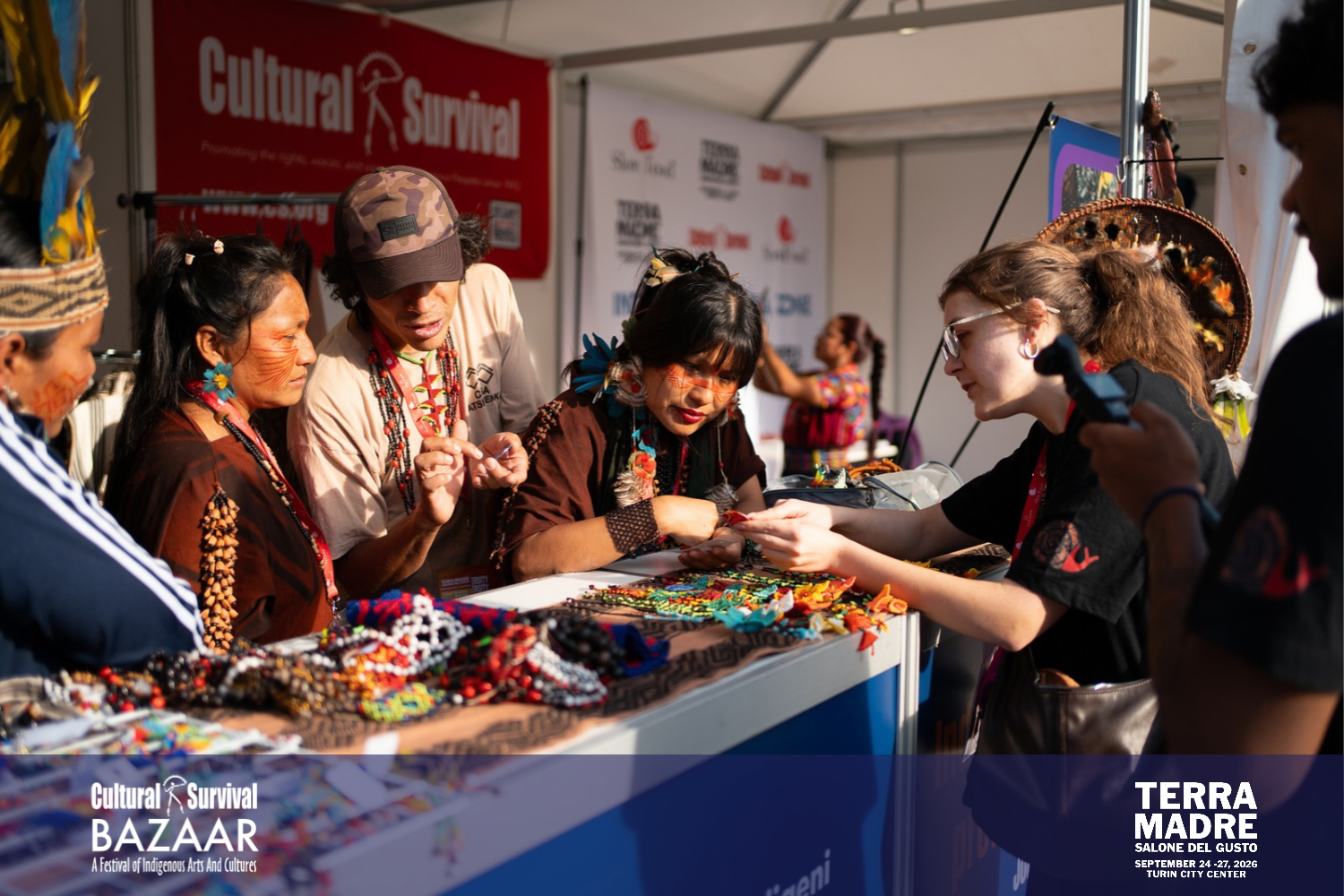
A major highlight of Cultural Survival’s presence at Terra Madre 2026 was its active participation through the Cultural Survival Bazaars. These markets provide a vital economic and cultural platform for Indigenous artists and craftspeople to exhibit their work directly to an international audience, ensuring that traditional art forms remain economically viable and culturally vibrant.
Four distinct artist collectives and independent creators were proudly showcased at the event, representing diverse geographical regions and cultural heritages:
ANARO (Ashaninka) from Peru: Representing the Ashaninka people of the Amazon rainforest, ANARO brought intricate crafts and textiles that reflect a deep symbiotic relationship with the rainforest ecosystem, highlighting the sustainable use of natural Amazonian fibers and dyes.
Manitas Creativas (Matsigenka) from Peru: Hailing from the Matsigenka community, this collective showcased fine artisanal work rooted in the rich biodiversity of southeastern Peru, translating traditional stories and environmental observations into physical art.
Philbert Begay (Diné/Navajo) from the United States: A master silversmith, Begay represented the Diné nation through exquisite, traditionally crafted jewelry. His work carries forward centuries-old Southwestern metalworking traditions infused with profound cultural symbolism tied to the sacredness of the land.
Afri-Root Collective (Baganda & Acholi) from Uganda: Representing East African heritage, the Afri-Root Collective brought the rich cultural expressions of the Baganda and Acholi peoples, demonstrating how traditional African art forms continue to thrive and adapt in contemporary contexts.
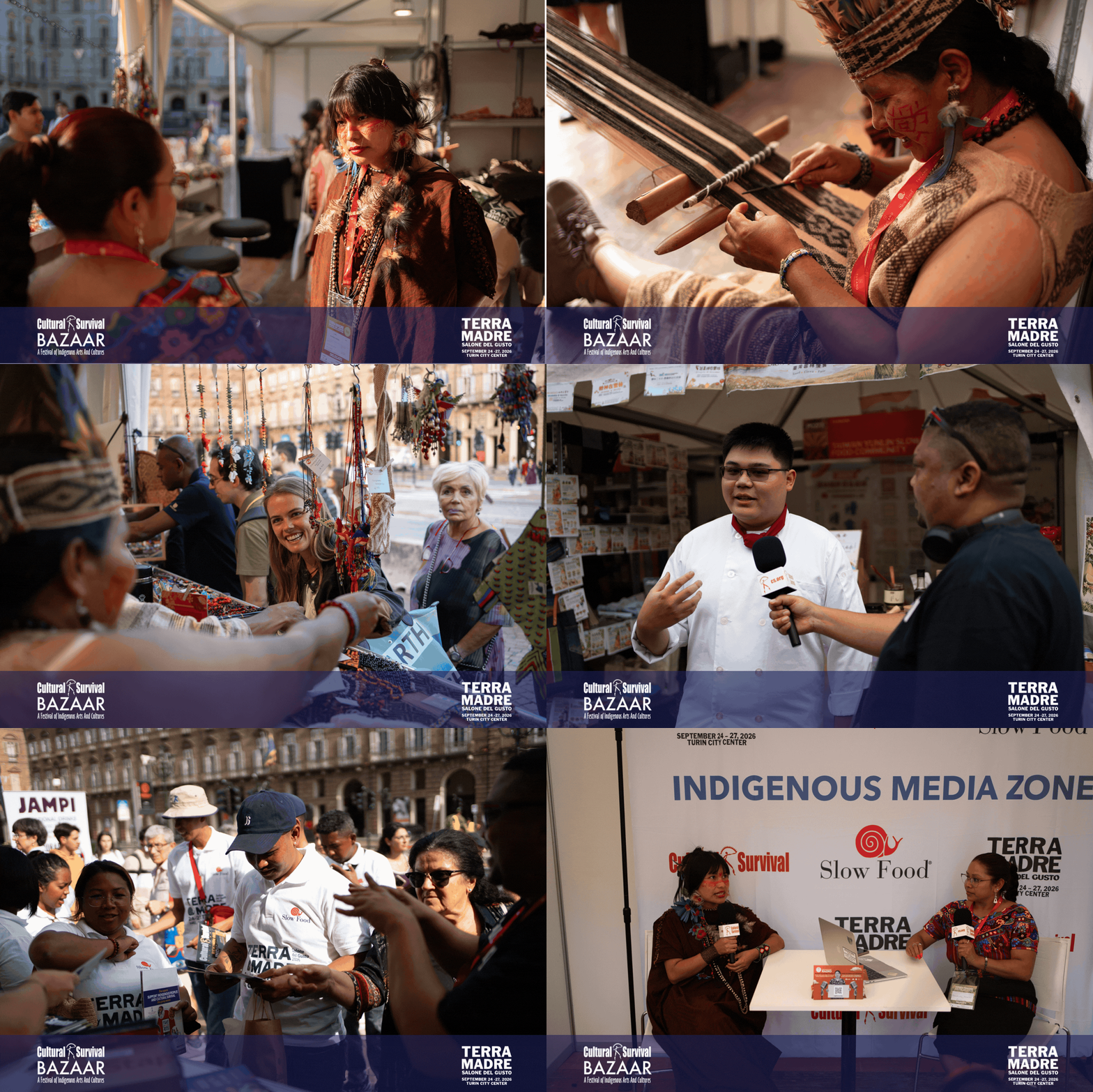
The inclusion of these artists at an international summit like Terra Madre emphasized that cultural preservation and food sovereignty are deeply intertwined. Art functions as another medium through which Indigenous Peoples document their connection to the land, assert their cultural autonomy, and sustain their communities economically.
Amplifying Voices Through the Indigenous Media Zone
Recognizing the historical underrepresentation of Indigenous voices in mainstream media, Cultural Survival’s team organized a dedicated Indigenous Media Zone on-site in Turin. The primary objective of the media zone was to conduct in-depth interviews with Indigenous delegates from around the globe, capturing firsthand accounts of their grassroots initiatives, local struggles, and strategic victories in achieving food sovereignty.
To ensure global accessibility and honor the linguistic diversity of the delegates, the recorded interviews were curated into specialized multilingual segments spanning English, Spanish, and Italian. These documented conversations provide an invaluable archive of contemporary Indigenous thought, covering topics ranging from ancestral seed saving in Mesoamerica to youth-led ecological restoration in East Africa.
The English-language interview series featured frontline activists and community organizers discussing the structural hurdles of industrial agriculture and the resilient alternatives being forged at the local level. Similarly, the Spanish-language sessions (En español) captured compelling narratives from Latin American seed guardians, highlighting the defense of communal lands against extractive industries and monoculture expansion. Finally, the Italian-language features (In italiano) facilitated direct dialogue with European audiences and policymakers, bridging local Italian agricultural movements with global Indigenous paradigms. These recorded sessions remain accessible to the public, serving as educational tools for researchers, students, and advocates worldwide.
Broader Impact and Policy Implications
The participation of Cultural Survival and the broader Indigenous delegation at Terra Madre Salone del Gusto 2026 carries significant implications for global environmental policy and sustainable agriculture. As international bodies increasingly grapple with the compounding crises of climate change and biodiversity collapse, empirical data consistently demonstrates that state-led conservation models frequently fail where Indigenous-led stewardship succeeds.
By highlighting the fact that Indigenous territories harbor a disproportionate share of the world’s remaining biodiversity, Terra Madre 2026 reinforced the legal and moral imperative of recognizing Indigenous land rights. Analysts note that true climate resilience cannot be attained through top-down technological interventions alone; rather, it requires the active devolution of environmental management authority to the Indigenous communities who have successfully sustained these ecosystems for millennia.
Furthermore, the emphasis on food sovereignty—as opposed to mere food security—challenges the industrial model of global food production. While food security focuses primarily on caloric availability, food sovereignty insists on the right of peoples to culturally appropriate, ecologically sound food produced through sustainable methods. The knowledge systems shared by delegates in Turin—ranging from ancient Peruvian agroforestry to East African pastoralist management—offer blueprint solutions for a post-carbon agricultural future.
Ultimately, Cultural Survival’s engagement at Terra Madre Salone del Gusto 2026 served as a powerful reminder that the fight for biodiversity is inseparable from the fight for human rights, self-determination, and cultural survival. As the international community looks toward future environmental summits, the testimonies, art, and policy frameworks championed in Turin will continue to guide the global movement toward a more equitable and ecologically balanced world.




