
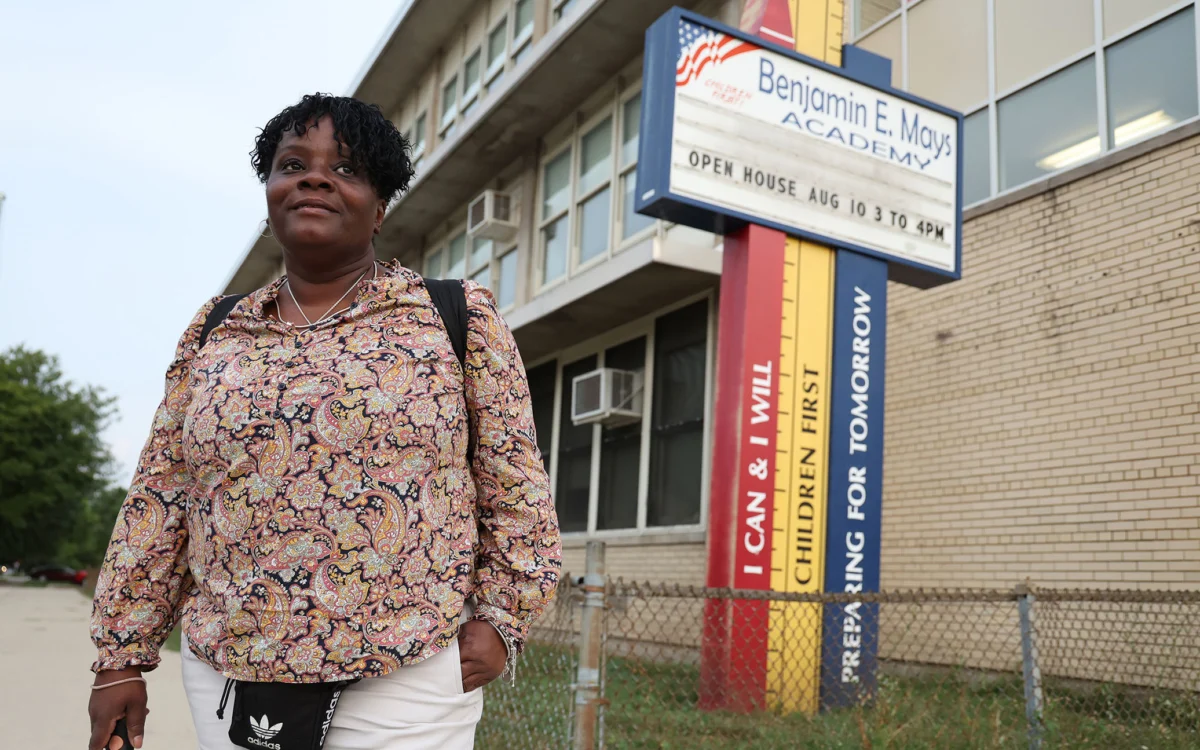
For years, Maria Johnson was a familiar face in Chicago Public Schools (CPS) classrooms, operating quietly as a volunteer parent. She offered an extra set of hands to help young students sound out unfamiliar words, guide reading groups, and manage the daily whirlwind of elementary education. Johnson’s journey began informally, driven by a personal desire to support her eldest son, who is now 22.
“I was not only trying to be there for my son, but I wanted to be there for other children, because I know everybody doesn’t get that,” Johnson reflected.
What began as unpaid, ad-hoc classroom support transformed into a viable, professional career trajectory last fall, courtesy of a statewide workforce development initiative. Through a specialized nonprofit offering free training, instructional classes, and dedicated one-on-one coaching, Johnson navigated the pathway toward state licensure as a paid paraprofessional. Just seven months after joining the program, the 53-year-old was officially hired as a special education classroom assistant (SECA) at Benjamin E. Mays Academy in the Englewood neighborhood.
Johnson’s story is no longer an isolated anomaly. Across Illinois, a targeted grassroots movement is systematically converting dedicated parent volunteers into credentialed, paid school professionals. By addressing chronic staffing shortages while simultaneously creating economic mobility for working-class families—predominantly Black and Latina mothers from Chicago’s South and West sides—this initiative is reshaping the human infrastructure of urban education.
The Genesis and Mechanics of Ladders of Opportunity
Ladders of Opportunity is a relatively new statewide nonprofit initiative explicitly designed to combat Illinois’ persistent shortage of school paraprofessionals. The program evolved organically out of the Parent Engagement Institute, an organization historically focused on recruiting parents to volunteer in their children’s schools. While volunteering builds community trust and provides immediate classroom assistance, Ladders of Opportunity takes the concept a step further. It identifies parents who have logged at least 100 volunteer hours and possess a demonstrated interest in pursuing a formal career in education, seamlessly routing them into an intensive licensure track.
Since its formal inception in 2023, the program has expanded rapidly. Backed by a substantial $25 million grant from the Illinois Department of Human Services, Ladders of Opportunity now operates across 11 pilot sites throughout the state. To date, the initiative has successfully guided more than 1,100 parents to state-licensed paraprofessional credentials, with approximately 373 of those certifications occurring directly within Chicago Public Schools.
The operational architecture of the program is designed to remove the traditional barriers that prevent low-income adults from pursuing higher education or professional certification. Participants are initially recruited by community-based organizers who are deeply embedded within local schools. Depending on the targeted licensure track, candidates undergo weeks of rigorous professional development training. The curriculum covers essential competencies, including digital literacy, English as a Second Language (ESL), and specialized academic instruction tailored to help participants pass rigorous state examinations.
Furthermore, the program offers a comprehensive suite of support services to ensure retention and success. Participants receive personalized coaching, complimentary childcare during program activities, and full reimbursement for all state licensure fees. Once instructional modules are complete, career coaches guide candidates through the intimidating hiring pipeline, offering mock interview sessions, resume-building workshops, and direct networking opportunities with local school principals.
Overcoming Adversity in Pursuit of a Calling
For many participants, the road to licensure demands immense personal resilience. Maria Johnson’s journey to becoming a SECA required balancing rigorous academic preparation with monumental personal hurdles. In February, while deeply immersed in her training modules and simultaneously caring for her 6-year-old son, Johnson was diagnosed with breast cancer.
Despite the physical and emotional toll of her diagnosis and subsequent medical treatments, Johnson refused to abandon her professional aspirations. She credits her success to the unwavering support of her program coach and community organizers with Teamwork Englewood, who routinely checked in on her study habits and managed her administrative paperwork.
“They were right there. They said, ‘Don’t give up, Maria. No, I’m not letting you give up,’” Johnson recalled. Her 6-year-old son, she notes with pride, remains deeply supportive of his mother’s historic career achievement.
A similar narrative unfolded for Anna Sanchez in the West Lawn neighborhood. Before discovering the Ladders program, Sanchez worked at a local ice cream shop. When she was hired in April as a substitute SECA at Hurley Elementary School—where her 7-year-old daughter attends second grade—she faced significant anxieties, chief among them a perceived language barrier. Having grown up in Mexico and lived in the United States for 17 years, Sanchez initially doubted her capacity to pass an exhaustive, hours-long professional licensure exam in English.
Through the program, however, Sanchez not only mastered the exam content but also gained deep insights into professional workplace norms, special education methodologies, and effective student engagement techniques.
“I learned that we should not only focus on the students, but also support and guide parents on how they can also help their children outside of school,” Sanchez said in Spanish. Buoyed by her newfound credentials, Sanchez has set her sights on her next professional milestone: becoming a fully certified classroom teacher.
Addressing Critical Staffing Deficits in Special Education
The demand for qualified paraprofessionals, particularly SECAs, remains one of the most pressing operational challenges for urban school districts. In Chicago Public Schools, perennial staffing imbalances have historically left individual campuses struggling to secure adequate support staff. While overall vacancy rates across the district hover at historic lows, administrators continue to grapple with the complexities of recruiting and retaining specialized workers for high-need roles. Across Illinois, paraprofessional turnover rates have traditionally been high, exacerbated by historically low hourly compensation rates and minimal onboarding training.
The need for classroom assistants is particularly acute within special education. Federal and state legal frameworks require districts to provide comprehensive support services to students with disabilities. However, systemic compliance failures have historical precedent. In 2018, Chicago Public Schools was subjected to a formal state corrective action process after federal and state investigations revealed systemic failures in providing mandated special education services, including the deployment of adequate SECAs.
Since 2019, the demographic profile of the district has shifted noticeably. The proportion of CPS students identified as having disabilities has grown steadily from 14.6% to 17.3%, representing a population of nearly 55,000 students. To keep pace with this rising demand, district employee rosters indicate that CPS has added approximately 3,600 SECA positions over the same timeframe.
While district officials report that the overall SECA vacancy rate sits at a manageable 2%—accounting for roughly 160 open positions—these aggregate figures mask persistent geographic disparities. Vacancy rates remain disproportionately higher in CPS administrative networks located on the South and West sides. Although district leadership implemented staffing adjustments last year in an effort to equitably redistribute SECAs to underserved communities, those logistical shifts achieved only modest results in correcting the systemic imbalance.
Bridging the Training Gap and Elevating Standards
Advocates and labor representatives argue that solving the retention crisis requires more than merely filling open seats; it requires elevating the quality of pre-service training.
To qualify as a SECA under standard state guidelines, applicants must either pass a basic skills exam covering reading, writing, and mathematics, or present a college degree, or alternatively complete 60 college credit hours in any general subject area. Critics argue this creates a systemic vulnerability.
“We have people who are hired because they have the required number of college credit hours in anything under the sun, but no particular training to work with children and no particular knowledge of disabilities,” said Barb Cohen, a special education advocate at the Legal Council for Health Justice. Cohen maintains that specialized professional preparation—precisely the gap that initiatives like Ladders of Opportunity aim to close—would drastically reduce burnout and subsequent turnover.
Labor representation has also fought for incremental improvements in workforce preparation. In their most recent collective bargaining agreement, SEIU Local 73, the union representing SECAs within Chicago Public Schools, successfully secured one day of mandatory paid onboarding and professional training for newly hired members—a historic first for the bargaining unit.
The Principal’s Perspective: Cultivating Local Talent
School administrators on the front lines of campus management have increasingly embraced community-rooted recruitment models. Daniel De Los Reyes, principal of Darwin Elementary School in the Logan Square neighborhood, hired four graduates of the Ladders program last year. Initially brought on as miscellaneous workers to fill part-time roles as lunch and recess monitors, these parent-turned-professionals quickly integrated into the school’s operational fabric.
De Los Reyes noted that hiring individuals who have graduated from a rigorous, community-based development program provides administrators with a distinct advantage. It “allows me to vet, train and develop the mindset, the disposition and the work ethic of job applicants,” he explained.
Darwin Elementary operates a robust dual-language program, with more than a third of its student body classified as English learners. In recent years, the campus has welcomed scores of newly arrived immigrant families. The Ladders program has functioned as an organic talent pipeline, enabling predominantly Latina mothers to step directly into educator support roles. These staff members play vital roles not only in academic settings, but also in cultural programming, such as organizing events for Hispanic Heritage Month and Día de los Muertos.
“There’s a need in school, and there’s a resource in the community,” De Los Reyes observed. Having spent four years working as a paraprofessional himself before transitioning to classroom teaching and eventually school leadership, De Los Reyes is a vocal proponent of homegrown talent pipelines. The impact of the initiative extends beyond baseline paraprofessional support; statewide, more than 160 Ladders alumni have advanced to become accredited substitute teachers, while approximately a dozen have successfully attained full Professional Educator Licenses.
“I have Ladders graduates from last year who I can see as primary bilingual teachers,” De Los Reyes said. “I often have the mindset that the solutions lie within the building, or within the community.”
The Broader Implications for Urban Education
The success of parent-to-paraprofessional pipelines highlights a fundamental paradigm shift in how urban school districts approach human resource management. By looking inward at the existing ecosystem of parents, caregivers, and community members, educational leaders are finding sustainable solutions to chronic labor shortages.
Organizers emphasize that the value parent professionals bring to a school environment extends far beyond basic staffing metrics. They offer irreplaceable lived experiences, deep-seated relationships forged over years of school drop-offs and pickups, cultural fluency, and an intrinsic, vested interest in neighborhood welfare.
At a recent program kickoff event, Flor Dimas, co-manager of Ladders of Opportunity, emphasized the direct correlation between community involvement and student achievement while addressing a room full of community organizers.
“You’ve got to have healthy schools for a healthy community. And for that, you’ve got to have engaged and involved parents,” Dimas said. “Who is impacted by parents in the classroom? Students. They look like them, they talk like them, they live in the community.”
As school districts nationwide continue to grapple with post-pandemic staffing challenges, funding retention initiatives, and the imperative to serve increasingly diverse student populations, the Illinois model offers a compelling blueprint. By transforming dedicated volunteers into credentialed professionals, programs like Ladders of Opportunity are simultaneously healing fractured labor pipelines and validating the profound truth that the most effective educational resources are often already inside the school building.




