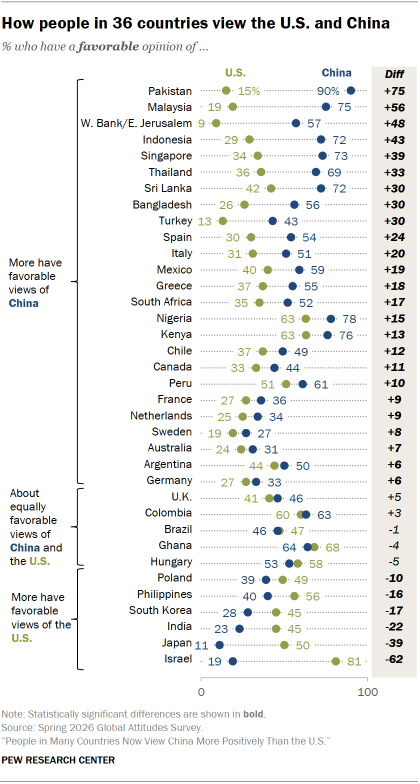
International perceptions of the United States and China have undergone a significant transformation, with China now surpassing the U.S. in favorability across a majority of surveyed nations. This dramatic shift, detailed in a comprehensive report by the Pew Research Center, highlights a complex interplay of evolving leadership evaluations, differing views on personal freedoms, and contrasting foreign policy approaches. The findings, based on surveys conducted between February 8 and May 13, 2026, involving 42,151 adults across 36 countries, paint a compelling picture of a changing global landscape.
A Reversal in Global Standing

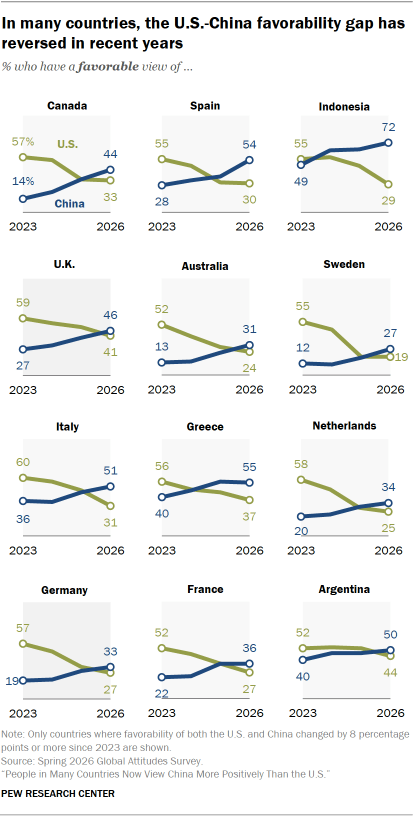
The report’s central finding is a stark reversal in how the world views the two global superpowers. In the past, and even as recently as the initial stages of President Donald Trump’s second term, global opinion generally favored the United States. However, this trend has demonstrably reversed. For the first time in recent memory, a greater proportion of respondents in most of the surveyed nations expressed a more positive opinion of China than of the U.S. This marks a pivotal moment in international public opinion, suggesting a recalibration of how global powers are perceived and evaluated.
The shift is not a singular event but a culmination of trends observed over recent years. The Pew Research Center’s data indicates a parallel movement: while views of China have steadily improved, opinions of the United States have simultaneously worsened. This dual dynamic has led to a scenario where the traditional perception of American global leadership is being challenged by a rising positive sentiment towards China.
Leadership Perceptions: A Tale of Two Presidents
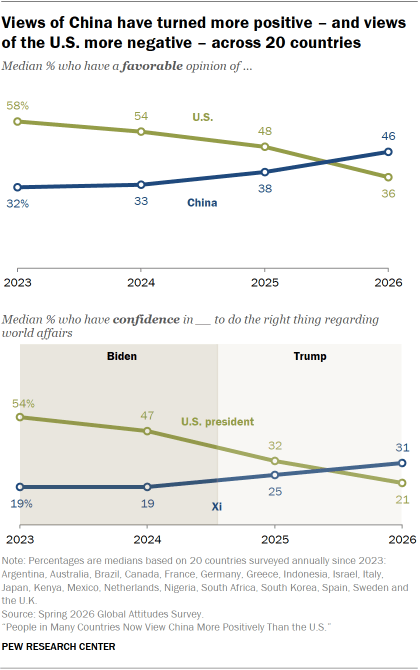
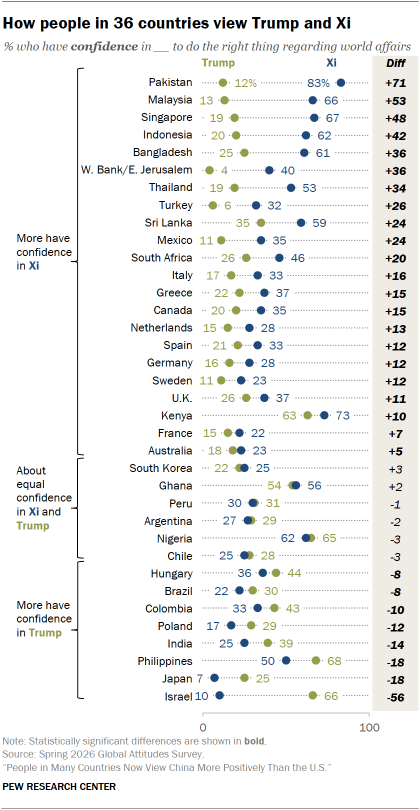
The global assessment of national leaders has mirrored the broader shifts in country favorability. During the latter half of President Joe Biden’s term, confidence in his leadership to handle international affairs was generally higher than that placed in Chinese President Xi Jinping, though Biden’s ratings did experience a decline in several countries between 2023 and 2024.
The period encompassing the first two years of President Trump’s second term, however, saw a significant deterioration in international confidence in the U.S. president. While confidence in President Xi Jinping remains a point of concern for many globally, his positive ratings have seen a widespread increase. Consequently, the current assessment indicates that more people worldwide now express confidence in Xi Jinping’s ability to act responsibly on the global stage than in Donald Trump. This divergence in leadership perceptions is a critical factor contributing to the overall shift in favorability between the two nations.
Personal Freedoms: A Narrowing Gap
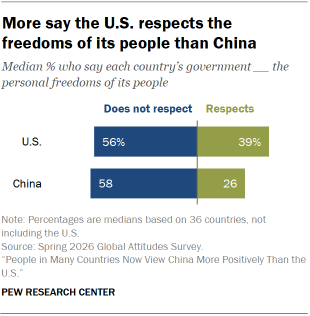
One area where the United States historically maintained a distinct advantage over China has been the perception of respect for personal freedoms. For years, international observers were more likely to believe that the U.S. government upheld the personal freedoms of its citizens compared to the Chinese government. However, this perception is rapidly converging.
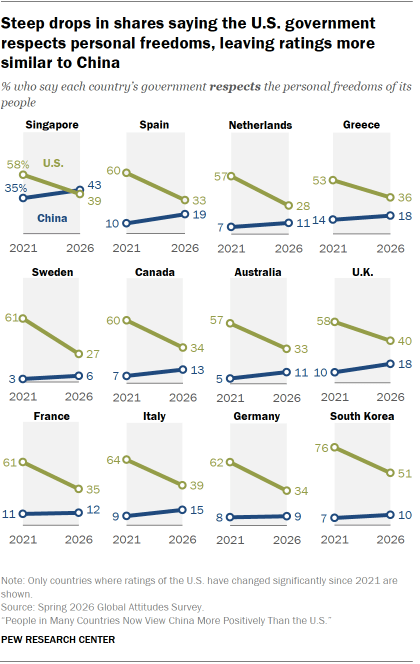
The report reveals a significant decline in the share of respondents who believe the U.S. government respects personal freedoms. This erosion of confidence has been particularly pronounced in many Western nations. For instance, in Sweden, the percentage of people who felt the U.S. government respected personal freedoms dropped from 61% in 2021 to a mere 27% in the current survey. Similar substantial decreases, exceeding 25 percentage points, were observed in Canada, France, Germany, Italy, the Netherlands, South Korea, and Spain.
This decline in perceptions of American respect for freedoms often coincides with a modest increase in the belief that the Chinese government respects personal freedoms in some countries. For example, in Australia, the percentage holding this view rose by 6 percentage points to 11% since 2021. The cumulative effect of these trends is a shrinking gap between the two nations’ perceptions regarding personal freedoms. In many of the 36 surveyed countries, a substantial portion of the population now expresses skepticism about whether either government adequately respects the personal freedoms of its people, particularly evident in Europe and Latin America. In Mexico, for instance, approximately 35% of respondents believe the Chinese government respects its citizens’ freedoms, while only 20% hold the same view regarding the U.S. government.
Foreign Policy Perceptions: China as a More Reliable Partner?
The ongoing competition for global influence between China and the United States has also shaped international perceptions of their respective foreign policy roles. The Pew Research Center’s investigation included a deeper dive into how citizens in six Latin American countries view the foreign policy contributions of both superpowers. Historically, these nations tended to view the U.S. as a more dependable partner than China. However, current data suggests a more divided sentiment.
A significant focus of both nations’ foreign policy efforts has been directed towards middle-income countries. China has cultivated substantial economic and security ties with nations like Brazil and Peru, as highlighted in analyses by the Council on Foreign Relations. Simultaneously, the 2025 U.S. National Security Strategy underscored the imperative to counter China’s growing economic influence in regions such as Southeast Asia, Latin America, and the Middle East.
In 17 middle-income countries surveyed, a median of 75% of respondents expressed concern that the U.S. interferes in the affairs of other nations to a significant or fair extent. In contrast, only 45% held the same view regarding China. This perception of American interference is more prevalent than that attributed to China in nearly every surveyed country.
Furthermore, many of these middle-income countries now perceive China as a more reliable partner than the U.S. They are also more inclined to believe that China contributes positively to global peace and stability. In South Africa, for example, 72% of respondents consider China a reliable partner, compared to 46% for the U.S. South Africans are also more likely to believe that China takes their country’s interests into account in international decision-making (64%) than they are to say the same of the U.S. (42%). The perception of China’s contribution to global peace and stability in South Africa has seen a notable increase, rising from 47% in 2023 to 64% in 2026.
While views on China’s global role have remained relatively stable in some nations, in Indonesia, both the U.S. and China have seen a decrease in the proportion of respondents who believe they contribute to global peace and stability.
In several Latin American nations – Argentina, Brazil, Colombia, and Peru – similar proportions of respondents view both the U.S. and China as reliable partners. The most significant divergences in perception between the two countries are observed in the Asia-Pacific region. In Pakistan, for instance, a striking 84% view China as a reliable partner, while only 36% say the same of the U.S. Conversely, in the Philippines, 81% consider the U.S. a reliable partner, compared to 42% for China.
Methodology and Scope of Research
This extensive report is the result of rigorous polling conducted by the Pew Research Center. The surveys were administered to 42,151 individuals across 36 countries, including a diverse range of nations from every continent: Argentina, Australia, Bangladesh, Brazil, Canada, Chile, Colombia, France, Germany, Ghana, Greece, Hungary, India, Indonesia, Israel, Italy, Japan, Kenya, Malaysia, Mexico, the Netherlands, Nigeria, Pakistan, Peru, the Philippines, Poland, Singapore, South Africa, South Korea, Spain, Sri Lanka, Sweden, Thailand, Turkey, the United Kingdom, and the West Bank and East Jerusalem.
Interviews were conducted over a three-month period, from February 8 to May 13, 2026. The research was designed to capture the views of the adult population in each country, ensuring a broad and representative sample. The Pew Research Center, known for its in-depth global surveys, utilized its extensive experience in this domain to gather and analyze the data. The full survey questions and detailed methodology are available for public access, providing transparency and allowing for further scholarly examination of the findings. This research builds upon the Center’s ongoing efforts to understand international perspectives on critical global issues, including views of the United States and China, and the leadership of their respective presidents.
Implications for Global Dynamics
The findings of this Pew Research Center report carry significant implications for the evolving global order. The diminishing favorability of the United States, coupled with the ascendant image of China, suggests a potential recalibration of international alliances and partnerships. The perception of China as a more reliable partner and its growing influence in middle-income countries could reshape trade, investment, and diplomatic relations.
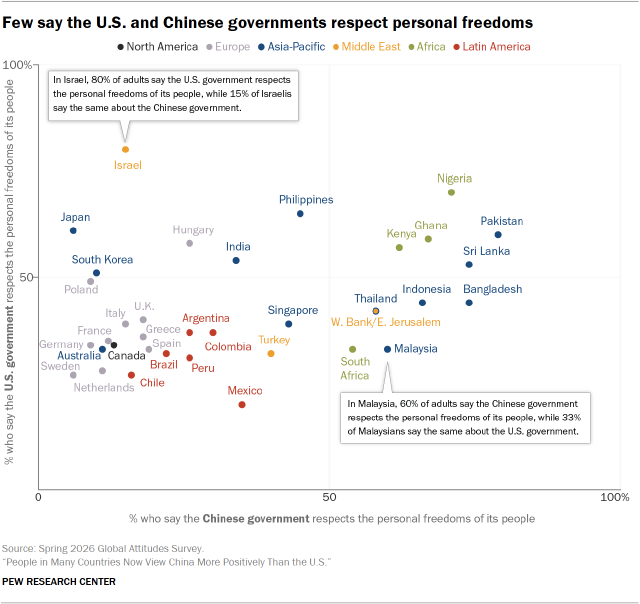
The decline in global confidence regarding the U.S.’s respect for personal freedoms, particularly in key allied nations, could pose challenges for American soft power and its promotion of democratic values. Conversely, China’s increasing positive international image, despite ongoing concerns about its human rights record, indicates a complex global sentiment where economic influence and perceived stability may be weighing more heavily in public opinion.
As the geopolitical landscape continues to shift, these perceptions will undoubtedly influence international policy decisions, trade negotiations, and the broader discourse on global governance. The data underscores the dynamic nature of international relations and the imperative for policymakers in both Washington and Beijing to understand and respond to these evolving global sentiments. The coming years will likely see intensified efforts by both superpowers to shape their international image and solidify their positions on the world stage, informed by the insights revealed in this comprehensive survey.