The exhibition meticulously showcases a quarter-century of Gordon Parks’s seminal work, spanning from 1942 to 1967 – a pivotal era in American history marked by profound struggles for civil rights and racial equality. Bryan Stevenson, renowned founder of the Equal Justice Initiative (EJI) and author of the critically acclaimed "Just Mercy," meticulously selected photographs that collectively articulate the "struggle, resilience, and constant striving of Black Americans." His curation is deeply informed by Parks’s unwavering commitment to social justice, a commitment Stevenson himself identifies with as an "African American survivor of racial injustice." Stevenson emphasizes that Parks’s acute awareness of race and class dynamics in America was not merely a backdrop but a palpable force that shaped every frame of his photographic oeuvre.
The Curator’s Vision: Bryan Stevenson and the Urgency of Memory
Bryan Stevenson’s involvement imbues the exhibition with a unique resonance, drawing parallels between Parks’s historical documentation and contemporary challenges to racial justice. As a tireless advocate for criminal justice reform and a leading voice against systemic inequality, Stevenson brings a profound understanding of the historical and ongoing battle for civil rights. His work at EJI, which includes establishing the National Memorial for Peace and Justice and The Legacy Museum in Montgomery, Alabama, is dedicated to confronting the legacy of slavery, lynching, and racial segregation. This background makes him an exceptionally insightful curator for an artist like Parks, whose life’s mission was to expose these very injustices.
Stevenson highlights the critical timing of this exhibition, noting "a moment when there is an intense and active effort of erasure, retreat from civil rights and silencing of Black voices and history in the United States." In this context, Parks’s images are not just historical artifacts but "provide insight and relevance to our current discourse," serving as a powerful "resistance to bigotry and oppression." This perspective underscores the exhibition’s role not just as a retrospective but as a contemporary call to action, reminding audiences of the cyclical nature of social struggles and the ongoing need for vigilance and advocacy. The collaboration between Alison Jacques Gallery, known for its focus on significant contemporary and modern artists, and The Gordon Parks Foundation, dedicated to preserving and promoting Parks’s legacy, further solidifies the exhibition’s platform for impactful dialogue.
Iconic Images: Challenging Narratives and Humanizing Experience
The exhibition features several of Parks’s most well-known and impactful works, each a testament to his unique ability to capture the human condition amidst systemic injustice. Among them is American Gothic, Washington, D.C. (1942), a searing portrait of Ella Watson, a Black cleaning woman working for the Farm Security Administration (FSA) – the very agency that employed Parks at the time. This photograph, a direct and subversive homage to Grant Wood’s famous painting, replaced the stern white farmer and his daughter with a Black woman holding a broom and mop, standing before an American flag. It starkly illuminated the racial hypocrisy of a nation that espoused democratic ideals while subjecting its Black citizens to profound discrimination. This image, initially met with controversy, became a cornerstone of Parks’s career, establishing his reputation for using photography as a tool for social commentary.
Also prominently featured are Parks’s photographs from the historic 1963 March on Washington for Jobs and Freedom, including his iconic portrait of Dr. Martin Luther King Jr. delivering his "I Have a Dream" speech. These images capture the sheer scale and moral force of the Civil Rights Movement at its zenith, providing an intimate glimpse into one of the most transformative moments in American history. Parks, with his unparalleled access and discerning eye, conveyed not just the speeches and the crowds, but the fervent hope and determined spirit of a people demanding equality.
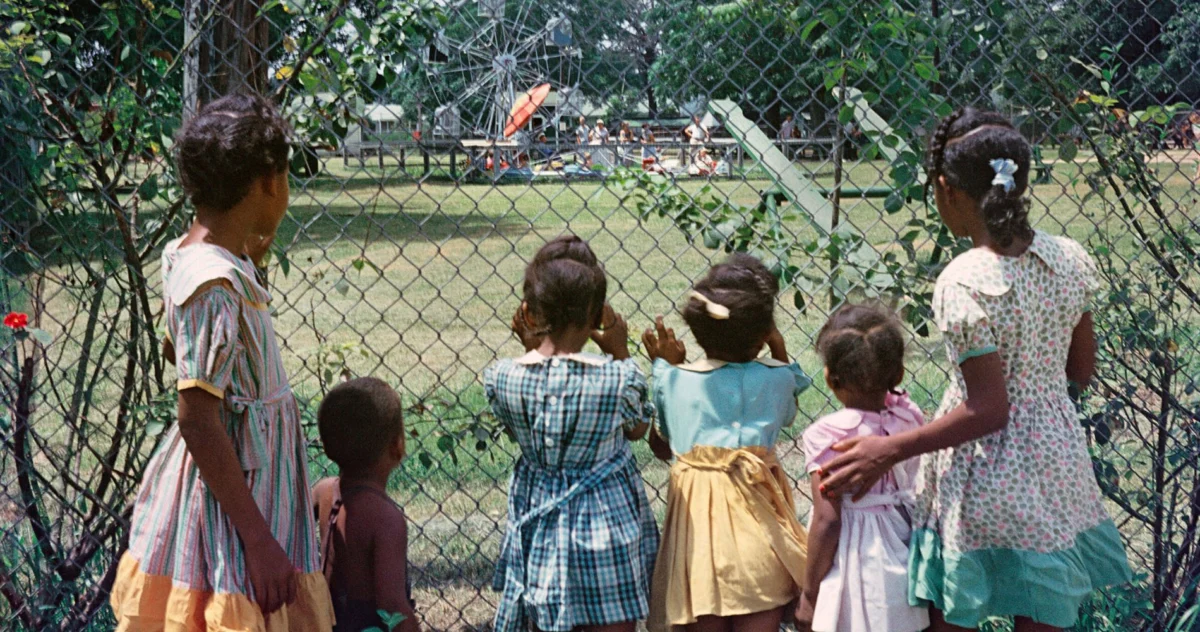
A significant portion of the exhibition is dedicated to Parks’s seminal Segregation Story series, commissioned by Life Magazine and published under the title "The Restraints: Open and Hidden" in 1956. This series, which includes iconic works such as Outside Looking In, Department Store, and Mr. and Mrs. Albert Thornton, chronicled the daily lives of Black families living under Jim Crow segregation in Alabama. Parks’s approach was revolutionary; instead of focusing solely on protests or violence, he embedded himself within communities, depicting the quiet dignity and enduring humanity of his subjects amidst the indignities of segregation. As The Gordon Parks Foundation explains, Parks often wrote his own accompanying articles, "allowing him to inject his personal perspective and challenge stereotypes." This comprehensive storytelling "humanised the effects of Jim Crow segregation… creating narratives that consistently expressed the dignity and complex humanity of his subjects, starkly contrasting with mainstream representations" that often caricatured or ignored Black lives.
Gordon Parks: A Chronology of a Visionary Artist and Activist
Gordon Parks’s life story is itself a testament to resilience and the pursuit of justice. Born in Fort Scott, Kansas, in 1912, Parks came of age in the early 20th century, a period defined by the brutal realities of Jim Crow laws across the American South and pervasive racial discrimination nationwide. He witnessed and personally endured the profound stress and degradation of racial hierarchy, experiencing firsthand the marginalization, exclusion, and humiliation enforced by segregation laws. This era was characterized by widespread mob violence and lynching, with an estimated 4,743 lynchings occurring in the United States between 1882 and 1968, disproportionately targeting Black individuals. Black Americans were systematically denied the essential right to vote through poll taxes, literacy tests, and grandfather clauses, effectively silencing their political voice.
Amidst this struggle, Parks picked up a camera as his "weapon of choice," teaching himself the art of photography. His early career saw him document the lives of ordinary Americans for the FSA, where he produced American Gothic. He later became the first African American staff photographer for Life Magazine, one of the most influential photojournalism outlets of its time, providing him with an unprecedented platform to illuminate the realities of Black America to a national audience. Parks’s artistic philosophy centered on documenting the story of America, focusing on the lives of Black people, bringing into sharp focus the pain and humiliation of segregation, the despair of poverty, the violence of abusive law enforcement officers, and the appalling hypocrisy of an America that preached democracy and equality abroad while mired in racial bigotry at home.
Beyond photography, Parks was a polymath: a celebrated film director (most notably for the groundbreaking 1971 film Shaft), a composer, a writer, and a poet. This multifaceted artistic output allowed him to explore and articulate the Black experience across various mediums, consistently challenging dominant narratives. He was energized by resistance to oppression and by the creativity flourishing within the Black community. The burgeoning Civil Rights Movement, the emergence of "Black Power," and the triumphs of Black athletes, musicians, and even gang leaders were all "counter-narratives to racial discrimination that Parks brilliantly brought to life." His art played a crucial role in challenging the legitimacy of racial caste, helping to "tear down the architecture of Jim Crow laws" and enabling a new generation of Black and white leaders to envision and build a more equitable society. Gordon Parks helped "imagine a more hopeful future less burdened by racial bigotry and violence, an artistic narrative to help create in the words of the Black poet Langston Hughes, ‘America be America.’"
Historical Context: The Unfinished American Project
The essay accompanying the exhibition, penned by Bryan Stevenson, provides vital historical context, grounding Parks’s work within the broader narrative of American racial injustice. It begins with the stark reality of 246 years of chattel slavery, during which ten million Black people were enslaved in what would become the United States. Following the Civil War in 1865, four million formerly enslaved people were emancipated, making the remarkable and often overlooked decision to commit to creating a more just America. Instead of seeking retribution against their enslavers, they chose citizenship, building churches, schools, and families with extraordinary fortitude.
However, this commitment was not reciprocated by those in power. Just over a decade after the war, protections for African Americans, enacted during the Reconstruction era, were systematically withdrawn. Former enslavers, white supremacists, and proponents of racial hierarchy regained power, while Congress and the Supreme Court abandoned constitutional commitments to equal protection and voting rights for emancipated Black people. This betrayal paved the way for the rise of Jim Crow, institutionalizing racial segregation and terror for nearly a century. Parks was born into this very landscape, making his perspective not just observational but deeply experiential.
Contemporary Relevance: Resisting Erasure in 2026
The art and photography of Gordon Parks possess renewed significance in 2026, precisely because his work meticulously details the reality and history of America that is now, as Stevenson argues, "being distorted and denied." Today, there is a discernible "retreating from a full commitment to equality and justice for all." Powerful forces are actively attempting to "rewrite history, minimizing the harms of slavery, lynching, segregation and racial bigotry." This includes efforts to restrict education about systemic racism, ban books that explore diverse perspectives, and undermine civil rights protections.
The current political and social climate sees "people of color being demonized and castigated because of their race, ethnicity or national origin." There is a "reinforced presumption of dangerousness, guilt or incompetence" being assigned to many Americans based solely on their color. Furthermore, "Black political power is being sabotaged through a multitude of schemes that the Supreme Court seems ready to legitimate," referring to ongoing challenges to voting rights and electoral maps designed to dilute minority representation. As the gains of the Civil Rights Movement are eroded, and censorship and the whitewashing of history are on the rise, even artistic freedom faces threats. In such a climate, it is understandable that many might feel compelled to "escape, retreat and once again become silent," believing "silence seems safer."
However, Gordon Parks was an artist who "absolutely rejected silence or retreat." He understood the "persistence and strength of the human spirit" too well to lay down his camera, even in the face of cruel and abusive power. His art serves as a powerful "retort to those who want to force Americans back to some earlier era of perceived greatness when racial and gender hierarchy reigned." This exhibition is therefore far more than a display of photographs; it is, as Stevenson emphatically states, "history, education and protest."
Broader Impact and Implications
The exhibition’s message extends beyond the gallery walls, urging a critical examination of contemporary society. It implies that understanding the past, as Parks so unflinchingly documented it, is essential for navigating the present and shaping a more just future. The implications are profound: if history is erased or distorted, the lessons learned from past struggles are lost, making society vulnerable to repeating its gravest errors. Parks’s work, by giving voice and visibility to the marginalized, reinforces the importance of diverse perspectives in historical narratives and contemporary discourse.
The collaboration between The Gordon Parks Foundation and Alison Jacques Gallery signals a commitment to leveraging art as a tool for public education and social advocacy. It underscores the belief that cultural institutions have a crucial role to play in fostering dialogue about difficult truths and inspiring collective action. By bringing Parks’s photographs to a wider audience, the exhibition contributes to a broader cultural movement that seeks to preserve historical memory and challenge systemic inequalities.
Ultimately, the artistry of Gordon Parks makes it clear that "we cannot turn back, we cannot remain silent and we cannot retreat from advancing true justice." His visual narratives empower us to articulate what many are prepared to say, and indeed, must say. In an era where fundamental rights are contested and history is weaponized, Parks’s legacy stands as an unyielding beacon, affirming the steadfast resolve embodied in the We Shall Not Be Moved.