
On December 10, 2025, the Australian government officially implemented a groundbreaking legislative framework designed to curtail the presence of minors on major social media platforms. The landmark policy mandates that entities such as TikTok, Instagram, and Snapchat implement rigorous age-verification protocols, effectively barring users under the age of 16 from maintaining active profiles. This move represents one of the most aggressive regulatory stances globally regarding digital safety, shifting the responsibility of enforcement from the end-user to the corporate service providers.
The legislation, which faced significant debate in the halls of Canberra before its passage, arrived after months of mounting pressure from advocacy groups, educators, and concerned parents who argued that the digital landscape was inflicting irreversible harm on the developmental well-being of the youth. As of early 2026, the Australian government has signaled its commitment to this mandate by doubling the maximum financial penalties for non-compliant technology firms, underscoring a resolve to ensure that digital borders are as strictly enforced as physical ones.
The Landscape of Public Opinion
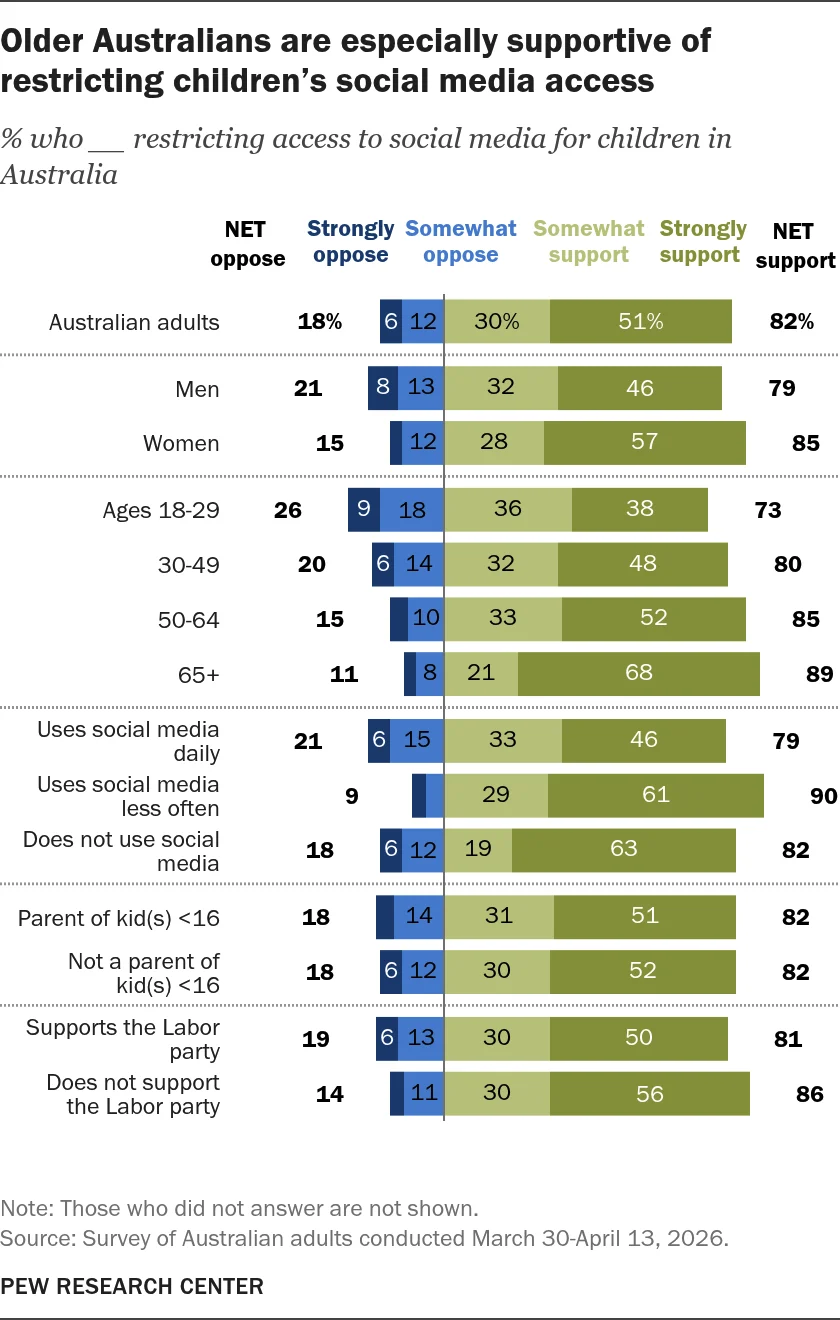
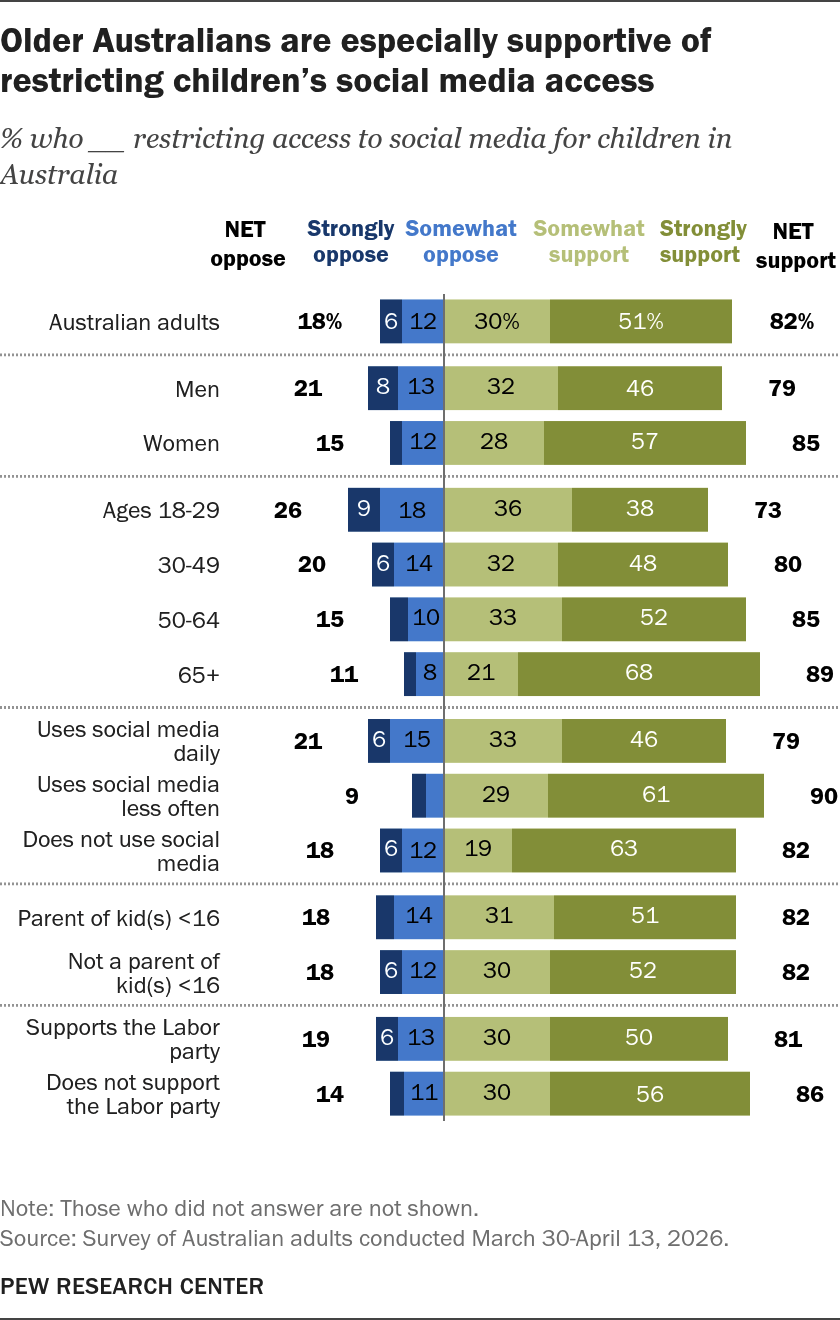
Data gathered by the Pew Research Center in a comprehensive survey of 2,064 Australian adults, conducted between March 30 and April 13, 2026, reveals a broad consensus in favor of these restrictions. Approximately 82% of the adult population in Australia supports the government’s decision to limit, or in some cases entirely remove, social media access for those under 16. Within this majority, a significant 51% express "strong support" for the measures, indicating that the policy aligns with a deeply held national desire to shield the next generation from the perceived pitfalls of algorithmic engagement.
The demographic breakdown of these figures provides a nuanced look at how different generations view digital connectivity. The data indicates that age is a primary driver of sentiment. Australians aged 65 and older represent the most fervent advocates for the ban, with 89% expressing support and 68% firmly stating they "strongly support" the restrictive measures. In contrast, younger adults—those in the 18 to 29 demographic—demonstrate the lowest levels of enthusiasm, with 73% in favor. While still a majority, the lower intensity among the youth demographic suggests a generational divide regarding the role of social media as a fundamental tool for socialization and self-expression.
Chronology of the Regulatory Push
The path to the December 2025 legislation was not instantaneous. It followed a decade of rising anxiety regarding cyberbullying, exposure to illicit content, and the addictive nature of "infinite scroll" interfaces.

- 2023–2024: Parliamentary committees began holding hearings regarding the mental health impacts of social media on Australian adolescents. Public testimony from psychologists and educational experts highlighted a correlation between heavy social media usage and declining academic performance and increased anxiety.
- Early 2025: The Australian government announced its intent to draft a formal "Digital Safety Act," proposing mandatory age verification technologies.
- December 10, 2025: The law officially takes effect, marking the first time a major developed nation has enforced a blanket ban on social media for children under 16.
- March 2026: Survey data confirms high public backing for the move, coinciding with global discussions on the same topic.
- Mid-2026: The government moves to strengthen the act, increasing penalties for platforms that fail to adequately identify and remove underage accounts.
Dissecting the Impact of Usage Habits
Perhaps most intriguing is the correlation between an individual’s own digital consumption and their support for the ban. The survey reveals that "light" social media users are actually more likely to support the restrictions than "heavy" users. Among those who report using social media platforms less frequently, 90% support the new law. Conversely, among those who report using social media on a daily basis, support drops to 79%.
This suggests a "digital divide" in perception: those who are less reliant on these platforms for daily connectivity or professional engagement may be more attuned to the negative external effects on society, while those deeply integrated into the digital ecosystem may view the restrictions as a more significant disruption to the social fabric. Furthermore, when analyzing parental status, the data shows that the concern is universal. There is no statistically significant difference in the support levels between parents of children under 16 and non-parents, indicating that the issue has transcended the home and has become a matter of broader public concern.
Global Context and International Momentum
Australia’s policy is not an isolated experiment. The international community is increasingly moving toward stricter oversight of the tech giants. Brazil set a significant precedent in March 2026 by becoming the first Latin American nation to implement legislation requiring parental consent for social media access for children under 16. Similarly, Indonesia has enacted comparable regulatory frameworks to safeguard its youth.
In Europe, the discourse has centered on a regional approach, with European Commission officials signaling intent to develop a bloc-wide ban for children under 13. While these proposals have yet to reach the legislative maturity of the Australian model, they signify a shift in the global zeitgeist. The common thread among these nations is the attempt to grapple with the "attention economy" and its impact on minors, a trend that many policymakers describe as a matter of national security and public health.
The United States Perspective
The United States remains a notable outlier, as it lacks a unified federal statute restricting social media for children. However, the sentiment in the U.S. is shifting toward alignment with the international trend. A recent survey conducted by the Pew Research Center in the spring of 2026 found that 56% of American adults support a ban on social media for those under 16. This support is notably higher among parents of minor children, suggesting that while the political process in the U.S. may be more fragmented, the public demand for protection is rising.
The U.S. legal landscape has also been influenced by high-profile litigation, including a landmark settlement involving Meta and 47 states. This settlement, which addressed allegations of intentionally addictive design features, has intensified the domestic conversation regarding the responsibility of corporations to design safer environments for their most vulnerable users.
Socio-Political Implications
The enforcement of the Australian ban brings with it significant technological and ethical challenges. The requirement for age verification raises questions regarding data privacy and the potential for "over-collection" of sensitive information. Critics of the law argue that verifying the age of every account holder may inadvertently create massive databases of personal information that could be vulnerable to security breaches.
Moreover, the efficacy of the ban remains a subject of intense academic and policy debate. Skeptics suggest that tech-savvy adolescents will inevitably find workarounds, such as Virtual Private Networks (VPNs) or spoofing software, to bypass age-verification protocols. Proponents, however, argue that the goal is not to eliminate usage entirely, but to create a systemic barrier that forces a delay in exposure, allowing for greater emotional and cognitive maturity before entering the digital public square.
Looking Ahead
As the Australian government continues to refine its approach—evidenced by the recent increase in fines—the world is watching closely. The success or failure of this experiment will likely influence future legislation in the United Kingdom, Canada, and potentially the United States.
The data confirms that this is not merely a fringe issue driven by moral panic; it is a mainstream, deeply held conviction among the Australian populace. Whether the policy succeeds in curbing the mental health crisis or simply pushes it further into the "dark" digital spaces remains to be seen. For now, Australia has established itself as the vanguard of a global movement to re-evaluate the terms of the digital contract between technology corporations and the youngest members of society. The consensus among the public, regardless of parental status or political affiliation, is clear: the era of unchecked, universal access for minors is coming to an end.




