The release of the United Kingdom’s first comprehensive Child Poverty Strategy in over a decade has ignited a national debate regarding the structural drivers of economic hardship and the role of the state in mitigating systemic inequality. On January 13, 2026, Priya Sahni-Nicholas, Co-Executive Director of The Equality Trust, addressed a specialized forum hosted by the Public Policy Exchange to dissect the government’s latest policy framework. While the strategy—titled Tackling Child Poverty: Improving Welfare, Security and Future Prospects—has been lauded for its shift in rhetoric and immediate income-boosting measures, analysts argue that its failure to address the concentration of wealth and corporate power may limit its long-term efficacy.
A New Framework for a National Crisis
In December 2025, the UK government unveiled a strategy designed to reverse a fifteen-year trend of rising child poverty. The document explicitly frames the current situation as a moral and economic failure, directly attributing the crisis to policy choices made after 2010. By the start of 2025, approximately 4.5 million children—one in three across the country—were living in poverty. Furthermore, nearly 20% of UK households reported consistent food insecurity, a statistic that stands in stark contrast to other advanced European economies where child poverty rates have generally declined or remained stable over the same period.
The strategy aims to "end child poverty" over the long term, with specific targets to achieve significant reductions within the current parliament. Central to this mission is the recognition that poverty is not a marginal social issue but a systemic failure requiring cross-departmental intervention. However, Sahni-Nicholas and other economic observers note that while the government has shifted its understanding of what poverty is, it has yet to fully grasp the symbiotic relationship between poverty and broader economic inequality.
Chronology of the UK’s Poverty Policy (2010–2026)
To understand the significance of the 2026 strategy, it is necessary to examine the policy trajectory of the last two decades.
- 1997–2010: Under the previous Labour administration, child poverty fell by approximately 600,000. This was largely achieved through the introduction of tax credits, significant investment in public services like Sure Start, and real-terms increases in benefits.
- 2010–2024: Following the 2010 general election, the UK entered a period of "austerity." Policies such as the benefit cap, the "bedroom tax," and most significantly, the two-child limit on Universal Credit and Child Tax Credits, were introduced. These measures, combined with stagnant wage growth, led to a steady climb in child poverty rates.
- 2024–2025: A change in government saw the establishment of a Child Poverty Taskforce. The subsequent months involved consultation with advocacy groups and families with lived experience of the welfare system.
- December 2025: The Tackling Child Poverty strategy is officially published, marking the first UK-wide strategy of its kind in 15 years.
- January 2026: Public Policy Exchange hosts a critical review of the strategy, highlighting both its redistributive successes and its structural omissions.
Immediate Wins: Income Redistribution and Social Support
The 2026 strategy introduces several high-impact policies that address the "sharp end" of inequality. The most significant of these is the abolition of the two-child limit. This policy, which prevented parents from claiming relief for a third or subsequent child born after April 2017, has been identified by the Child Poverty Action Group (CPAG) as a primary driver of large-family poverty. Removing this limit is projected to lift roughly 450,000 children out of relative poverty almost immediately.
Beyond direct transfers, the strategy emphasizes the "cost of essentials." New measures include:
- Universal Free School Meals Expansion: Extending eligibility to ensure no child goes hungry during the school day.
- National Breakfast Clubs: Providing a nutritional start for all primary school pupils to improve educational outcomes.
- Uniform Price Caps: Regulating the cost of school-branded clothing to reduce the "poverty premium" faced by low-income families.
- Childcare Expansion: Increasing subsidies to remove barriers for parents, particularly mothers, seeking to re-enter the workforce.
The government has also committed to uprating Universal Credit and increasing the National Living Wage. These measures represent a return to the redistributive logic of the late 1990s, focusing on raising the "income floor" to prevent families from falling into destitution.

The Missing Pillar: The Omission of Wealth Inequality
Despite the tactical successes of the strategy, The Equality Trust has raised concerns regarding the total absence of "wealth" from the government’s diagnosis. While income (the flow of money) is addressed, wealth (the stock of assets) is not mentioned once in the 2026 strategy.
Sahni-Nicholas argued at the Public Policy Exchange that treating poverty solely as an income problem ignores the reality of the UK’s asset-based economy. Families with identical incomes can experience vastly different standards of living based on their access to assets. A family that owns their home outright or has a modest savings buffer is resilient to economic shocks, such as a broken boiler or a period of illness. Conversely, a family in the private rental sector with no savings exists in a state of perpetual insecurity.
Referencing the work of economist Thomas Piketty, analysts point to the "r > g" formula—the concept that returns on capital (wealth) grow faster than the economy as a whole (wages). When wealth grows faster than wages, structural inequality widens. A child poverty strategy that ignores the concentration of assets at the top of the economy is, according to Sahni-Nicholas, "like trying to empty a bath while leaving the taps running."
Corporate Power and the "Unspoken Dimension"
A secondary critique of the strategy involves the role of power. The Equality Trust posits that inequality is not merely a lack of resources but a lack of agency. The current economic model is designed to reward capital and assets over labor and community needs.
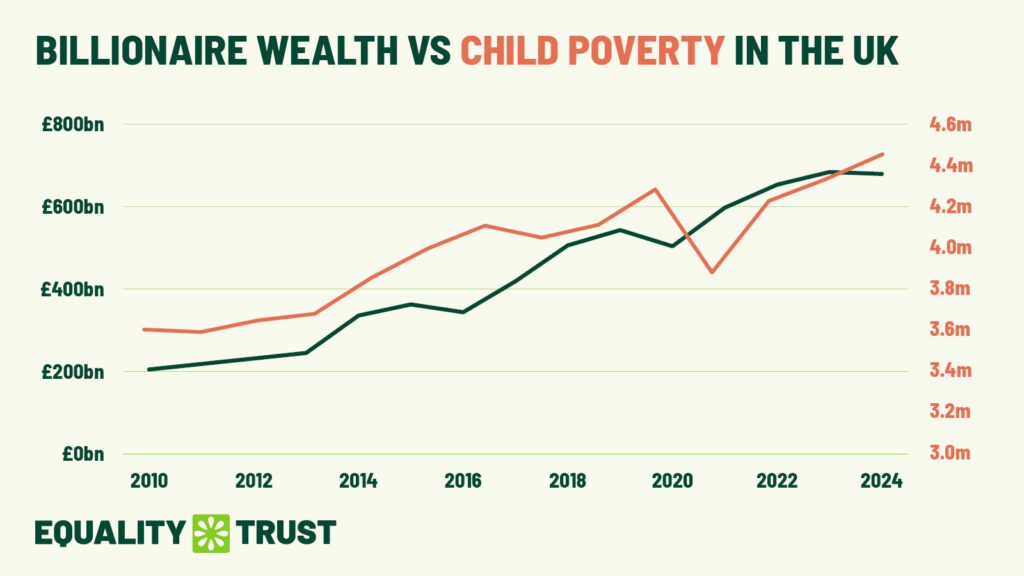
The strategy discusses "opportunity" and "life chances," but it remains silent on how corporate influence, the deregulation of the housing market, and the low taxation of wealth actively produce the conditions for poverty. For example, while the government aims to increase wages, the lack of rent controls or social housing investment means that a significant portion of any wage increase is immediately absorbed by private landlords. This "leakage" of public funds into private wealth further entices the cycle of inequality.
Historical Precedents and Fiscal Realities
History suggests that the most durable reductions in child poverty occur when the state makes deliberate choices to restructure the economy. Following the Second World War, the UK saw a sustained period of falling inequality. This was not an accidental byproduct of growth but the result of:
- The creation of a comprehensive social security system.
- The establishment of the National Health Service (NHS).
- Massive investment in social housing.
- Strong labor protections and high trade union density.
- Highly progressive taxation on both income and inherited wealth.
The 2026 strategy attempts to replicate the social security improvements of the past without the accompanying fiscal reform. Currently, the UK government derives the majority of its revenue from income tax and National Insurance—taxes on work. Meanwhile, returns on assets, such as capital gains and dividends, are taxed at significantly lower rates. This creates a fiscal "trap" where investment in public services is limited by the growth of wages, even as the wealth of the top 1% continues to surge.
Broader Implications and Future Recommendations
The consensus among social policy experts is that the Tackling Child Poverty strategy is a "necessary corrective" rather than a transformative overhaul. It successfully reverses the most punitive elements of the austerity era, but it does not yet offer a vision for a more equal society.

To move from poverty reduction to true inequality reduction, Sahni-Nicholas and The Equality Trust suggest the following steps for future policy iterations:
- Integrate Wealth Metrics: Future strategies must track asset poverty and debt alongside income levels.
- Fiscal Reform: Aligning the tax rates on wealth with those on income to provide a sustainable funding stream for social investment.
- Housing Reform: Recognizing that housing is a human right and a core utility, rather than a speculative asset class.
- Binding Accountability: Moving beyond "ambitions" to legally binding targets for narrowing the gap between the richest and poorest deciles of the population.
- Democratizing Power: Ensuring that people with lived experience of poverty are not just "consulted" but are given a seat at the table in designing economic policy.
Conclusion: A Welcome Shift with Unfinished Business
The January 2026 briefing served as a reminder that while the government has reclaimed child poverty as a national priority, the battle against inequality remains in its early stages. The abolition of the two-child limit and the focus on the costs of essentials will undoubtedly improve the lives of millions of children. However, as long as the UK’s economic structures continue to prioritize the accumulation of wealth at the top, the roots of child poverty will remain firmly planted.
The strategy marks a pivot toward a more compassionate welfare state, but it stops short of challenging the economic model that produces poverty in the first place. For organizations like The Equality Trust, the goal for the coming years will be to ensure that this strategy serves as a floor for future progress, rather than a ceiling. Ending child poverty is not merely a matter of shifting money; it is a matter of shifting power.