The demographic landscape of the United States is increasingly shaped by the contributions of immigrants, and within the Black population, this trend is particularly pronounced. Between 2000 and 2024, the number of Black immigrants in the U.S. has seen a substantial and sustained increase, now constituting approximately one in every ten Black individuals in the country. This influx has not only expanded the Black population but has also significantly enriched its cultural and ethnic diversity. While the overall U.S. immigrant population experienced a decline in 2025 for the first time in half a century, the specific trajectory of Black immigrant populations remains a critical area of focus, with recent federal immigration policies potentially impacting future trends.

Key Demographic Shifts and Contributions
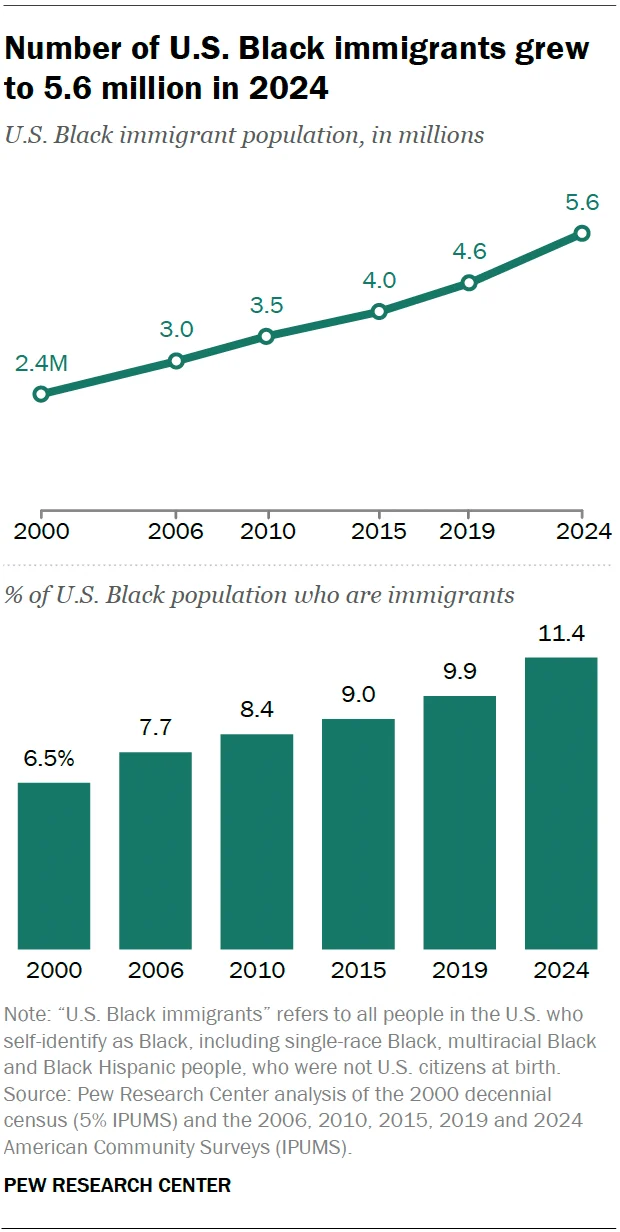
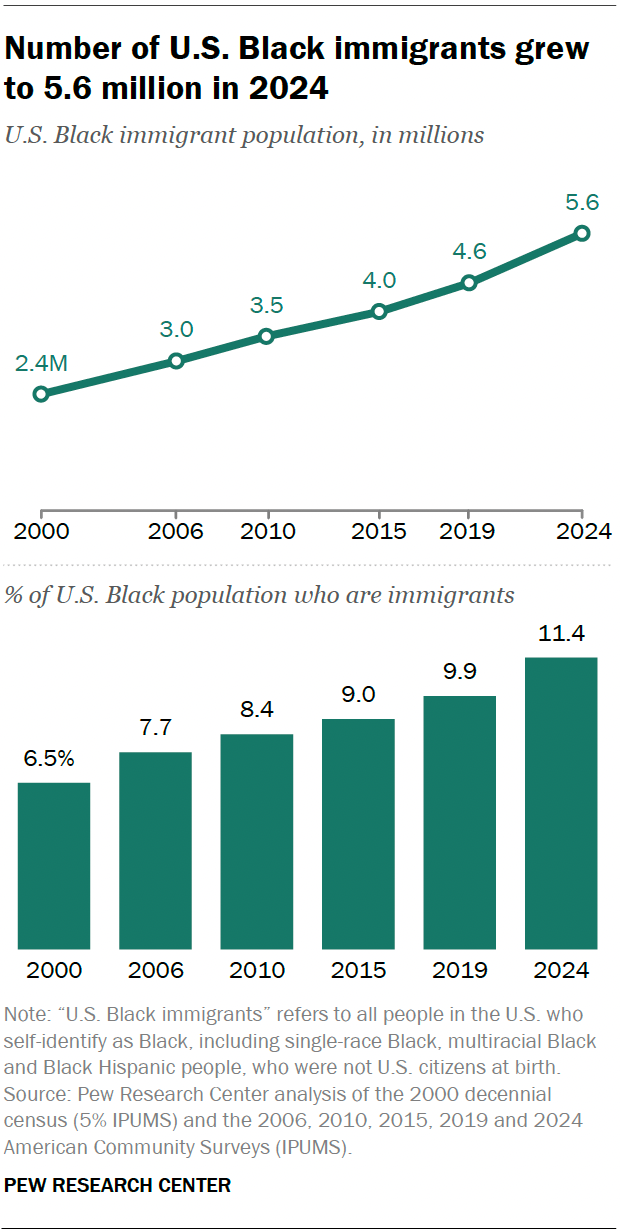
The Pew Research Center’s analysis of the U.S. Census Bureau’s 2024 American Community Survey reveals a dramatic expansion of the Black immigrant community. In 2000, there were approximately 2.4 million Black immigrants residing in the United States. By 2024, this number had surged to 5.6 million, more than doubling over a 24-year period. This significant growth accounted for roughly a quarter of the overall increase in the U.S. Black population during the same timeframe, which saw a total rise of 13 million individuals.
Currently, Black immigrants represent 11.4% of the total Black population in the U.S. and also constitute 11.2% of the nation’s entire immigrant population. This highlights their substantial presence and integration within both the Black community and the broader immigrant community. Further analysis, drawing on the 2025 Current Population Survey, indicates that a quarter of all Black Americans are either immigrants themselves or are U.S.-born individuals with at least one immigrant parent. This figure is comparable to the share among White Americans (24%), though it is considerably lower than that of Hispanic (66%) or Asian Americans (86%).
African-Born Immigrants Leading the Growth
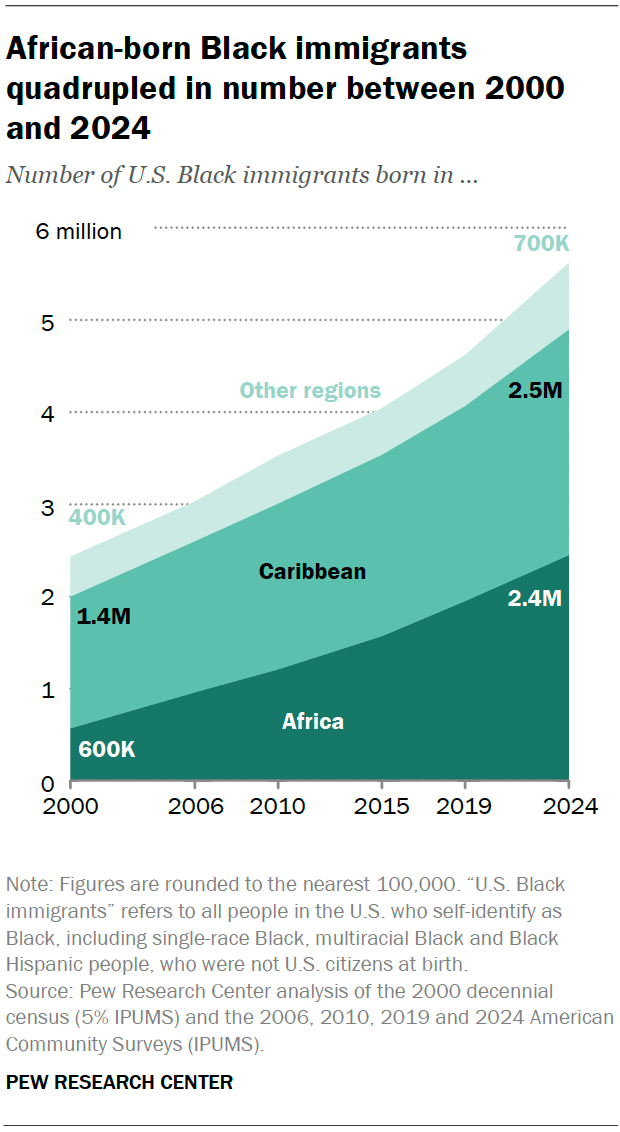
A significant driver of this demographic expansion has been the rapid growth of African-born Black immigrants. Between 2000 and 2024, their numbers quadrupled, increasing from approximately 600,000 to 2.4 million. This surge means that African-born immigrants now comprise 44% of all Black immigrants in the U.S., a substantial increase from their 24% share in 2000. This growth is nearly mirrored by the proportion of Black immigrants born in the Caribbean, which also stands at 44%, representing 2.5 million individuals.
The top countries of origin for Black immigrants in the U.S. are Jamaica, Haiti, and Nigeria. Together, these three nations accounted for four in ten Black immigrants in 2024. A broader look at the top 10 birthplaces reveals a strong concentration in Africa and the Caribbean, with immigrants from these regions making up 64% of all Black immigrants in the U.S. in 2024. This demographic concentration underscores the deep historical and cultural ties that continue to connect these regions with the United States.
Immigration Trends and Policy Implications
The context for this growth is set against a backdrop of shifting immigration patterns in the U.S. In 2025, the nation experienced its first overall decline in the immigrant population in 50 years. The precise impact of recent federal immigration actions on the Black immigrant population specifically remains to be seen. Measures such as the termination or proposed termination of temporary deportation protections for individuals from several countries, alongside the pausing of diversity visa issuances, could have multifaceted effects. These policies, while broadly aimed at managing immigration flows, carry the potential to influence the size and composition of various immigrant groups, including Black immigrants from affected regions. Understanding these potential ramifications is crucial for policymakers and community stakeholders alike.
Geographic Distribution and Settlement Patterns
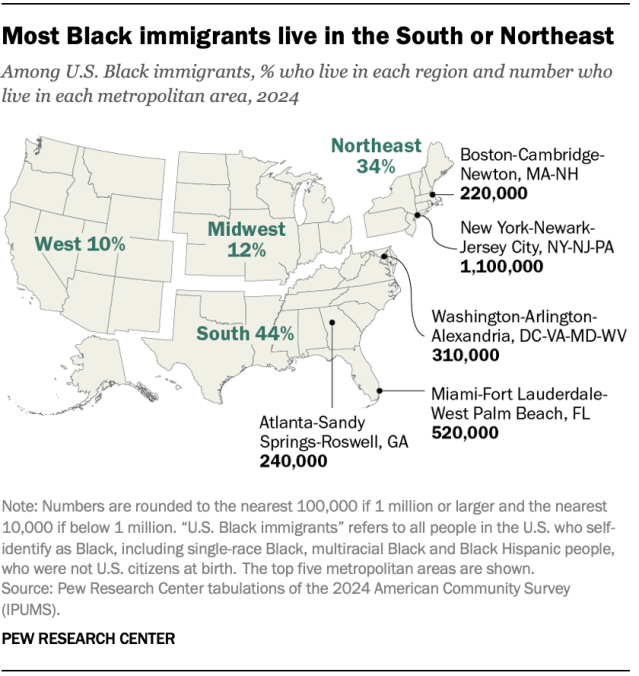
New York City continues to be the primary hub for Black immigrants, hosting approximately 1.1 million in 2024. The Miami metropolitan area follows with the second-largest Black immigrant population at 520,000, followed by Washington, D.C., with 310,000. Other significant metropolitan areas attracting Black immigrants include Atlanta, Boston, Houston, and Dallas.
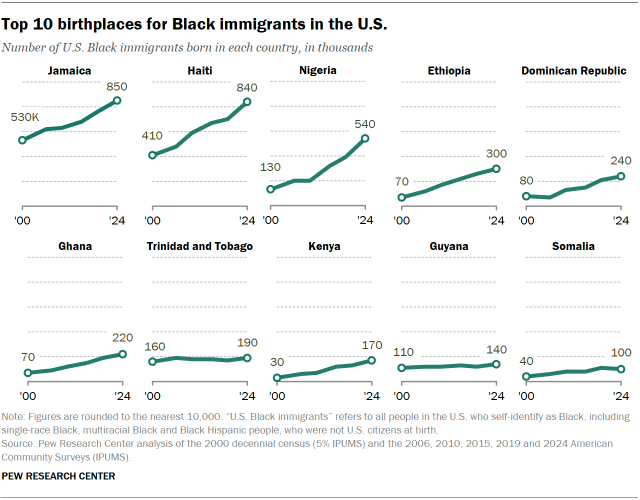
Within these metropolitan areas, specific settlement patterns emerge. For instance, a substantial portion of immigrants from Jamaica reside in the New York metropolitan area (43%), while a significant number of Haitian immigrants are concentrated in the Miami area (41%). Similarly, Nigerian immigrants are predominantly found in the Houston metropolitan area (25%). These localized concentrations highlight the role of established community networks and existing diaspora populations in attracting new arrivals.
Regionally, the South (44%) and the Northeast (34%) are home to the largest proportions of Black immigrants. The Midwest and the West account for 12% and 10%, respectively. This distribution reflects historical migration patterns and the economic and social opportunities available in these regions.
Legal Status and Citizenship
In 2023, an estimated 79% of Black immigrants were in the U.S. legally, while 21% were unauthorized. This proportion of unauthorized individuals among Black immigrants is notably lower than the overall unauthorized immigrant population in the U.S., which stood at 27% during the same period. Despite the overall increase in the unauthorized immigrant population reaching a record high in 2023, the share of unauthorized Black immigrants remained below the national average.
A majority of Black immigrants are naturalized U.S. citizens, with 61% having achieved this status by 2024. This figure represents a significant increase from 44% in 2000, indicating a strong trend towards integration and civic participation. This naturalization rate for Black immigrants is higher than that for all U.S. immigrants combined, where 51% are naturalized citizens. The rates of naturalization vary by region of origin, with higher proportions of those born in the Caribbean (64%), Africa (59%), and South America (55%) becoming citizens. Immigrants from Central America and Mexico, while also integrating, have a lower naturalization rate of 43%.
Educational Attainment and Language Proficiency
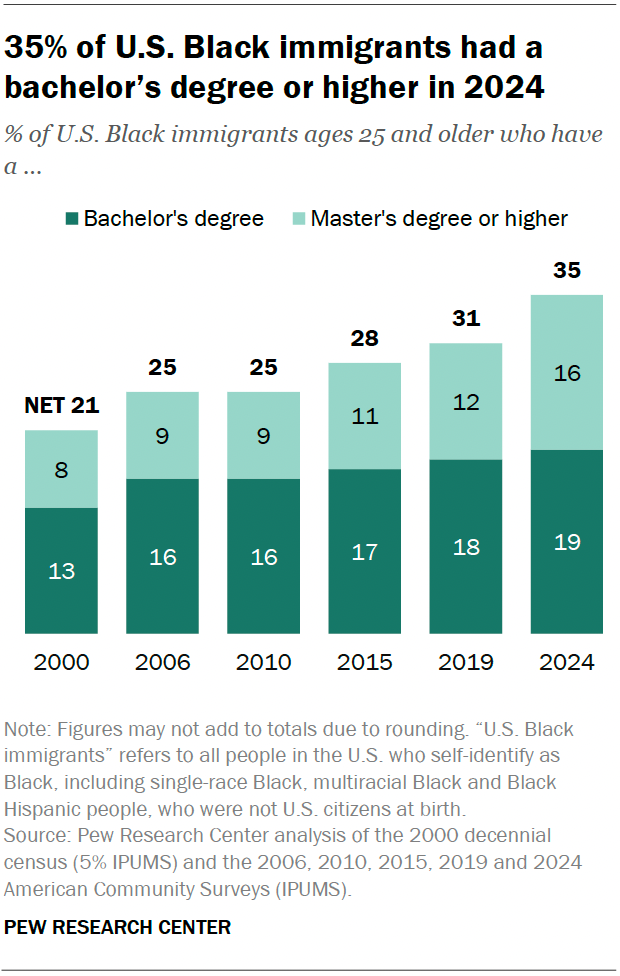
The educational profile of Black immigrants is also evolving. In 2024, 35% of Black immigrants aged 25 and older held a bachelor’s degree or higher, a notable increase from 21% in 2000. This educational attainment is on par with that of immigrants overall (36%) but significantly higher than that of U.S.-born Black adults (26%). Educational outcomes vary considerably by country of origin, with Nigerian-born Black immigrants demonstrating the highest likelihood of holding a college degree (67%), while Mexican-born Black immigrants have a lower rate (13%).
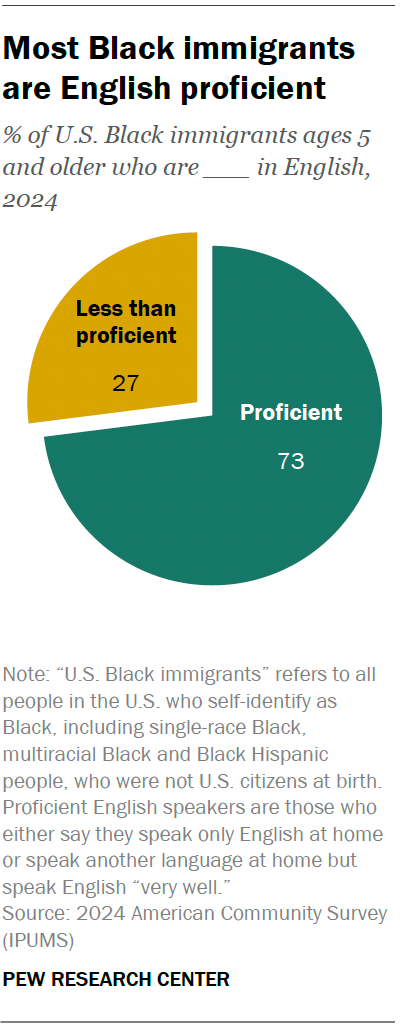
Regarding language, a substantial majority of Black immigrants aged 5 and older (73%) are proficient in English as of 2024. This means they either speak English exclusively at home or report speaking it "very well." While this is a slight decrease from 77% in 2000, Black immigrants remain significantly more likely to be English proficient than immigrants overall (53%).
Despite high English proficiency, it is common for Black immigrants to speak a non-English language at home. In 2024, 62% of Black immigrants aged 5 and older spoke a language other than English at home, while 38% spoke only English. Among the most frequently spoken non-English languages are Spanish, French, Portuguese, and various African languages such as Yoruba, Swahili, and Igbo. This linguistic diversity enriches the cultural tapestry of communities across the U.S.
A Deeper Look at the Data and Methodology
The Pew Research Center’s analysis relies on data from various federal sources, including the U.S. Census Bureau’s American Community Survey (ACS) and Current Population Survey (CPS). Data from the IPUMS from the University of Minnesota is utilized for its comprehensive demographic information. Specific years of the ACS, such as 2005 and 2020, were excluded from the analysis due to data collection issues or the exclusion of certain populations, ensuring the comparability and reliability of the findings.
The study defines racial groups to include individuals who self-identify with a given race alone or in combination with other races or Hispanic ethnicity. This means the Black population encompasses single-race Black, multiracial Black, and Black Hispanic individuals. Similarly, Hispanic is defined as individuals of any race. Immigrants are identified as U.S. residents born in foreign countries to non-U.S. citizen parents, while U.S.-born individuals are those born in the U.S. or its territories, or born abroad to U.S. citizen parents. The analysis is limited to countries of birth for which the ACS provides data.
Conclusion
The demographic narrative of the United States is undeniably being rewritten by the significant and growing presence of Black immigrants. Their increasing numbers, diverse origins, and contributions to the nation’s social, cultural, and economic fabric are profound. As federal immigration policies continue to evolve, understanding the specific dynamics and trajectories of Black immigrant populations will be crucial for fostering inclusive communities and informed policy development. The data presented underscores a community that is actively integrating, contributing, and enriching the broader American mosaic.