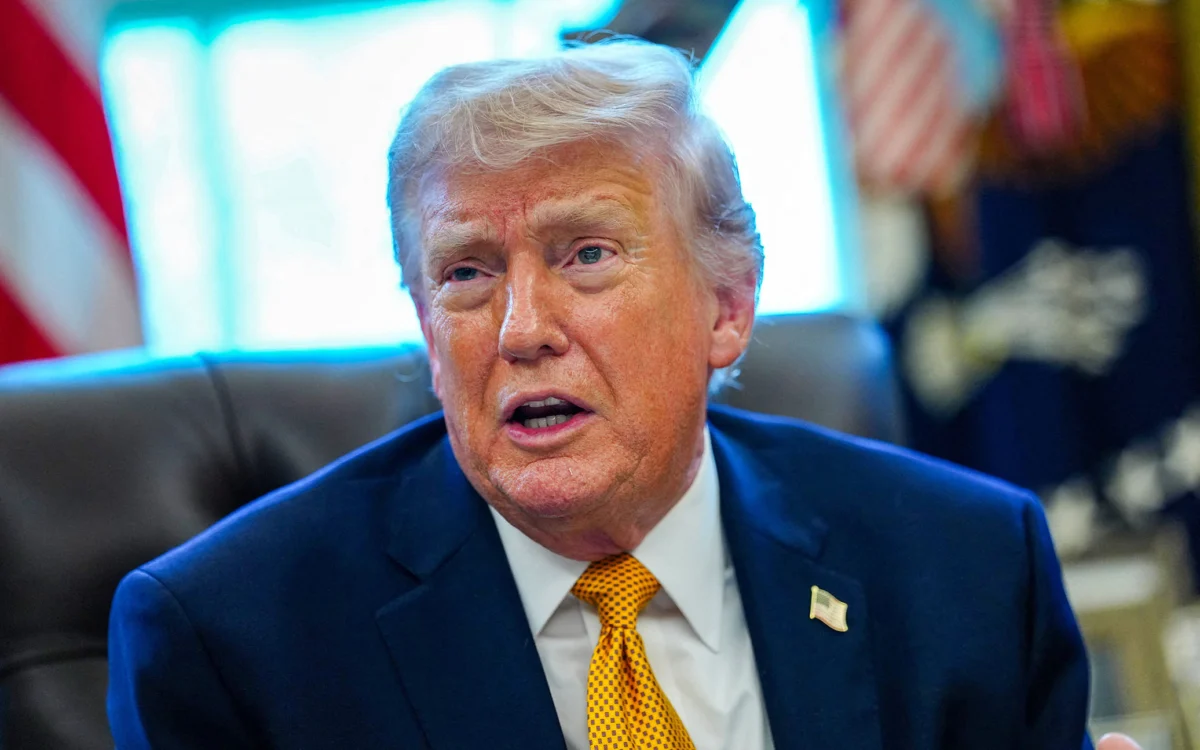
Former President Donald Trump has ignited a firestorm of criticism for his repeated assertions that individuals with learning disabilities should be barred from holding the office of President of the United States. These controversial statements, delivered in public remarks and interviews, have drawn sharp rebukes from disability advocacy groups, political commentators, and even from the target of his remarks, California Governor Gavin Newsom. The ensuing debate has reignited conversations about stigma, intelligence, and the qualifications necessary for the nation’s highest office.
Escalating Rhetoric in the Oval Office and Beyond
The most recent wave of Trump’s comments occurred on Monday when he addressed reporters in the Oval Office. His remarks were explicitly directed at Governor Gavin Newsom, a prominent Democrat and a potential contender for the presidency in 2028. Trump, who has consistently referred to Newsom by the derogatory nickname "Newscum," stated, "Honestly, I’m all for people with ‘learning disabilities,’ but not for my president. I don’t want, I think a president should not have ‘learning disabilities,’ okay?" He further characterized Newsom, who has openly discussed his dyslexia, as "low IQ" and declared, "Everything about him is dumb."
These declarations were not isolated incidents. Trump had previously voiced similar sentiments in an interview with Brian Kilmeade of Fox News the preceding week. In that exchange, he elaborated on his stance, saying, "He admitted he had learning disabilities. Somebody said, ‘Well, what’s wrong with that?’ I said, ‘That’s okay, but not for the president.’ President can’t have learning disability. If you have that, that’s ‘not a good thing.’"
Disability Advocacy Groups Denounce "Factually and Morally Incorrect" Statements
The National Center for Learning Disabilities (NCLD) was among the first and most vocal organizations to condemn Trump’s remarks. In a strong statement, the NCLD characterized the comments as "both factually and morally incorrect" and argued that they serve only to perpetuate harmful stereotypes. The organization emphasized that while learning disabilities affect how an individual’s brain processes information, they are in no way an indicator of a person’s intelligence, judgment, or inherent capacity to lead.
Jackie Rodriguez, CEO of the NCLD, highlighted the historical success of individuals with learning disabilities in various professional fields, including public service. "In fact, people with learning disabilities have risen to the upper echelon of every public office in the United States, including former presidents," Rodriguez stated. This assertion directly challenges Trump’s premise that such disabilities preclude someone from the presidency.
Rodriguez also underscored the broader, detrimental impact of Trump’s pronouncements on individuals living with learning disabilities. "For decades, students with learning disabilities have been told, directly or indirectly, that they should lower their expectations about what they can achieve," she explained. "Many people still do not disclose a learning disability due to fear of negative reactions, such as the ones made by the president today. They perpetuate the very same stigma that families, educators, and advocates have been working tirelessly to dismantle."
A Pattern of Attacks and Counterattacks
The verbal sparring between Donald Trump and Gavin Newsom is a well-documented aspect of the current political landscape. Trump’s latest comments represent an escalation in this ongoing feud, leveraging Newsom’s openness about his dyslexia as a political weapon. Newsom’s press office responded swiftly to Trump’s Oval Office remarks, posting on the social media platform X (formerly Twitter) that "the media needs to start reporting on Donald Trump’s mental decline." In a separate post, Newsom directly addressed the issue of learning disabilities and presidential fitness, suggesting that a "dyslexic president instead of a brain-dead one" would represent a "big upgrade."
This exchange illustrates a pattern where political opponents attempt to discredit each other by questioning their cognitive abilities and fitness for office. However, Trump’s specific focus on learning disabilities as an automatic disqualifier has drawn particular ire due to its perceived ignorance and discriminatory nature.
Understanding Learning Disabilities: Beyond Stereotypes
Learning disabilities are neurological conditions that affect how the brain receives, processes, and responds to information. They are not indicative of intellectual capacity, and individuals with learning disabilities possess a wide range of cognitive abilities, from average to gifted. Common learning disabilities include dyslexia (difficulty with reading), dysgraphia (difficulty with writing), and dyscalculia (difficulty with mathematics).
The prevalence of learning disabilities in the United States is significant. According to the National Center for Learning Disabilities, approximately 1 in 5 children in the U.S. have learning and attention issues. This means that a substantial portion of the population, including many successful and capable individuals, may identify as having a learning disability.
The idea that someone with a learning disability cannot be a leader is not only factually inaccurate but also deeply harmful. History is replete with examples of highly successful individuals who have navigated learning disabilities to achieve greatness in various fields, including politics, business, arts, and sciences. For instance, historical figures like Albert Einstein and Leonardo da Vinci are often cited as individuals who may have exhibited traits consistent with learning disabilities, yet their contributions to human knowledge and culture are immeasurable. In more recent times, numerous business leaders, scientists, and public figures have spoken openly about their learning disabilities and their successful careers.
The Broader Implications of Trump’s Statements
Trump’s repeated statements carry significant implications beyond the immediate political context:
- Stigmatization: By framing learning disabilities as a disqualifier for the presidency, Trump actively contributes to the stigmatization of millions of Americans. This can lead to increased discrimination, reduced self-esteem, and a reluctance to seek help or accommodations for those affected.
- Misinformation: His comments promote a fundamental misunderstanding of learning disabilities, equating them with a lack of intelligence or capability. This misinformation can have a ripple effect, influencing public perception and educational policies.
- Political Strategy: The strategy of using a potential opponent’s disability as a point of attack is a contentious one. While political attacks are common, targeting a specific disability raises ethical questions and can alienate segments of the electorate, particularly those with direct experience with learning challenges.
- Focus on Superficial Qualities: Trump’s emphasis on a perceived cognitive "defect" distracts from a more substantive evaluation of a candidate’s policies, experience, and vision for the country.
Reactions from the Political Sphere
While specific responses from other prominent political figures have been less immediate, the widespread condemnation from advocacy groups suggests a broader unease within the political establishment regarding Trump’s rhetoric. Typically, such controversial statements by a leading political figure often elicit responses from both sides of the aisle, either in direct support or strong opposition. The silence from some quarters might reflect a strategic decision to avoid engaging with the controversy or a tacit acknowledgment of the divisive nature of the topic. However, the forceful denunciation by the NCLD and the direct counter-attack from Newsom’s office indicate that this issue is far from being dismissed.
The Road Ahead: Challenging Stigma and Promoting Understanding
The controversy surrounding Donald Trump’s remarks highlights the persistent challenges faced by individuals with learning disabilities in a society that often misunderstands and stigmatizes them. The NCLD’s assertion that people with learning disabilities have achieved success at the highest levels of American life serves as a powerful counter-narrative to Trump’s exclusionary pronouncements.
As the political discourse continues, the focus is likely to remain on the broader societal implications of such statements. Advocates will likely redouble their efforts to educate the public, challenge misconceptions, and promote a more inclusive understanding of intelligence and capability. The debate underscores the critical need for accurate information and empathy when discussing disabilities, particularly in the context of public leadership. The qualifications for the presidency should, as many argue, be based on a candidate’s ability to govern, their policies, and their vision for the nation, rather than on unsubstantiated fears or prejudiced views about neurological differences. The ongoing discussion serves as a stark reminder of the work that still needs to be done to dismantle the pervasive stigma associated with learning disabilities.