
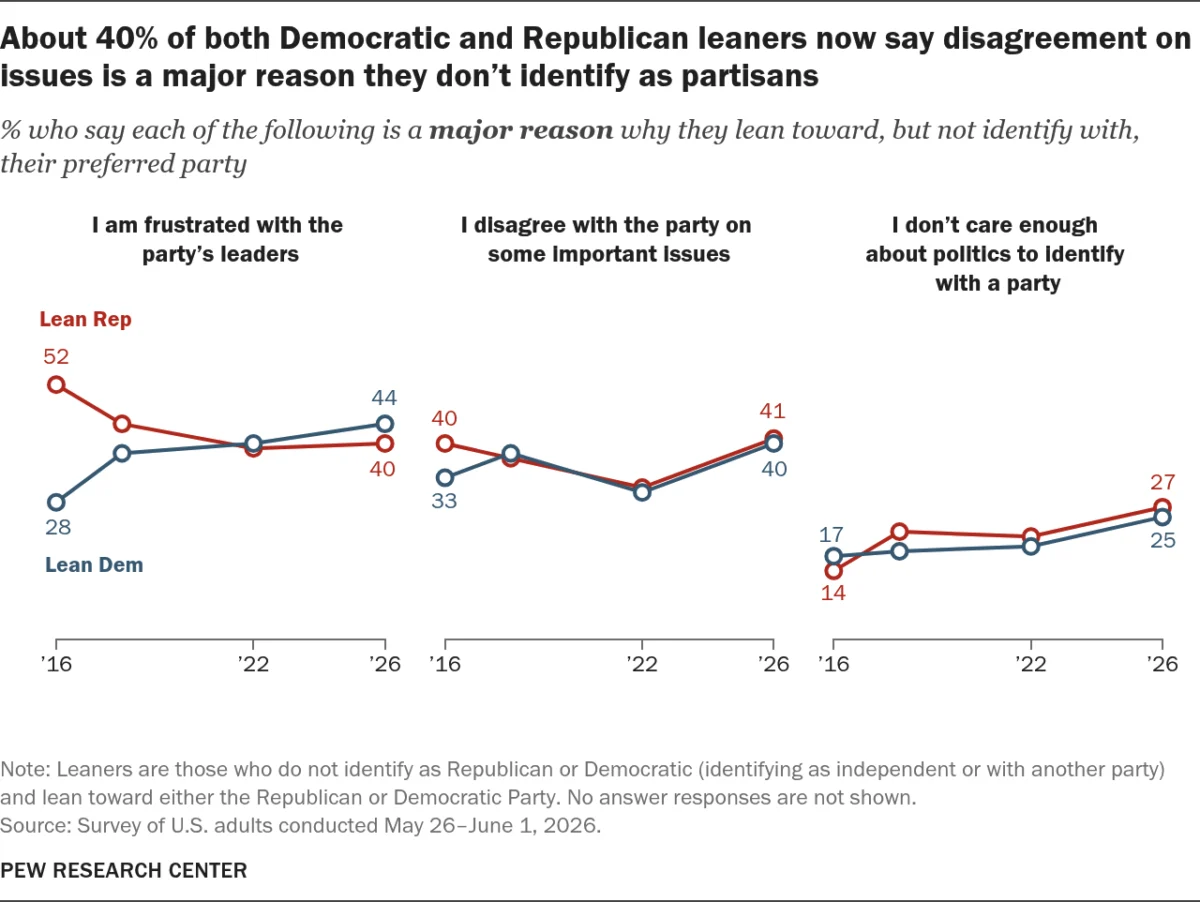
In the complex tapestry of American political identity, the binary division between Republicans and Democrats remains the dominant feature, yet it is increasingly nuanced by the motivations of the electorate. A comprehensive study conducted by the Pew Research Center, surveying 9,750 U.S. adults between May 26 and June 1, 2026, reveals that the engine driving party affiliation—and the decision to remain on the periphery as a "leaner"—is rooted less in unified ideological agreement and more in a reactive opposition to the perceived dangers of the opposing political camp.
For the majority of Americans who identify firmly as partisans, the impetus for their affiliation is twofold: a belief in the efficacy of their own party’s platform combined with a deep-seated conviction that the opposition’s agenda is actively harmful to the country. However, the dynamics shift significantly when observing the growing cohort of independent "leaners"—individuals who eschew a formal party label but consistently align with one side of the aisle. For these voters, political identity is defined predominantly by what they are against rather than what they are for.
The Anatomy of Partisan Identification
The data suggests that among dedicated partisans, the internal logic of identity is balanced. Approximately 72% of self-identified Republicans and 67% of Democrats cite their own party’s policy successes as a major reason for their support. This sense of pride is mirrored by a defensive stance: 73% of Republicans and 75% of Democrats believe the policies proposed by the other side constitute a genuine threat to the nation.
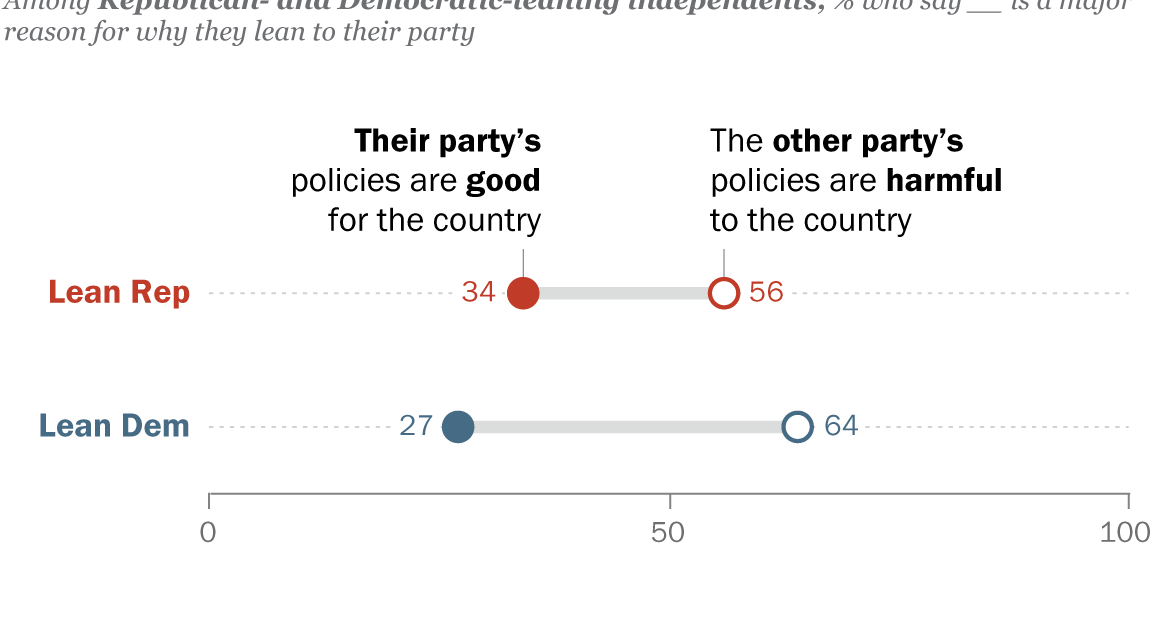
This alignment of positive self-affirmation and negative partisanship has remained relatively stable since 2022. However, a notable shift has occurred within the Democratic base. The percentage of Democrats who identify the harm of Republican policies as a primary driver of their political identity has climbed from 68% in 2022 to 75% in the current 2026 findings. This suggests an intensifying sense of urgency among Democratic voters regarding the perceived risks of GOP governance.
The Leaner Paradox: Motivation Through Opposition
"Leaners" occupy a unique and increasingly significant space in American politics. These individuals do not claim the title of Republican or Democrat, yet they lean toward one of the two major parties. The research highlights a stark reality: these voters are not "moderate" in the sense of being equidistant from both parties. Instead, their "lean" is a pragmatic, often reluctant, choice driven by antipathy toward the alternative.
Among Republican leaners, 56% cite the perceived harm of Democratic policies as a major factor in their preference, compared to only 34% who feel their own party’s policies are beneficial. The disparity is even more pronounced among Democratic leaners, where 64% point to the dangers of Republican policy as their main driver, while only 27% focus on the merits of the Democratic platform. This suggests that for a large segment of the American electorate, the voting booth is less a place for expressing support for an ideal and more a mechanism for checking the influence of a party they fear.
Chronology of Disenchantment: A Growing Divide
To understand how these motivations have evolved, one must look at the longitudinal data provided by the American Trends Panel. Over the past decade, the reasons leaners cite for refusing to fully join a party have shifted, indicating a growing frustration with the establishment.
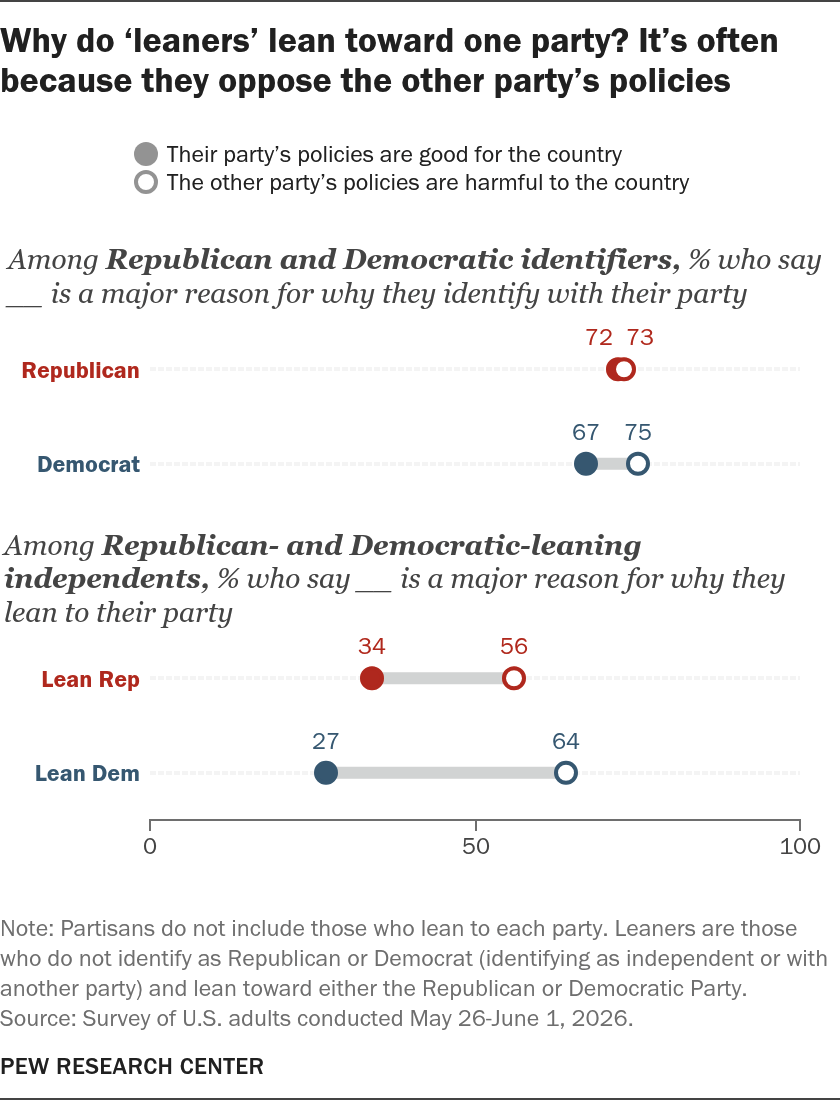
In 2016, 40% of Republican leaners pointed to disagreement on specific issues as a major reason for their independence. That number dipped in 2022 to 31% but has rebounded to 41% in 2026. Similarly, Democratic leaners have seen a consistent rise in policy-based disagreement, moving from 33% in 2016 to 40% in 2026.
Leadership frustration serves as another critical indicator of the distance between voters and parties. Currently, 44% of Democratic leaners express that frustration with party leadership is a major reason they avoid full affiliation. This is a significant climb from the 28% who felt similarly in 2016. While Republican leaners report a similar level of frustration (40%), the trend line for the GOP has been more volatile, peaking at 52% in 2016 before settling into the current range.
Contextualizing the Independent Voter
The term "independent" often masks a wide variety of political behaviors. Historically, political science research has categorized independents as either "leaners" or "pure independents." The Pew analysis confirms that leaners behave much like partisans in their electoral choices, even if they reject the formal label. They are effectively part of the party’s base, even if they are critical members of it.
The 2019 Pew report on political independents underscored that these individuals share more in common with their respective lean-party than they do with the opposing side’s leaners. This recent 2026 data confirms that this is not merely a matter of cultural affinity, but a shared tactical concern regarding the opposition. The "leaner" is often a voter who feels alienated from the party’s leadership or specific ideological planks but finds the prospect of the opposing party’s victory too unpalatable to remain neutral.

Political Implications and Strategic Realities
The finding that opposition to the "other side" serves as a primary motivator has profound implications for electoral strategy. For both the Republican and Democratic parties, this data suggests that negative campaigning—emphasizing the flaws and dangers of the opponent—is likely to be more effective at mobilizing the "leaner" demographic than positive policy-based outreach.
Political consultants and party strategists often weigh the "enthusiasm gap" against "turnout through fear." With large swaths of both partisan and non-partisan voters identifying the harm of the opposing party as their primary motivator, the incentive structure for political candidates tilts toward polarization. If voters are primarily voting to prevent the "other side" from gaining power, the common ground between the two parties becomes increasingly difficult to cultivate.
Furthermore, the rising tide of "disagreement on issues" among leaners indicates that the two major parties are struggling to maintain a cohesive ideological tent. As both parties grapple with internal factions—ranging from populist movements to institutionalists—the voters who theoretically form the backbone of the party are finding it harder to sign off on the full platform. This creates a volatile electoral environment where a party’s base is both loyal in practice and critical in theory.
Methodology and Data Integrity
This analysis is derived from a robust sample of 9,750 U.S. adults, providing a high degree of statistical confidence. The American Trends Panel, a nationally representative group, ensures that these views are not merely reflective of a specific region or demographic but capture the national sentiment. By analyzing responses alongside the 2016, 2018, and 2022 datasets, the research provides a clear, fact-based trajectory of the American political psyche.

The survey instruments—ranging from questions about party identification to specific policy grievances—offer a window into the "why" behind the "who." As the 2026 political calendar progresses, these figures serve as a baseline for understanding how the electorate will engage with the issues of the day. The data does not offer an opinion on the policies themselves, but it does offer an empirical assessment of how those policies are perceived by a public that is increasingly motivated by what they seek to avoid.
Future Outlook
As the American political landscape moves toward future election cycles, the role of the "leaner" will likely remain a decisive factor. If these voters continue to feel frustrated with both leadership and specific policies, the parties may face an ongoing struggle to transition these individuals into formal party members.
For now, the message from the American public is clear: while party loyalty remains strong for many, a significant portion of the electorate is engaged in a defensive crouch. They are defining their political existence by the threats they perceive from the opposition, a trend that appears to be strengthening rather than dissipating. Whether the parties can bridge this gap by addressing the concerns of these "leaners," or whether they will continue to rely on negative partisanship as their primary tool for engagement, remains one of the most significant questions facing the U.S. political system today. The data from 2026 suggests that, for the moment, the path of least resistance for both parties is to lean into the divide.




