
India has achieved monumental strides in public health over the past two decades, drastically cutting infant mortality rates and scaling up universal immunization programs. Yet, as national vaccination coverage expands, health authorities face a stubborn and complex final frontier: identifying and immunizing zero-dose children—those who have never received even their first routine injection of the diphtheria, tetanus, and pertussis (DTP1) vaccine. While national averages continue to improve, granular data reveals that these unreached populations are increasingly concentrated in specific pockets, particularly within rapidly growing urban slums and marginalized rural-urban borderlands. Addressing this challenge requires moving beyond broad, top-down awareness campaigns toward hyper-local, empathetic, and adaptable problem-solving models.
In the densely populated states of Bihar and Uttar Pradesh, health organizations and local administrators have embraced a paradigm shift. By deploying a dynamic Learning by Doing approach that merges human-centred design (HCD) with continuous real-time iteration, public health teams are working directly with urban communities to dismantle the invisible barriers keeping vulnerable children from receiving life-saving vaccines.
The Magnitude of the Challenge: Understanding Zero-Dose Realities in Northern India
To grasp the significance of the interventions in Bihar and Uttar Pradesh, one must examine the broader epidemiological landscape of India’s immunization framework. Historically, remote rural geographies posed the primary obstacle to vaccine delivery due to difficult terrain and a lack of cold-chain infrastructure. However, rapid urbanization has birthed a new demographic of vulnerable children: those living in informal urban settlements, construction sites, and transient migrant communities.
In states like Bihar and Uttar Pradesh—home to hundreds of millions of citizens—urbanization has outpaced municipal health infrastructure. Caregivers in these areas are often daily-wage laborers, domestic workers, or seasonal migrants whose precarious living conditions make routine clinic visits nearly impossible. Furthermore, social stratification, misinformation, administrative blind spots, and fear of lost daily wages create deep chasms between public health facilities and the communities they are mandated to serve.
Public health experts note that the reasons a child remains unvaccinated are rarely monolithic. In one neighborhood, fear of vaccine side effects and subsequent lost wages may drive hesitancy. In an adjoining settlement, the issue might be structural: clinics operating only during hours when working parents are absent, or health workers lacking accurate mapping of newly formed migrant clusters. Recognizing that a one-size-fits-all strategy cannot resolve these diverse hurdles, implementers turned to a localized, co-creative framework.
The 3D Framework: Define, Design, and Deliver
At the core of the recent initiatives in Bihar and Uttar Pradesh is a structured methodology known as the 3D approach: Define, Design, and Deliver. Rather than imposing external solutions, this framework places caregivers, frontline health workers (such as Accredited Social Health Activists or ASHAs and Auxiliary Nurse Midwives or ANMs), and municipal government stakeholders at the center of the problem-solving process.
Phase 1: Define
The first phase focuses on radical empathy and deep listening. Instead of relying solely on quantitative surveys, public health practitioners utilized human-centred design tools—including ethnographic interviews, journey mapping, and immersive observational studies—to shadow families in urban pockets. By engaging directly with mothers, fathers, and local leaders, teams uncovered the nuanced, everyday realities that prevent vaccination. They mapped not just physical distances to health centers, but psychological and operational barriers, such as humiliating administrative hurdles at clinics or the sheer exhaustion of daily survival that pushes immunization down a parent’s priority list.
Phase 2: Design
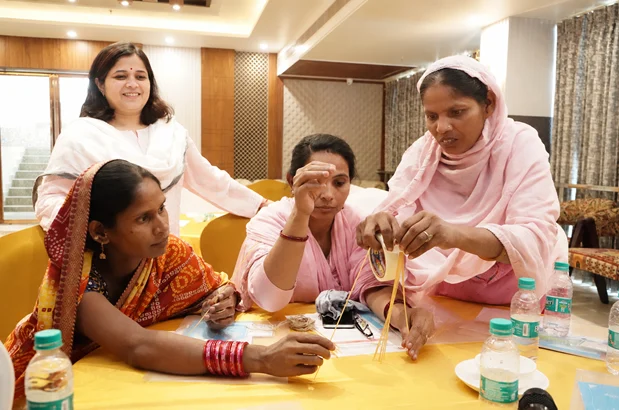
Armed with insights from the ground, the initiative moved to co-creation workshops. Caregivers, frontline workers, and local health officials sat together to brainstorm, prototype, and test potential interventions. This participatory design phase ensured that any proposed solution was practical, culturally resonant, and respectful of the community’s time and dignity. Solutions ranged from flexible evening immunization camps tailored to working hours to simplified communication collateral designed to demystify vaccine side effects.
Phase 3: Deliver
The final phase operationalized these co-created solutions through a cycle of continuous learning. Implementation was treated as an ongoing experiment rather than a rigid rollout. Teams monitored the uptake of services in real time, gathered immediate feedback from frontline workers, and rapidly adapted strategies that fell short of expectations. If a newly introduced weekend outreach post saw low turnout, field teams immediately investigated why, adjusting timings or mobilizing community influencers within days rather than months.
Chronology of the Urban Immunization Push
The integration of human-centred design into Bihar and Uttar Pradesh’s public health apparatus represents the culmination of years of targeted immunization reforms in India.
- 2014–2018 (Intensified Mission Indradhanush Launch): Following early realizations that routine immunization progress was plateauing, the Government of India launched Mission Indradhanush, later intensified (IMI), to rapidly reach unvaccinated and partially vaccinated children in high-risk districts. While IMI successfully vaccinated millions, urban vulnerabilities persisted, highlighting the need for specialized urban strategies.
- 2020–2021 (Pandemic Disruption and Resilience): The COVID-19 pandemic severely disrupted routine immunization services worldwide, threatening to reverse hard-won gains in zero-dose reduction. In northern India, health systems faced unprecedented strain, yet the crisis also accelerated the need for agile, community-embedded health delivery models that could rebuild trust and resilience.
- 2022–2023 (Pilot Deployments of HCD in Northern India): Public health agencies began introducing human-centred design frameworks in select urban blocks of Bihar and Uttar Pradesh. Recognizing that traditional awareness drives were hitting diminishing returns, pilot projects focused on qualitative barrier mapping and localized solution prototyping.
- 2024 and Beyond (Scaling Localized Problem-Solving): Building on early successes, the Learning by Doing approach transitioned from isolated pilots into broader operational frameworks. Health departments began institutionalizing feedback loops, ensuring that frontline workers are equipped not just with vaccines, but with problem-solving toolkits to engage hesitant or overlooked urban communities.
Voices from the Ground: Stakeholder Perspectives
While quantitative metrics capture broad trends, the human element of the Bihar and Uttar Pradesh initiatives is best understood through the perspectives of the key actors driving the change—frontline health workers and local administrators.
An Auxiliary Nurse Midwife (ANM) operating in a densely populated urban ward of Uttar Pradesh noted the transformation in community relations. "In the past, our job felt like an endless chase," she explained. "We would visit an area with vaccines, find that families had locked their homes or gone to work, and mark them as uncooperative. By sitting down with community elders and mothers during the design phase, we realized we were holding sessions at the exact time women were cooking and preparing for evening labor. Shifting our outreach camps to late afternoons changed everything. Parents now wait for us."
Local government health officials have similarly praised the shift toward decentralized problem-solving. A district health officer in Bihar emphasized that empowering frontline workers to iterate solutions is vital for administrative efficiency. "When you give ASHAs and local supervisors the permission to test new ideas and adapt based on daily realities, you remove the bureaucratic paralysis that often stalls public health delivery. The community stops seeing the health system as an outsider imposing rules, and starts seeing it as a collaborative partner."
Analytical Implications: Why Flexibility Matters for India’s Public Health Future
The operational success observed in Bihar and Uttar Pradesh carries profound implications for national and global health strategies aiming to achieve equity in immunization.
First, it underscores the limitation of macro-level awareness campaigns. In marginalized urban pockets, low immunization is rarely a result of total ignorance regarding vaccines. More often, it stems from a complex matrix of logistical barriers, opportunity costs, and localized distrust. Standardized posters or generalized television advertisements cannot address why a daily-wage earner cannot afford to lose four hours of wages to visit an overcrowded municipal hospital. By replacing generic awareness with targeted, human-centred problem solving, health programs successfully lower the friction of compliance.
Second, the Learning by Doing model highlights the indispensable value of frontline resilience. Frontline workers are the eyes and ears of the public health apparatus; when equipped with qualitative tools and institutional backing, they transition from passive vaccine administrators into active community diagnosticians. This not only improves vaccine coverage rates but strengthens overall primary health care systems, fostering institutional trust that can be leveraged for other health interventions, from nutrition programs to maternal health services.
Finally, as India presses forward toward its public health targets, the lessons from Bihar and Uttar Pradesh offer a scalable blueprint for other high-density, complex urban environments across the globe. Reaching the final percentage of zero-dose children requires an evolution in how health systems listen, learn, and adapt. By treating urban communities not as passive recipients of medical goods, but as active partners in the design of public health delivery, India is proving that the last mile, while difficult, is entirely navigable.




