As of October 2026, the United States remains embroiled in a military confrontation with Iran that has increasingly strained the American public’s confidence in the executive branch’s strategy. A comprehensive survey conducted by the Pew Research Center between September 28 and October 4, 2026, reveals that approximately two-thirds of the American electorate (65%) now disapprove of President Donald Trump’s management of the conflict. This marks a notable decline in public support since the inception of military operations earlier this year. With only 33% of the public expressing approval, the administration faces a widening gap in domestic consensus, particularly as the conflict shows little sign of reaching a swift resolution.
The survey, which sampled 5,062 U.S. adults, underscores a pervasive sense of skepticism regarding the administration’s stated objectives. A majority of respondents (52%) stated they are not at all or not too confident that the Trump administration will achieve its strategic goals in the region. Perhaps more telling is the public’s grim outlook on the timeline of the engagement; nearly half of all Americans (47%) believe the military action will last for at least another year, while only a small fraction (2%) anticipate the conflict concluding within the next month.
A Chronology of Escalation and Domestic Response
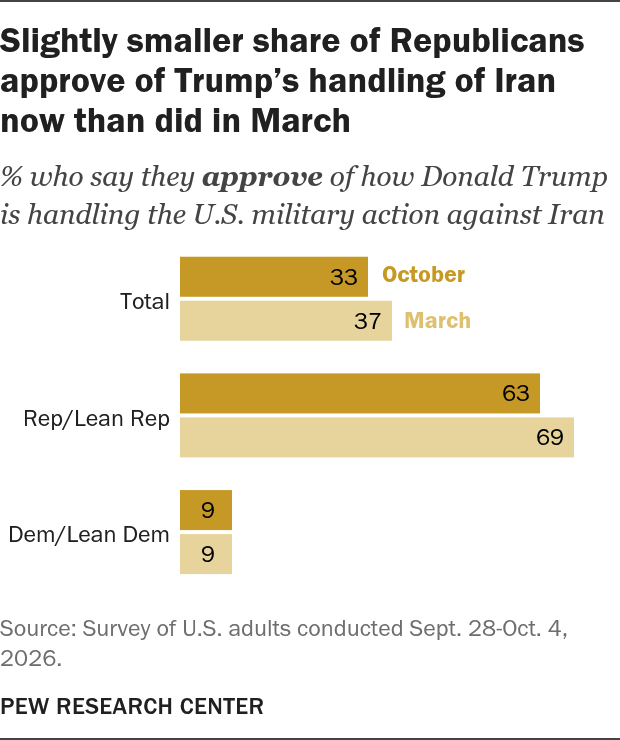
The current military posture in the Mediterranean and the broader Middle East is the result of a rapid deterioration in diplomatic relations that began in early 2026. The initial decision to authorize military force in March was met with immediate, though tempered, debate. At that time, 37% of Americans approved of the President’s handling of the situation, a figure that has since eroded to 33%.
The trajectory of public opinion suggests that the "rally around the flag" effect, which often accompanies the early stages of military conflict, has failed to sustain itself. Instead, as the operation has transitioned from a series of kinetic strikes to a sustained deployment, the political costs have become more apparent. The shift is particularly visible within the President’s own party. In March, 69% of Republicans and Republican-leaning independents expressed approval for his handling of the Iran conflict. By October, that number had dipped to 63%. While this remains a robust level of support compared to the near-unanimous disapproval from Democrats, the downward trend among the administration’s core base signals that the prolonged nature of the conflict is a source of concern even among those who initially favored a firm stance.
The Economic and Security Concerns of the American Public
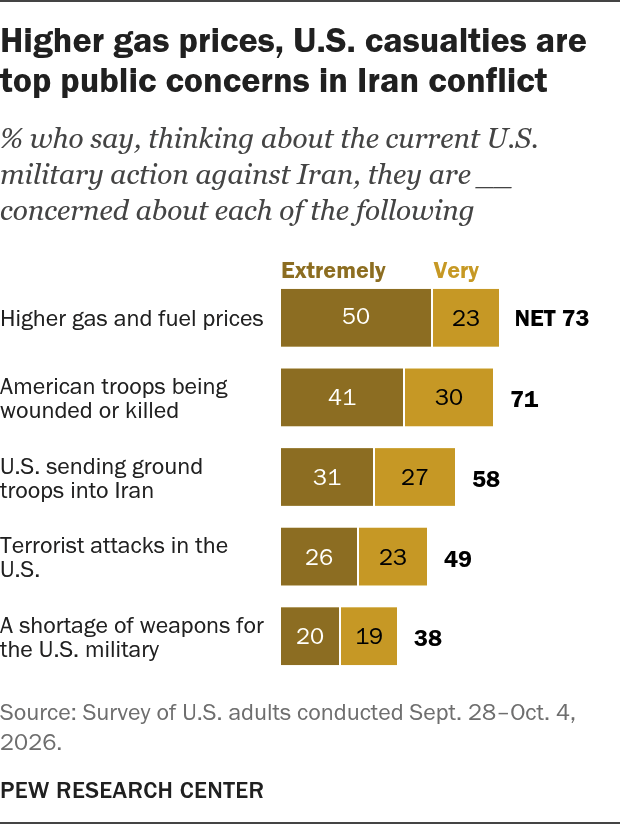
The survey data highlights a clear hierarchy of concerns among the public, with immediate economic and physical security issues topping the list. When asked about their primary anxieties regarding the conflict, 73% of Americans identified rising gas and fuel prices as a primary concern. This reflects a broader awareness of how geopolitical instability in the Persian Gulf directly impacts the American consumer’s wallet.
Close behind economic anxiety is the physical safety of service members. Approximately 71% of respondents expressed extreme or very high levels of concern regarding the potential for American troops to be wounded or killed in action. This figure remains a consistent, driving factor in public apprehension, reflecting a nation wary of the human cost of long-term interventions.
The fear of a broader, more costly engagement is also prevalent. Over half of the respondents (58%) indicated they are deeply concerned about the prospect of the United States sending ground troops into Iran. This particular concern highlights a clear partisan divide: 72% of Democrats are alarmed by the possibility of ground intervention, compared to 43% of Republicans. This divergence underscores how different political coalitions perceive the scope and risk of the current mission.
Partisan Perspectives and Shifting Priorities
While the general disapproval of the President’s strategy is widespread, the underlying reasons for that dissatisfaction vary significantly by party affiliation. Democrats have become increasingly vocal in their concerns, particularly regarding the economic fallout of the conflict. Since March, the percentage of Democrats reporting extreme or very high concern regarding fuel prices rose from 79% to 85%.
Furthermore, there is a growing apprehension among the Democratic base regarding the readiness of the U.S. military. The survey found that 45% of Democrats are now very or extremely concerned about potential weapon shortages, a sharp increase from 34% in the spring. This suggests that the administration’s critics are closely monitoring not just the political outcome, but the logistical sustainability of the ongoing military campaign.
Republicans, meanwhile, remain generally more supportive, yet they are not immune to the anxieties of a drawn-out conflict. While their disapproval of the President’s handling has remained relatively steady, their confidence in the initial decision to use force has shifted. In March, 71% of Republicans believed the use of force in Iran was the right decision. By October, that number had declined to 65%.
Broader Implications and Strategic Uncertainty
The persistence of the conflict, coupled with the rising costs of energy and the inherent risks of military escalation, has created a complex political landscape for the White House. The administration has frequently cited the necessity of these actions to maintain regional stability and deter threats to U.S. interests. However, the data suggests that these justifications have not been sufficient to assuage a public that is increasingly preoccupied with the domestic consequences of foreign policy.
The potential for further escalation remains a critical variable. Recent rhetoric from the President regarding the possibility of retaliatory strikes against U.S. cities has added a new layer of volatility to the public discourse. Although the Pew survey was conducted prior to these specific comments, the baseline of anxiety regarding domestic terrorist threats—which currently stands at 49%—is likely to be sensitive to any further inflammatory messaging.
From a geopolitical standpoint, the conflict has placed significant pressure on the U.S. military-industrial complex. With 38% of the total public expressing concern over weapons stockpiles, the government may face increasing scrutiny regarding the sustainability of its military supply chains. As the operation enters its next phase, the administration must navigate not only the tactical challenges in the Middle East but also the erosion of the domestic mandate required to sustain a long-term military project.
Conclusion: A Nation at a Crossroads
The findings from the September-October 2026 survey serve as a snapshot of a nation reflecting on the costs and potential outcomes of a modern, persistent conflict. The combination of high public disapproval, the expectation of a lengthy engagement, and the specific concerns regarding inflation and military casualties creates a challenging environment for leadership.
As the conflict approaches the one-year mark, the gap between the administration’s strategic goals and the public’s perception of those goals appears to be widening. Whether this trend will lead to a change in military policy or a renewed effort to communicate the strategic necessity of the engagement remains to be seen. What is clear, however, is that the American public is increasingly focused on the domestic ramifications of the Iran conflict, and their patience—and approval—is being tested by the realities of a conflict that shows few signs of coming to a close.
For policymakers, the data provides a clear warning: the longer the engagement persists, the more difficult it will be to maintain a unified public front. As the 2026 midterms and future policy cycles approach, the handling of the Iran situation will undoubtedly serve as a central pillar of the broader debate regarding the role of the United States in global affairs and the price that Americans are willing to pay for security abroad.