A recent comprehensive survey by the Pew Research Center reveals a significant and deepening public apprehension regarding President Donald Trump’s handling of critical foreign policy matters. Conducted between March 23rd and March 29th, 2026, the poll of 3,507 adults indicates that majorities of Americans hold little to no confidence in the President’s decision-making across a spectrum of international challenges, a sentiment particularly pronounced in the context of ongoing U.S. military actions against Iran, which commenced in February 2026.
The research, drawing from the robust American Trends Panel, underscores a growing national unease about the direction of U.S. foreign policy under the current administration. The survey delved into Americans’ perceptions of Trump’s capacity to navigate complex geopolitical landscapes, assessing confidence levels across twelve distinct foreign policy areas. These included bilateral relations with key global players, intricate trade negotiations, and the management of international military conflicts, with the U.S. engagement in Iran emerging as a focal point of concern.
Public Confidence Dips Across Key Foreign Policy Arenas
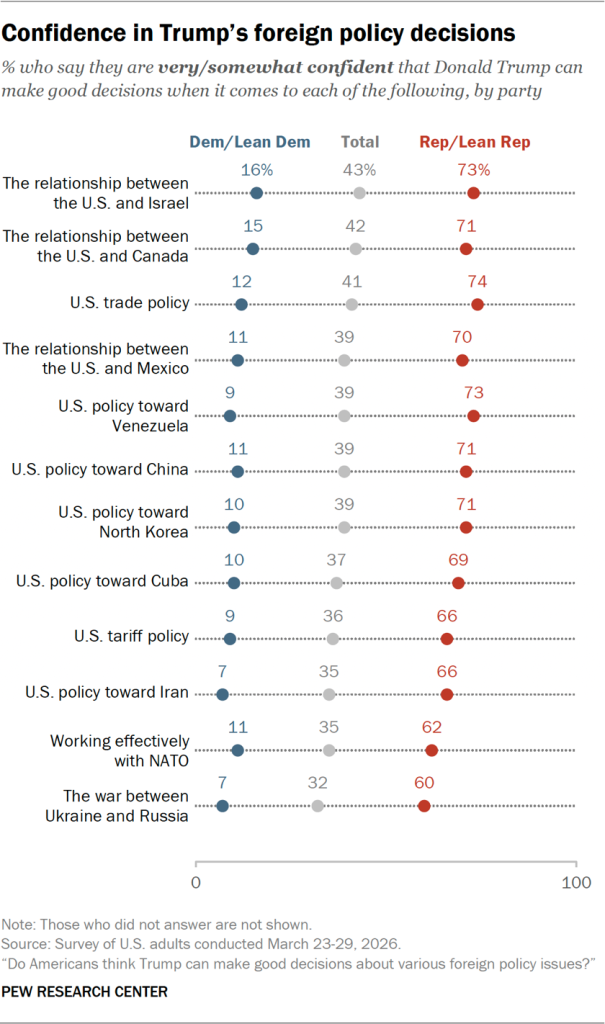
The findings indicate a pervasive lack of broad public trust in President Trump’s foreign policy acumen. No single issue surveyed garnered a majority of Americans expressing strong confidence. However, disparities were evident, with certain areas eliciting slightly more positive sentiment than others. For instance, 43% of respondents conveyed moderate to high confidence in Trump’s approach to U.S.-Israel relations. In stark contrast, confidence in his decision-making regarding the protracted Russia-Ukraine war was considerably lower, at just 32%.
These figures paint a picture of a nation divided and increasingly wary of the administration’s foreign policy initiatives. The Pew Research Center, a non-partisan fact tank dedicated to informing the public, media, and policymakers on important issues, has a long history of tracking public sentiment on matters of national security and international engagement. This latest report continues that tradition, offering a granular look at public opinion at a critical juncture in U.S. foreign relations.
Deep Partisan Divides Emerge in Confidence Levels
A defining characteristic of the survey results is the stark and persistent partisan divide in confidence levels. Republicans and those who lean Republican expressed significantly higher trust in President Trump’s foreign policy decision-making. Confidence within this demographic ranged from a high of 74% on trade policy to 60% concerning the Russia-Ukraine war.

Conversely, Democrats and those leaning Democratic exhibited substantially lower levels of confidence. Their highest point of trust, a mere 16%, was registered regarding Trump’s handling of U.S.-Israel relations. For more contentious issues like U.S. policy toward Iran and the Russia-Ukraine conflict, confidence among Democrats dwindled to as low as 7%. This chasm in perceptions highlights the deep ideological polarization shaping views on foreign policy, a trend that has been amplified in recent years.
Generational Gaps Within the Republican Electorate
Further segmentation of the data revealed generational differences within the Republican party itself. Republicans aged 50 and older consistently demonstrated higher confidence in President Trump’s foreign policy decisions compared to their younger counterparts (ages 18-49). This generational gap was particularly pronounced in assessments of U.S.-Israel relations, where older Republicans showed 27 percentage points more confidence than younger Republicans (87% versus 60%). This suggests that established political affiliations and potentially different life experiences may influence the perception of presidential leadership among different age cohorts within the same party.
Timeline of Confidence: A Downward Trajectory for Key Issues
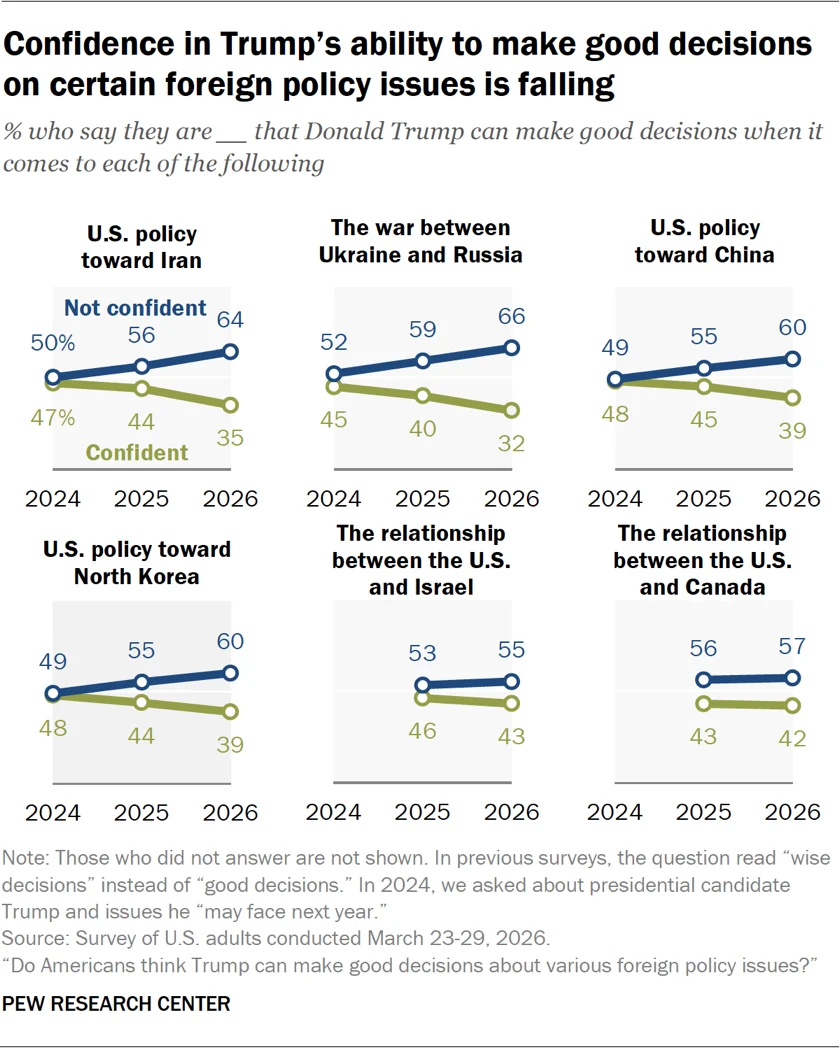
The survey also provided a temporal perspective, indicating a noticeable decline in public confidence on several foreign policy fronts over time. Confidence in President Trump’s handling of the Russia-Ukraine war, for example, has seen a significant dip. In 2024, during his second presidential campaign, 45% of Americans expressed confidence in his approach to this conflict. This figure receded to 40% in 2025 and has now fallen to 32% in the latest survey.
Similar downward trends were observed in public confidence regarding Trump’s policies toward Iran, China, and North Korea. While confidence in U.S. relations with Israel and Canada has remained relatively stable since 2025, assessments of his policy toward Venezuela have seen a decline, falling from 44% in January 2026 to 39% in the current survey. This pattern suggests a growing erosion of trust in the administration’s foreign policy effectiveness, particularly concerning regions and conflicts that have seen heightened tensions or prolonged engagement.
The Iran Context: A New Front in Foreign Policy Concerns
The timing of this survey is particularly significant, coinciding with the escalation of U.S. military action against Iran in February 2026. While the specific triggers and objectives of this military engagement are not detailed in the survey’s methodology, the report implicitly links public apprehension to this developing situation. The low confidence levels expressed by a significant portion of the American public regarding U.S. policy toward Iran underscore a potential domestic unease with the administration’s chosen course of action.
Historically, U.S. policy towards Iran has been a complex and often contentious issue, marked by periods of heightened tension, diplomatic standoffs, and intermittent military posturing. The current administration’s approach has often been characterized by a more assertive and confrontational stance, contrasting with previous efforts at engagement or de-escalation. The Pew Research Center’s findings suggest that this assertive approach, while perhaps favored by a segment of the population, is not widely embraced, particularly as it involves direct military action.
Broader Implications and Expert Analysis
The implications of these findings extend beyond mere polling numbers. A significant segment of the population expressing low confidence in foreign policy decision-making can create challenges for executive action and diplomatic initiatives. It can embolden critics, both domestically and internationally, and potentially weaken the administration’s leverage in negotiations or conflict resolution.
Dr. Evelyn Reed, a professor of International Relations at Georgetown University, commented on the survey’s findings, stating, "The Pew data reflects a palpable sense of uncertainty among the American public regarding the direction of foreign policy. In an era of complex global challenges, a lack of broad-based confidence can have a chilling effect on diplomatic efforts and could lead to greater domestic opposition to sustained international commitments. The stark partisan divides are also a cause for concern, suggesting that foreign policy decisions may become increasingly politicized, making consensus-building more difficult."
The survey’s methodology, which involved 3,507 adults from the American Trends Panel, ensures a representative sample of the U.S. adult population, lending significant weight to its conclusions. The detailed questionnaire, topline responses, and survey methodology are publicly available, allowing for further scrutiny and analysis by researchers and the public alike.
The Road Ahead: Navigating Public Opinion and Global Realities
As the United States navigates a dynamic and often volatile international landscape, the insights provided by the Pew Research Center offer a critical barometer of public sentiment. The growing skepticism towards President Trump’s foreign policy decisions, particularly in the shadow of ongoing military actions in Iran, suggests that the administration faces a significant challenge in building and maintaining public trust. The deep partisan rifts and generational divergences observed within the data further complicate the task of crafting and executing a cohesive and broadly supported foreign policy agenda.
The Pew Research Center’s commitment to providing objective data on these vital issues serves as an essential resource for understanding the complexities of American public opinion. The report’s findings will undoubtedly inform ongoing discussions about the nation’s role in the world and the leadership required to address the multifaceted challenges of the 21st century. The administration’s response to these trends, and its ability to bridge the divides in public confidence, will be a critical factor in shaping both domestic discourse and America’s standing on the global stage.