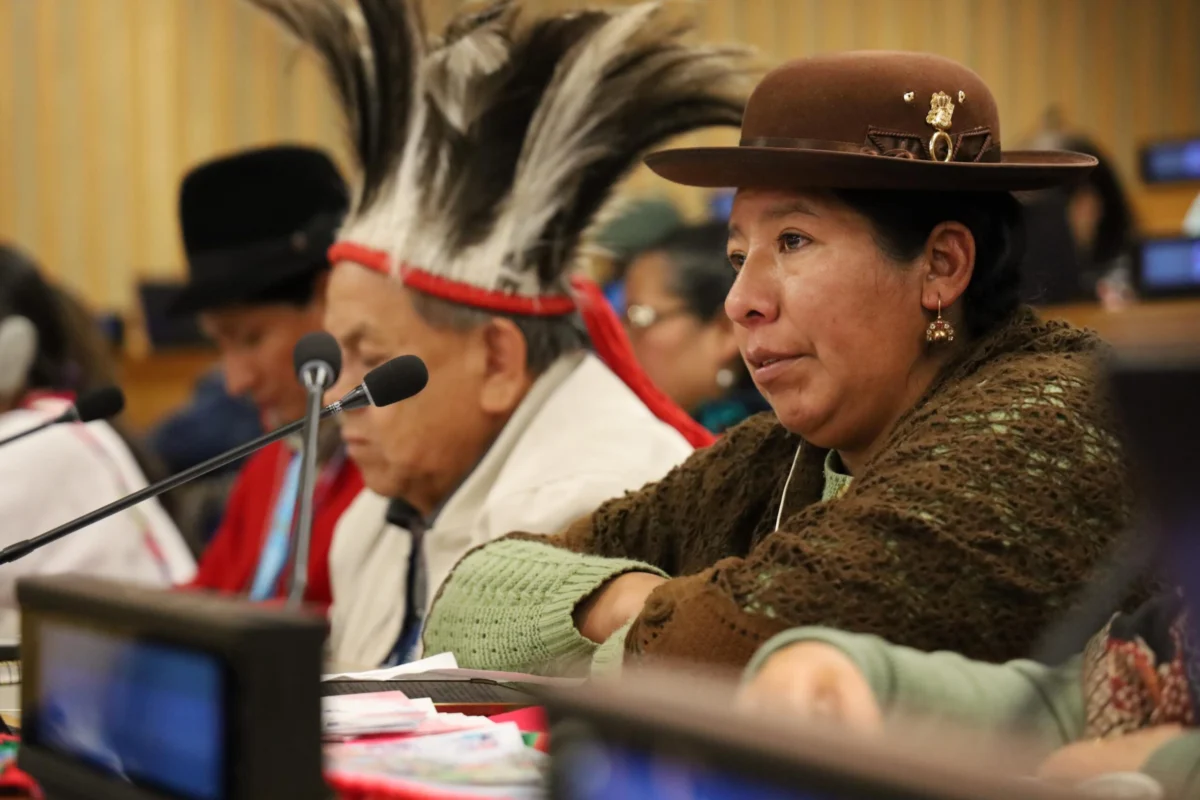
New York – April 21, 2026 – At the 25th session of the United Nations Permanent Forum on Indigenous Issues (UNPFII), Rosa Fátima Mamani Quispe, representing the Chimpu Warmi Network of Bolivia and a partner of Cultural Survival’s Indigenous Community Media Fund, delivered a powerful address on behalf of Bolivia’s indigenous peoples, particularly its women. Her statement highlighted the devastating environmental degradation impacting their ancestral territories, the tragic loss of vital water bodies like Lake Poopó, and the severe health consequences faced by indigenous communities due to unchecked mining activities. Quispe directly called upon the Bolivian government to uphold its commitments to indigenous rights and to implement policies that protect both the land and its people.
The Voices of Bolivia’s Indigenous Women at the UN
The 25th session of the UNPFII, held in New York, provided a crucial platform for indigenous representatives from around the globe to voice their concerns and advocate for their rights. This year’s theme, "Ensuring the health of Indigenous Peoples, including in the context of conflicts," resonated deeply with the experiences of indigenous communities in Bolivia. Quispe, a recognized advocate for indigenous women’s rights and environmental justice, articulated the profound connection between the health of Mother Earth, or Pachamama, and the well-being of indigenous peoples.
"I bring the message of the indigenous peoples—and particularly the indigenous women—of Bolivia, who are fighting to defend our territories, our living spaces, and our right to self-determination," Quispe stated, acknowledging the support from the International Work Group for Indigenous Affairs (IWGIA) that facilitated her participation. She emphasized that for indigenous women, the preservation of traditional knowledge, languages, governance systems, and life plans are intrinsically linked to the health of their territories. Their cultural practices, including textile weaving, are not merely artistic expressions but serve as a living repository of ancestral wisdom and a testament to their enduring connection to the land.
A Land Under Siege: Extractivism and the Erosion of Rights
Quispe’s address detailed the systematic violations of indigenous rights within Bolivia, despite the recognition afforded by the United Nations Declaration on the Rights of Indigenous Peoples (UNDRIP). She pointed to extractivist policies, fueled by both formal mining companies and informal operations, as a primary driver of this devastation. The intervention of state institutions, such as the National Institute for Agrarian Reform (INRA) and the Authority for the Oversight and Social Control of Forests and Land (ABT), was also cited for facilitating the encroachment of third parties into indigenous territories. These groups, historically referred to as "colonizers" and now termed "intercultural settlers," along with "mining cooperatives," are actively weakening indigenous autonomy, disrupting traditional ways of life, and fragmenting self-governance structures.
The use of highly toxic substances, particularly mercury in gold mining, was identified as a critical threat. This indiscriminate practice has led to widespread contamination of rivers, destruction of ecosystems, and the impoverishment of indigenous lands. The health implications for indigenous communities are dire, with Quispe highlighting the increasing difficulty in accessing clean water and healthy food – essential elements for sustaining families and communities. The environmental degradation also fosters an environment of heightened violence, disproportionately affecting women, children, and the elderly, the most vulnerable segments of indigenous populations.
The Grief of a Dying Lake: Lake Poopó and the Cultural Wound
A particularly poignant aspect of Quispe’s testimony was the lament for the ecological catastrophe that befell Lake Poopó, revered as Mamacocha (Mother Lake) by the Andean peoples. The death of this once vibrant and sacred water body represents more than just an environmental loss; it signifies a profound cultural and spiritual wound. "Just as the lake has died, many communities today live suspended between grief and resilience," she stated, underscoring that the vanishing of the lake signifies the erosion of culture, worldview, and collective memory.
This tragedy serves as a stark symbol of the broader environmental crisis facing Bolivia. The once-thriving ecosystem supported a rich biodiversity and was central to the livelihoods and cultural practices of numerous indigenous communities. Its disappearance has displaced communities, disrupted traditional fishing practices, and led to significant economic hardship. The ecological collapse of Lake Poopó is not an isolated incident but reflects a pattern of unsustainable resource extraction that prioritizes economic gain over ecological integrity and human well-being.
Redefining Health: An Indigenous Perspective
Quispe challenged the prevailing Western paradigm of health, which often focuses on individual well-being. She presented an indigenous understanding of health as an interconnected and reciprocal relationship with Mother Earth. In this worldview, the health of Pachamama is inextricably linked to the health of her people. "If Mother Earth is healthy, we are healthy too, for she provides us with sustenance, balance, and the space to live. But if Mother Earth is ailing, we too fall ill—physically, emotionally, and spiritually."
This holistic perspective emphasizes the crucial role of a healthy environment in ensuring the physical, mental, and spiritual well-being of indigenous communities. The contamination of sacred sites, hills, rivers, and ceremonial spaces with toxic elements like mercury and arsenic severs the vital bond of care between the community and its environment. Consequently, for indigenous peoples, speaking of well-being necessitates a profound respect for nature, the protection of their territories, and the safeguarding of their collective rights.
A Call to Action: Upholding UNDRIP and Fulfilling State Obligations
The Chimpu Warmi Network, through Quispe’s voice, issued a clear and urgent demand to the Bolivian government to uphold its international and national obligations. The United Nations Declaration on the Rights of Indigenous Peoples (UNDRIP), ratified by Bolivia as Law 3760 on November 7, 2007, is legally binding and must be actively implemented. Quispe asserted that the State has a fundamental responsibility to create an environment that enables indigenous peoples to live with dignity, health, and freedom.
This call to action extends beyond mere legislative compliance. It requires concrete policy changes that prioritize environmental protection, halt destructive extractivist practices, and ensure the meaningful participation of indigenous peoples in decision-making processes that affect their lands and lives. The ongoing destruction of natural resources and the poisoning of ecosystems represent a direct assault on the fundamental human rights of indigenous communities, threatening their very existence and cultural continuity.
Broader Implications and the Path Forward
The situation described by Rosa Fátima Mamani Quispe is emblematic of challenges faced by indigenous communities worldwide. The UNPFII serves as a critical forum for raising awareness, fostering dialogue, and pressuring governments to address these complex issues. The plight of Bolivia’s indigenous peoples highlights the urgent need for a global shift towards sustainable development models that respect the rights and knowledge of indigenous peoples and recognize the intrinsic value of the natural world.
The environmental damage caused by mining, particularly gold mining, has far-reaching consequences. Mercury, a persistent and bioaccumulative toxin, contaminates water sources, enters the food chain, and poses long-term health risks, including neurological damage and developmental problems, especially for children. The loss of biodiversity due to habitat destruction further exacerbates ecological imbalances and threatens the livelihoods of communities dependent on natural resources.
The Bolivian government’s response to these concerns will be closely watched by international bodies and indigenous rights organizations. Previous commitments to environmental protection and indigenous rights have often been undermined by economic pressures and the powerful influence of mining interests. The sustained advocacy of indigenous women leaders like Quispe is crucial in holding governments accountable and ensuring that the voices of those most affected by environmental degradation are heard and acted upon.
The ongoing struggle of the Chimpu Warmi Network and other indigenous organizations in Bolivia represents a vital effort to defend not only their territories and cultural heritage but also the health of the planet. Their resilience in the face of adversity, their unwavering commitment to Pachamama, and their persistent calls for justice offer a powerful testament to the enduring strength and wisdom of indigenous peoples. As Quispe concluded her address, the message was clear: the defense of territory is the defense of life itself, and the protection of water is the safeguarding of the future.
Supporting Data and Context:
- Lake Poopó’s Decline: Lake Poopó, once Bolivia’s second-largest lake, experienced a catastrophic ecological collapse. While its drying out has been a gradual process exacerbated by climate change and water diversion for mining and agriculture, its near-complete disappearance in recent years has been a devastating blow to the region. Reports from the early 2010s already indicated significant environmental stress on the lake, with local communities raising alarm bells about dwindling water levels and increasing pollution.
- Mercury Contamination: The artisanal and small-scale gold mining sector in Bolivia is a significant source of mercury pollution. Estimates suggest that thousands of tons of mercury have been released into the environment over the past decades. This mercury contaminates rivers, sediments, and fish, posing severe health risks to human populations, particularly those who consume fish from affected water bodies. The World Health Organization (WHO) has identified mercury as a substance of global concern due to its neurotoxic effects.
- UNDRIP and Bolivian Law: The United Nations Declaration on the Rights of Indigenous Peoples, adopted in 2007, recognizes the collective rights of indigenous peoples, including their rights to lands, territories, and resources, as well as their right to self-determination and cultural preservation. Bolivia’s Law 3760 enacted UNDRIP into national law, theoretically providing a legal framework for the protection of indigenous rights. However, the gap between legal recognition and on-the-ground implementation remains a significant challenge.
- Extractivist Policies: Bolivia has historically relied heavily on the extraction of natural resources, including minerals, hydrocarbons, and agricultural products, as a key driver of its economy. While these policies have generated revenue, they have also led to significant environmental degradation, social conflicts, and the marginalization of indigenous communities whose territories are often targeted for resource exploitation.
Potential Reactions and Analyses:
- Government Response: The Bolivian government, under President Luis Arce, has often expressed commitment to indigenous rights and environmental protection. However, balancing these commitments with the economic imperatives of resource extraction and the influence of powerful mining lobbies presents a consistent challenge. Official statements following Quispe’s address would likely reiterate the government’s dedication to indigenous welfare while potentially emphasizing ongoing efforts to regulate mining and address environmental concerns through existing legal frameworks. Analysts might question the effectiveness of these measures in light of the ongoing environmental damage.
- International Scrutiny: Quispe’s address at the UNPFII will likely draw attention from international human rights organizations, environmental advocacy groups, and UN bodies. These entities may issue statements of solidarity with Bolivia’s indigenous peoples, urge the Bolivian government to take more decisive action, and advocate for greater international support for sustainable development and environmental remediation in the region.
- Broader Impact: The health crisis stemming from environmental contamination has long-term implications for the social and economic well-being of indigenous communities. Increased healthcare costs, loss of traditional livelihoods, and displacement due to environmental degradation can lead to cycles of poverty and social disruption. The erosion of cultural practices tied to a healthy environment further exacerbates these challenges, threatening the cultural survival of indigenous peoples. The connection between environmental health and human health, as articulated by Quispe, underscores the need for integrated policy approaches that address both environmental protection and public health.
The ongoing advocacy by indigenous women leaders like Rosa Fátima Mamani Quispe is vital for bringing these critical issues to the forefront of global discourse and for demanding accountability from governments and corporations. Their voices, grounded in deep ancestral knowledge and lived experience, are essential for forging a more just and sustainable future.