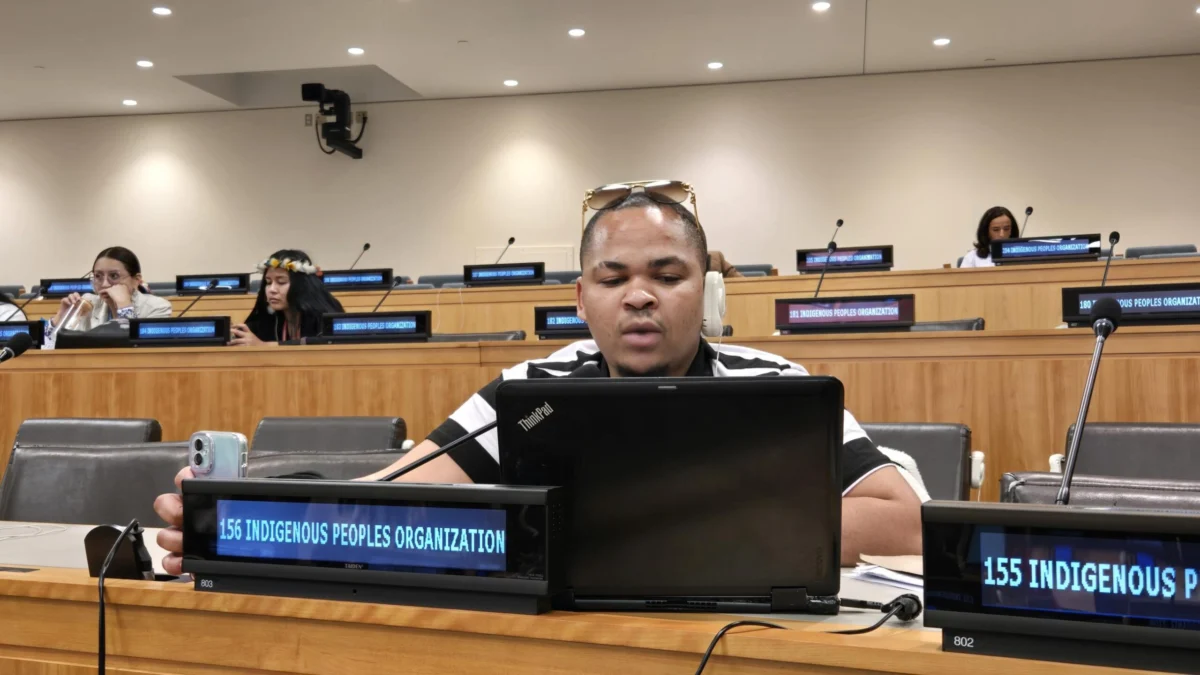
New York – April 23, 2026 – Samuel Stanley, Chairperson of the Indigenous Ink Network and Director of the Indigenous Youth Summit, delivered a significant statement at the 25th session of the UN Permanent Forum on Indigenous Issues, highlighting both advancements and persistent challenges faced by Indigenous youth in Botswana, with a particular focus on the San and Nama Peoples. His address underscored the critical need for the Botswanan government to fully integrate Indigenous rights into its national policies, especially concerning land, identity, and development.
A Call for Deeper Inclusion: Indigenous Youth Voices at the UN
Stanley’s intervention, on behalf of Indigenous youth, acknowledged recent positive strides by the Government of Botswana. He noted "growing recognition… of the importance of human rights, including recent commitments expressed at the highest political level." This includes expressed intentions towards a more "human rights-based approach to governance," engagement with UN mechanisms, and the development of national policies aimed at youth empowerment. The recent visit of the UN Special Rapporteur on the Rights of Indigenous Peoples was also cited as a positive development, encouraging continued cooperation with international human rights systems.
However, Stanley was unequivocal in pointing out that "significant gaps remain." A primary concern articulated was the inadequacy of the recently developed national youth policy to "adequately recognize or address the specific realities and rights of Indigenous youth, including those of the San Peoples." This omission, he warned, "risks reinforcing existing inequalities and excluding Indigenous youth from national development processes."
The Crucial Nexus of Land and Identity
At the heart of the San and Nama Peoples’ concerns lies the fundamental issue of land rights. Stanley emphasized that for Indigenous communities, "land is not merely an economic asset—it is the basis of identity, culture, spirituality, and survival." He identified "continued displacement, restricted access to ancestral territories, and lack of legal recognition of traditional land tenure systems" as constituting "serious violations of fundamental human rights, including the rights to self-determination, culture, and livelihood."
The statement forcefully argued that a true human rights-based approach necessitates that all policies be "inclusive, non-discriminatory, and responsive to the distinct identities and lived experiences of marginalized groups." It stressed that Indigenous youth are not a monolithic group but "rights holders with unique cultural, social, and historical contexts that must be explicitly recognized."
Background: The Permanent Forum on Indigenous Issues
The UN Permanent Forum on Indigenous Issues (UNPFII) was established in 2000 by the Economic and Social Council (ECOSOC) of the United Nations. It is the highest-level UN body dedicated to Indigenous Peoples, serving as an advisory body to ECOSOC and acting as a catalyst for action and coordination of activities related to Indigenous issues within the UN system. The Forum meets annually in New York, bringing together Indigenous representatives, governments, UN agencies, and other stakeholders to discuss pressing issues, make recommendations, and promote the rights and well-being of Indigenous Peoples worldwide. The 25th session, held in April 2026, continues this tradition of dialogue and advocacy.
Botswana’s Indigenous Peoples: A Historical Perspective
Botswana is home to several distinct Indigenous groups, most notably the San (often referred to as Basarwa) and the Khoe-San. The San, comprising various subgroups like the G//ana, Gwi, and G//amang, are among the oldest inhabitants of Southern Africa. Their traditional lifestyles, deeply intertwined with hunting and gathering on ancestral lands, have been profoundly impacted by historical processes, including colonialization, land alienation, and the expansion of state control and commercial interests.
For decades, Indigenous communities in Botswana have faced significant challenges related to land dispossession, particularly concerning access to ancestral territories like the Central Kalahari Game Reserve. These issues have often been framed as conflicts between conservation efforts, wildlife management, and the rights and livelihoods of Indigenous peoples. The lack of formal recognition of traditional land tenure systems has further exacerbated these vulnerabilities, leading to displacement and marginalization.
Chronology of Key Developments
- Pre-2000s: Historical land alienation and marginalization of San communities in Botswana.
- 2002: Landmark High Court ruling in Botswana recognized the San’s right to return to the Central Kalahari Game Reserve. However, implementation and enforcement have been inconsistent.
- Ongoing: Continued challenges related to land access, water rights, and recognition of traditional governance structures for San and Nama communities.
- Early 2020s: Increased engagement by the Government of Botswana with UN human rights mechanisms, including invitations for Special Rapporteurs.
- 2025-2026: Development of a new national youth policy by the Government of Botswana.
- April 2026: Statement delivered by Samuel Stanley at the 25th UN Permanent Forum on Indigenous Issues.
Supporting Data and Analysis
While precise, up-to-date statistical data disaggregated by Indigenous identity within Botswana can be challenging to obtain due to reporting limitations, reports from human rights organizations and UN bodies consistently highlight disparities. For instance, studies have indicated that Indigenous communities, particularly the San, often experience higher rates of poverty, lower educational attainment, and poorer health outcomes compared to the general population.
The assertion that the national youth policy "risks reinforcing existing inequalities" is grounded in the understanding that universal policies may not adequately address the specific needs of marginalized groups. Indigenous youth often face unique challenges stemming from cultural erosion, discrimination, and lack of access to culturally relevant education and economic opportunities. Their exclusion from national development processes can perpetuate cycles of disadvantage.
The emphasis on land rights is critical. For Indigenous communities globally, secure land tenure is intrinsically linked to their ability to maintain cultural practices, transmit traditional knowledge, and ensure food security. Without this foundation, efforts to promote education, health, and overall well-being are significantly hampered. The lack of legal recognition of traditional land tenure systems, often based on customary practices rather than formal state titles, leaves Indigenous communities vulnerable to encroachment and expropriation.
Potential Reactions and Implications
The statement delivered by Samuel Stanley is likely to resonate with many Indigenous delegates and human rights advocates present at the UN Forum. It aligns with broader global discussions on the need to implement the UN Declaration on the Rights of Indigenous Peoples (UNDRIP), adopted in 2007, which affirms the collective and individual rights of Indigenous peoples, including their rights to their lands, territories, and resources.
Inferred Government Response: While the article does not include a direct quote from the Botswanan government in response to Stanley’s statement, the acknowledgement of "growing recognition" and "positive steps" suggests a government that is, at least publicly, engaging with human rights frameworks. A potential official response might reiterate commitments to inclusivity and development, while possibly defending the current policy framework as a broad approach. However, sustained pressure from international bodies and civil society is often necessary to translate stated commitments into tangible policy changes and enforcement.
Broader Impact and Implications
The implications of Stanley’s address extend beyond Botswana. It serves as a crucial reminder that the empowerment of Indigenous youth requires more than general youth development initiatives; it demands specific attention to their unique rights and cultural contexts. The call for a "human rights-based approach" to governance underscores a global imperative for states to move beyond tokenistic gestures and implement policies that are genuinely inclusive and equitable.
The focus on land rights highlights a recurring theme in Indigenous advocacy worldwide, where the protection and restitution of ancestral territories are often seen as prerequisites for achieving self-determination and sustainable development. By bringing these issues to the UN Permanent Forum, Indigenous advocates aim to galvanize international support and hold governments accountable for their commitments to Indigenous Peoples.
Stanley concluded his statement with a powerful plea: "The dignity, knowledge, and rights of the San Peoples must not only be recognized in principle, but fully realized in practice." This sentiment encapsulates the ongoing struggle of Indigenous communities globally to see their fundamental rights translated from international declarations and national commitments into tangible improvements in their daily lives. The 25th UN Permanent Forum on Indigenous Issues provides a critical platform for these voices to be heard, and for the international community to engage in meaningful dialogue and action.