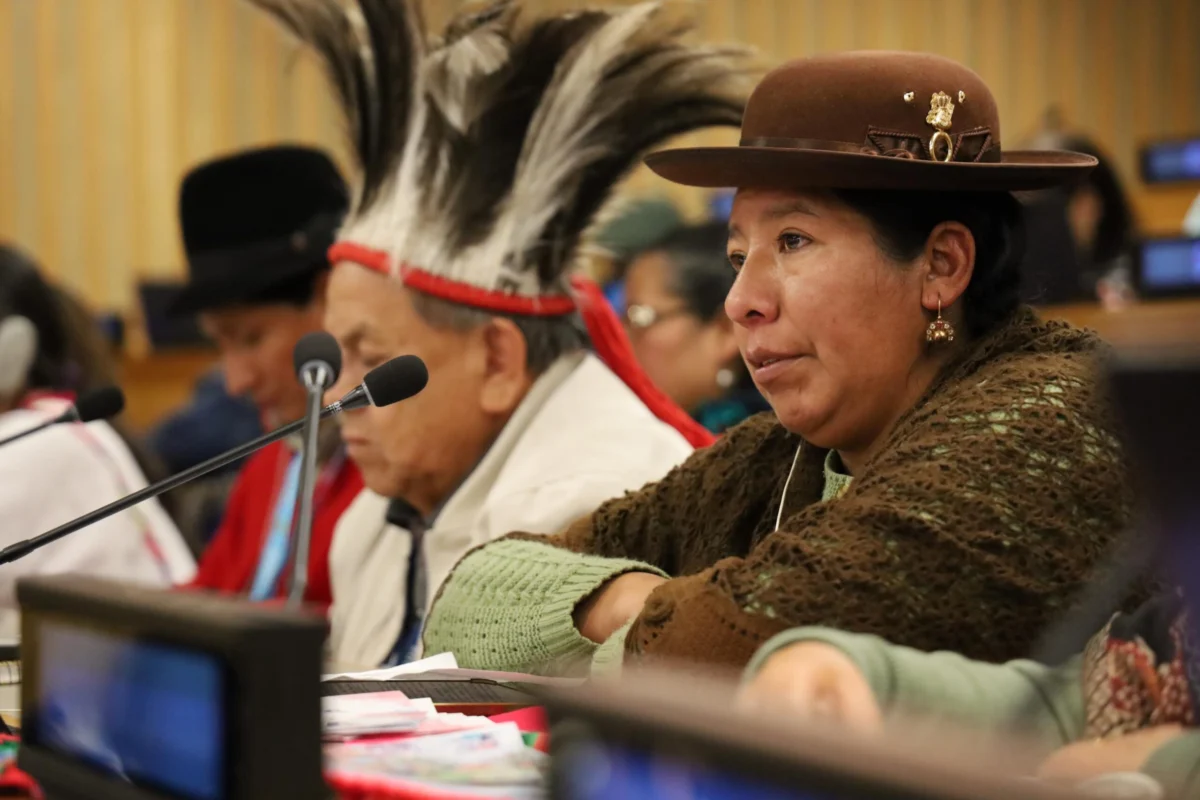
New York, April 21, 2026 – At the 25th session of the United Nations Permanent Forum on Indigenous Issues (UNPFII), Rosa Fátima Mamani Quispe, representing the Chimpu Warmi Network of Bolivia and a partner of Cultural Survival’s Indigenous Community Media Fund, delivered a powerful address on behalf of Bolivia’s indigenous peoples. Her statement, a stark testament to the devastating environmental degradation and its profound impact on indigenous health, served as an urgent plea to the Bolivian government to address the critical demands of communities witnessing the ecological collapse of vital natural resources, including the once-thriving Lake Poopó, and the pervasive sickness inflicted upon Pachamama, or Mother Earth. Mamani Quispe highlighted the destructive activities of mining companies, whose use of highly toxic substances is poisoning Bolivian territories, jeopardizing the health of both the land and its indigenous inhabitants.
The UNPFII, an advisory body to the Economic and Social Council (ECOSOC) of the United Nations, convenes annually to facilitate dialogue and cooperation on issues concerning indigenous peoples. The 25th session, held from April 20th to May 1st, 2026, focused on the crucial theme of "Ensuring the health of Indigenous Peoples, including in the context of conflicts." This theme provided a critical platform for Mamani Quispe to articulate the interconnectedness of environmental health, cultural integrity, and the well-being of indigenous communities.
A Cry from the Land: Indigenous Women as Guardians of Life
Mamani Quispe began her address by acknowledging the President of the Forum and expressing gratitude to the International Work Group for Indigenous Affairs (IWGIA) for facilitating her participation. She conveyed the urgent message from the indigenous peoples of Bolivia, with a particular emphasis on the indigenous women who are at the forefront of defending their ancestral territories, their sacred living spaces, and their inherent right to self-determination. "For us," she stated, "the theme of this session… offers an ideal space for our voices and our thoughts to help safeguard the very fabric of life."
The statement underscored the historical role of indigenous women as sustainers of life, preserving invaluable knowledge, wisdom, languages, institutions, systems of self-governance, and life plans. Mamani Quispe eloquently described their traditional weaving as a tangible manifestation of this role, a "living memory of life" inherited from female ancestors. The defense of their territories, she asserted, is intrinsically linked to the defense of life itself, as for her people, the land is revered as "Woman – it is Pachamama, our Mother Earth, fertile and bountiful."
Undermining Rights and Polluting the Earth: The Reality on the Ground
Despite the recognition of indigenous rights to lands, territories, and resources in the United Nations Declaration on the Rights of Indigenous Peoples (UNDRIP), Mamani Quispe detailed how these rights are being systematically violated within Bolivia. She pointed to the detrimental impact of "extractivist policies" driven by both large-scale mining companies and informal mining operations. These activities, she explained, are compounded by institutional actions from entities like the National Institute for Agrarian Reform (INRA) and the Authority for the Oversight and Social Control of Forests and Land (ABT). These institutions, through their policies and land management practices, inadvertently facilitate the encroachment of third parties – previously termed "colonizers" and now euphemistically referred to as "intercultural settlers" – and so-called "mining cooperatives" into indigenous territories.
This influx, Mamani Quispe argued, serves to weaken and fragment indigenous autonomy, disrupt traditional ways of life, and undermine established systems of self-governance. Concurrently, these processes are leading to the widespread pollution and sickening of Mother Earth.
The Devastation of Gold Mining
The statement specifically condemned the environmental damage wrought by mining operations, particularly gold mining, due to its "indiscriminate use of mercury." This toxic substance has led to the contamination of rivers, the destruction of delicate ecosystems, and the impoverishment of indigenous territories. The health consequences for indigenous communities and families have been severe. For indigenous women, the impact is even more profound, as it increasingly impedes access to clean water and healthy food, essential for sustaining their families and their traditional livelihoods. Furthermore, these polluted environments are fostering an atmosphere of heightened violence, disproportionately affecting the most vulnerable segments of the population: women, children, and the elderly.
The Death of Lake Poopó: A Symbol of Ecological and Cultural Loss
A particularly poignant example of this environmental crisis is the death of Lake Poopó in the Altiplano region. Mamani Quispe referred to the lake as Mamacocha (Mother Lake), a sacred entity for the Andean peoples. Its demise signifies more than just the disappearance of water; it represents a profound wound to the culture, worldview, and collective memory of the people. Communities living in its vicinity are now caught in a state of perpetual grief and a struggle for resilience.
This ecological tragedy is not an isolated incident but a symptom of a broader pattern of environmental disregard that impacts the very foundation of indigenous well-being.
Redefining Health: A Reciprocal Relationship with Pachamama
Mamani Quispe challenged the prevailing Western, individualistic understanding of health, emphasizing that for indigenous communities, health is an "integral, reciprocal relationship with Mother Earth." This worldview posits that the health of Pachamama is inextricably linked to the health of her people. "If Mother Earth is healthy, we are healthy too, for she provides us with sustenance, balance, and the space to live," she explained. Conversely, when Mother Earth suffers, so too do her inhabitants – physically, emotionally, and spiritually.
The desecration of sacred sites, including lakes, hills, rivers, and ceremonial spaces, through contamination by mercury, arsenic, and other life-threatening elements, severs the vital bond of care between the community and its environment. Therefore, Mamani Quispe asserted, discussions about well-being must encompass respect for nature, the protection of territory, and the safeguarding of collective rights.
A Call to Action: Upholding Commitments and Protecting Future Generations
In the face of these grave challenges, indigenous women are standing firm, resisting, "sowing seeds of hope, and weaving the fabric of life." Their defense of territory is a defense of life itself; their defense of water is a defense of the future. Mamani Quispe concluded with a direct appeal to the Bolivian State to fulfill its commitments under the UNDRIP, which was legally enacted in Bolivia as Law 3760 on November 7, 2007, granting it the force of national law.
The statement implicitly calls for robust policy enforcement, accountability for mining operations, and a fundamental shift in the government’s approach to resource management, prioritizing the rights and well-being of indigenous peoples and the health of the environment. The State, she emphasized, "must shoulder its responsibilities to ensure an environment that enables Indigenous peoples to live with dignity, health, and freedom."
Background and Context: The Longstanding Struggle for Environmental Justice
The issues raised by Rosa Fátima Mamani Quispe are not new. Indigenous communities across Bolivia have for decades been voicing concerns about the impacts of extractivist industries. The decline of Lake Poopó, once the second-largest lake in Bolivia and a vital source of water, food, and cultural significance for Aymara and Quechua communities, has been a gradual but devastating process. Environmental scientists have documented the lake’s shrinkage due to climate change, increased water diversion for agriculture and mining, and pollution from mining runoff. By the early 2010s, the lake had significantly diminished, and by late 2015, it had virtually dried up, a stark environmental disaster that reverberated globally.
The Chimpu Warmi Network, as a prominent indigenous women’s organization, has been instrumental in advocating for the rights and protection of indigenous women and their territories. Their partnership with Cultural Survival, an organization dedicated to supporting indigenous peoples’ rights, cultures, and self-determination, amplifies their voice on international platforms like the UNPFII.
Supporting Data and Broader Implications
The indiscriminate use of mercury in artisanal and small-scale gold mining (ASGM) is a well-documented global environmental and health crisis. According to the United Nations Environment Programme (UNEP), ASGM is the largest source of mercury emissions to the atmosphere, with significant portions of this mercury ending up in water bodies and ecosystems. Mercury bioaccumulates in fish and other organisms, posing serious neurological and developmental risks to humans, particularly through dietary consumption.
In Bolivia, gold mining has become a significant economic activity, but often operates with minimal environmental oversight, especially in informal sectors. The contamination of rivers like the Pilcomayo and Beni, which originate in mining regions, has been a recurring concern for downstream communities, including indigenous populations who rely on these waterways for drinking water, irrigation, and fishing.
The implications of this environmental degradation extend far beyond immediate health impacts. The loss of traditional territories and resources erodes cultural identity, disrupts social structures, and can lead to increased conflict and displacement. For indigenous women, who often bear the primary responsibility for gathering food, water, and fuel, these environmental changes directly threaten their livelihoods and their roles within their communities. The heightened vulnerability to violence in contaminated areas further exacerbates their challenges.
Official Responses and Analysis
While the Bolivian government has ratified UNDRIP and passed national legislation recognizing indigenous rights, the implementation and enforcement of these laws have frequently been criticized by indigenous organizations and international human rights bodies. The perceived prioritization of economic development through extractivist industries often appears to outweigh environmental protection and indigenous rights.
The statement at the UNPFII serves as a critical mechanism for indigenous peoples to hold states accountable for their international commitments. It also aims to influence policy decisions by raising awareness among global stakeholders, including UN member states, other indigenous organizations, and international development agencies. The UNPFII, through its recommendations and reports, can exert pressure on governments to adopt more sustainable and rights-based approaches.
The broader impact of Mamani Quispe’s address lies in its powerful articulation of the interconnectedness of environmental justice and indigenous rights. By framing health not merely as an individual concern but as a collective well-being dependent on a healthy planet, she challenges conventional paradigms and calls for a holistic approach to development. The "weaving of life" metaphor powerfully illustrates the intricate relationship between human societies and the natural world, a relationship that is being torn asunder by unsustainable practices. The urgency of her message underscores the need for immediate and decisive action to prevent further irreversible damage to Bolivia’s natural heritage and the lives of its indigenous peoples.