Americans navigate a complex and often overwhelming news landscape, facing persistent concerns about the accuracy of information, deep political polarization in media consumption, and the rapidly evolving influence of artificial intelligence on journalism. Against this backdrop, a comprehensive new study by the Pew Research Center, conducted in partnership with the John S. and James L. Knight Foundation, delves into what it means for citizens to be a "good news consumer" in the 21st century. The findings reveal a diverse set of perspectives, underscoring the increasing agency and responsibility individuals hold in shaping their own understanding of the world through news.
This in-depth analysis, part of the ongoing Pew-Knight Initiative, aims to shed light on how Americans perceive their role in consuming and verifying information. The initiative is dedicated to supporting new research into how citizens engage with civic information, construct their beliefs and identities, and participate in their communities. Pew Research Center, a nonpartisan fact tank, and Knight Foundation, a social investor focused on informed and engaged communities, collaborate to provide crucial insights into these evolving dynamics.
The Evolving Information Ecosystem: Challenges and Perceptions
The contemporary media environment is characterized by an unprecedented volume of information, a fragmented audience, and a growing distrust in established institutions. Recent Pew Research Center reports have highlighted significant challenges:
- Pervasive Concerns About Inaccurate News: A substantial portion of Americans report frequently encountering false or misleading information online. A survey from October 2025 indicated that many individuals find it difficult to discern truth from falsehood, contributing to a general sense of unease and skepticism.
- Deep Political Divides in News Sources: The way Americans consume news is increasingly stratified along political lines. A June 2025 study revealed stark differences in the news outlets favored by Republicans and Democrats, leading to echo chambers that can reinforce existing beliefs and limit exposure to diverse perspectives.
- The Rise of Artificial Intelligence: The integration of AI into news production and distribution presents both opportunities and anxieties. Americans largely foresee AI having negative effects on journalism, raising concerns about job displacement, the potential for sophisticated misinformation, and the erosion of human journalistic judgment.
These prevailing conditions set the stage for the Pew-Knight Initiative’s latest research, which directly solicited Americans’ definitions of a "good news consumer." The variety of responses underscores the multifaceted nature of information consumption and the personal strategies individuals employ to navigate this complex terrain.
Methodology: Understanding the Citizen’s Perspective
The findings presented are derived from a comprehensive survey of 3,560 U.S. adults conducted by the Pew Research Center’s American Trends Panel from December 8-14, 2025. This panel is designed to reflect the views of the entire U.S. adult population.
Researchers posed an open-ended question: "What does it mean to be a ‘good news consumer’?" A total of 2,563 responses were meticulously analyzed and manually categorized to identify recurring themes and common perceptions.
To further enrich the understanding of these perspectives, the study also incorporated insights from nine online focus group discussions involving 45 U.S. adults, held between June 10 and June 18, 2025. These qualitative discussions, while not representative of the entire U.S. population, provided valuable context and personal anecdotes that illuminate the survey findings. Quotes from these focus groups were lightly edited for clarity and conciseness.
This research builds upon a prior Pew Research Center report released in February 2026, which explored Americans’ broader relationship with news and their perceived role within the information ecosystem. The Pew-Knight Initiative is a collaborative effort funded by The Pew Charitable Trusts and the John S. and James L. Knight Foundation.
Defining the "Good News Consumer": Key Attributes
The responses to the open-ended question revealed several core attributes that Americans associate with being a good news consumer. These can be broadly categorized as follows:
1. Being Skeptical and Discerning
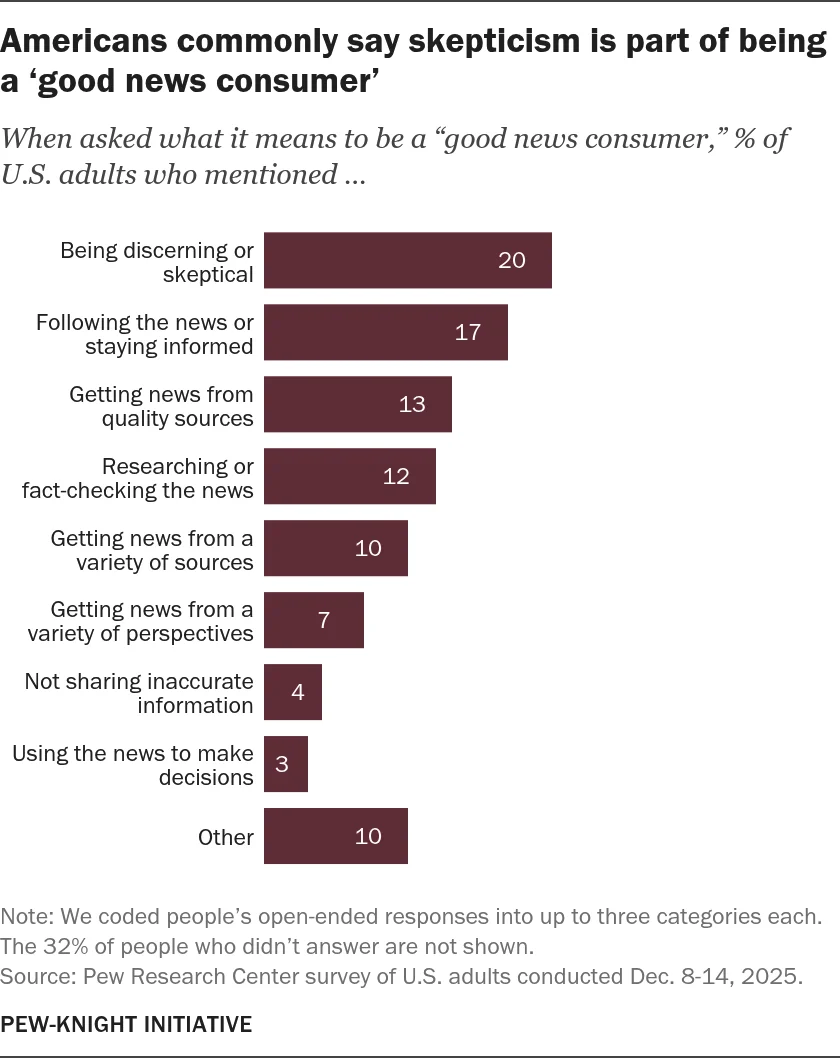
A significant proportion of Americans—one in five adults—identified skepticism and discernment as paramount qualities of a good news consumer. This theme encompassed a range of attitudes, from general critical thinking to actively questioning the information presented.
- Qualitative Insights: Respondents frequently used phrases like "take things with a grain of salt," "don’t believe everything you hear," and expressed awareness of "propaganda." This suggests a conscious effort to avoid passive acceptance of news narratives.
- Research and Fact-Checking: Complementing this general skepticism, 12% of respondents emphasized the importance of actively researching and fact-checking news. This includes cross-referencing information from multiple sources, performing online searches to verify claims, and critically evaluating the statements made by news organizations and official sources.
- Prevalence of Fact-Checking: The commitment to verifying information is widespread. A striking 82% of Americans reported that they "at least sometimes do their own research" to check the accuracy of the news they encounter, highlighting a proactive approach to information consumption.
2. Staying Informed and Engaged
Another prevalent characteristic of a good news consumer, cited by 17% of respondents, is the commitment to staying informed and regularly engaging with news. This involves a conscious effort to keep abreast of current events.
- Daily Engagement: Many expressed the importance of "following the news on a daily basis" or making an effort to "stay informed on current events."
- Generational Differences: While a majority of U.S. adults (47%) consider regular news consumption to be extremely or very important, this sentiment is less pronounced among younger adults. This aligns with broader trends where younger demographics are more likely to encounter news incidentally rather than actively seek it out. Indeed, about half of Americans now report primarily encountering news by chance rather than by design.
3. Evaluating the Quality of News Sources
For 13% of respondents, a defining aspect of being a good news consumer involves carefully assessing the credibility and quality of the news outlets being used.
- Seeking Reputable Outlets: This includes making an "attempt to find reputable news outlets" or seeking out "unbiased news organizations." The desire for "high standards for reporting and accuracy, as well as fair and balanced coverage" was also frequently mentioned.
- The Trust Deficit: This emphasis on source quality is particularly relevant given the current media landscape. Pew Research Center’s 2025 data indicated that Americans’ trust in news outlets varies significantly, especially along political lines. Notably, no single news outlet among the 30 surveyed achieved majority trust among the U.S. adult population. This lack of universal trust compels consumers to be more discerning about their sources.
4. Consuming a Variety of News Sources and Perspectives
Given the aforementioned trust challenges, it is unsurprising that 10% of Americans believe a good news consumer actively seeks information from a diverse range of sources.
- Broad Information Gathering: Focus group participants articulated this need for comprehensive information gathering, emphasizing "double-checking, verifying, gathering news from multiple types of media and from multiple sources, and then drawing your own conclusion about what is correct or what is not correct."
- Seeking Diverse Viewpoints: This concept extends beyond just the number of sources to encompass the variety of perspectives offered. Approximately 7% of respondents specifically mentioned the importance of obtaining news from a range of viewpoints, often framing it as getting "both sides of an issue." This strategy aims to provide a more holistic understanding of complex topics.
5. Responsible News Consumption and Application
A smaller but significant segment of respondents focused on the actions taken after consuming news, highlighting responsible sharing and the application of news to real-world decisions.
- Preventing the Spread of Misinformation: Four percent of respondents stressed the importance of not sharing inaccurate news, with phrases like "make sure you get everything right before you post something" reflecting this concern. Anecdotal evidence from focus groups highlighted instances of individuals realizing they had shared information without full verification.
- Informed Decision-Making: Three percent of Americans indicated that a good news consumer uses news to inform their decisions. This was particularly evident in comments about civic engagement, such as "be able to make informed choices about who you choose to represent you," underscoring the link between news consumption and democratic participation.
Broader Implications for Civic Engagement and Democracy
The diverse definitions of a "good news consumer" reflect a public grappling with the complexities of the modern information age. The findings from the Pew-Knight Initiative underscore a growing awareness among Americans of their own agency and the critical need for media literacy.
The emphasis on skepticism and fact-checking suggests a public that is increasingly aware of the potential for misinformation and is developing personal strategies to combat it. However, the stark political divisions in news source preferences and the general distrust in media outlets present ongoing challenges to achieving a shared understanding of facts.
The Pew-Knight Initiative’s ongoing research aims to provide a deeper understanding of these dynamics, offering valuable insights for journalists, policymakers, educators, and the public alike. By illuminating how Americans define responsible news consumption, this research contributes to the broader effort of fostering a more informed and engaged citizenry in an era of rapid technological and informational change. The ability of individuals to critically evaluate, diversify, and responsibly use news is not merely a personal skill but a vital component of a healthy democratic society.
The detailed survey questions, topline results, and methodology are available for further exploration, offering transparency and enabling deeper analysis of the data presented.