As the United States approaches a monumental milestone – its 250th anniversary – a comprehensive new report from the Pew Research Center reveals a nation grappling with a generally pessimistic outlook, yet one that retains glimmers of hope for the future. The findings, based on extensive surveys conducted in early 2026, paint a complex picture of the American psyche on the cusp of this significant bicentennial. While a majority of U.S. adults express dissatisfaction with the country’s current trajectory and believe its best days are in the past, a substantial portion also conveys feelings of optimism and happiness when contemplating what lies ahead.

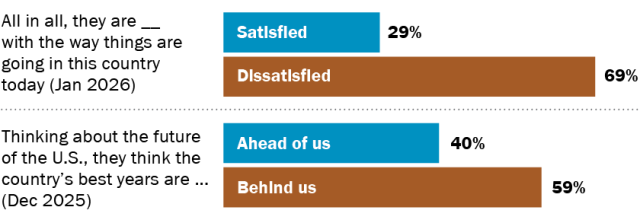
The research underscores a persistent trend observed over recent years: a widespread sense of discontent with the nation’s direction. In surveys conducted in late 2025 and early 2026, a significant majority of Americans reported dissatisfaction with the way things are going in the United States. This sentiment is further amplified by the prevailing belief that the country’s most prosperous era has already passed. This perception, that the "best days are behind us," has become a dominant theme in public discourse, contributing to the overall somber national mood.
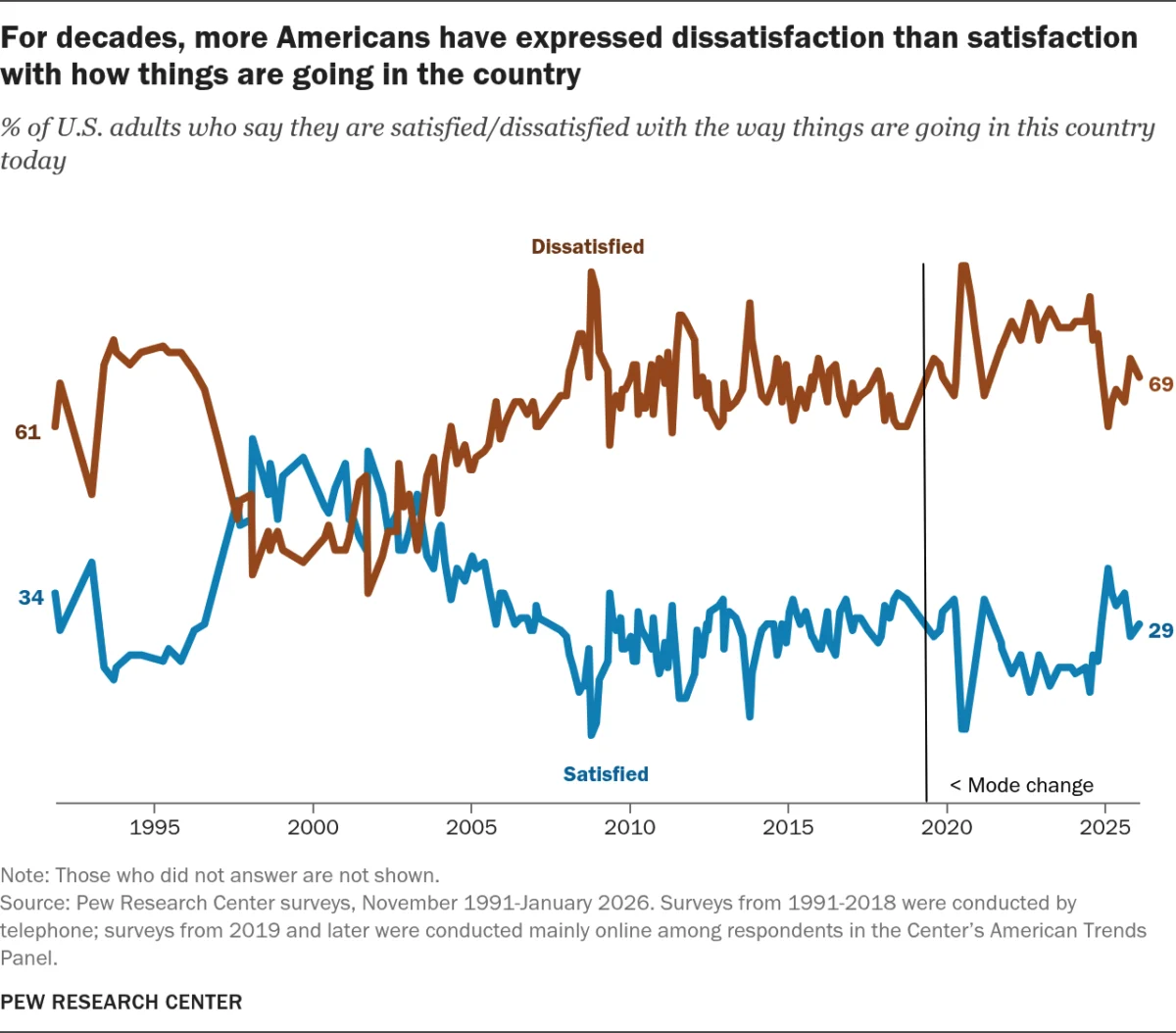
This pervasive sense of dissatisfaction is not a new phenomenon, but rather a continuation of a trend that has spanned over two decades. Pew Research Center data consistently shows that more Americans have expressed dissatisfaction than satisfaction with the country’s direction since the early 2000s, with notable dips during periods of economic recession and national crisis. The current data from January 2026 indicates that while satisfaction has seen a marginal rebound from its lowest points during the COVID-19 pandemic, it remains at a level where dissatisfaction significantly outweighs it, with 69% expressing dissatisfaction compared to 29% satisfaction.
Beyond general dissatisfaction, the research highlights a deepening distrust in both fellow citizens and key institutions. Americans have grown increasingly skeptical of one another and of established bodies, including the federal government, major political parties, the mainstream media, and academic institutions. This erosion of trust is a critical factor shaping the national mood, contributing to a sense of fragmentation and uncertainty.
When compared to citizens of other high-income countries, Americans exhibit a notably higher degree of dissatisfaction with the functioning of their democracy. Furthermore, there is a pronounced doubt regarding the moral character of their fellow citizens. These findings suggest a distinct internal challenge within the American civic landscape, one that appears more acute than in many comparable nations.

Looking ahead to the mid-21st century, specifically the year 2050, the outlook among U.S. adults is largely tinged with pessimism. A majority anticipate a weaker economy, a diminished role for the United States on the global stage, increased political polarization, and a worsening of the American system of government. This forward-looking pessimism, while widespread, is not monolithic, with varying degrees of concern expressed across different demographics and political affiliations.
However, amidst this prevailing sense of unease, a countercurrent of optimism persists. When asked about the future in more general terms, many Americans report feeling hopeful and happy. This duality – a pessimistic outlook for specific national trajectories juxtaposed with personal feelings of hope and happiness – underscores the resilience of the American spirit. The data reveals that 54% of U.S. adults report feeling happy when contemplating the days to come, and a remarkable 68% feel hopeful about the future. When considering the nation’s future specifically, the sentiment is more divided, with 48% expressing optimism and 51% pessimism.

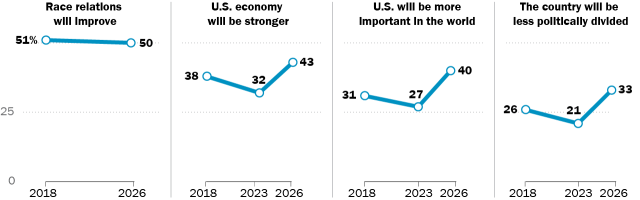
Moreover, there are subtle indications of recent improvements in public sentiment regarding future expectations. A comparison of survey data from April 2023 to April 2026 shows a notable uptick in the proportion of Americans who believe the nation’s economy will strengthen and that political divisions will lessen by 2050. This suggests that while the current mood is largely sour, there might be a gradual shift towards a more positive outlook on certain long-term prospects.
About This Research
This comprehensive report by the Pew Research Center delves into the current national mood of U.S. adults as the nation approaches its 250th anniversary. Utilizing data from a survey of 3,592 U.S. adults, conducted between April 6-12, 2026, as part of the Center’s American Trends Panel (ATP), the analysis offers deep insights into public perceptions of the country’s present state and future prospects. The survey carries an overall margin of error of plus or minus 1.9 percentage points, ensuring a high degree of statistical reliability. The research also draws upon previously released findings from the Center’s extensive survey archive, providing a historical context for contemporary attitudes.

Trends in the Public’s Mood: A Deeper Dive
As 2026 commenced, the prevailing sentiment regarding the nation’s condition was one of significant concern. The January 2026 survey data revealed that only 29% of U.S. adults were satisfied with the way things were going in the country, while a commanding 69% expressed dissatisfaction. This imbalance has been a consistent feature of American public opinion for more than two decades, with periods of slightly higher satisfaction in the late 1990s and early 2000s, followed by a more extended period of predominantly negative assessments.
The feeling that "their side is losing" on the issues that matter most is also a recurring theme. Over the past decade, a consistent majority of Americans have indicated that their political side is losing more often than winning. This perception of being on the losing end of political discourse contributes to the general disaffection and contributes to the sour national mood. In January 2026, 63% of Americans felt their side was losing more often than winning, a slight decrease from a peak of 72% in 2022, but still indicative of a widespread sense of political disadvantage.

This sentiment is closely tied to partisan identification. When the presidency is held by a party aligned with their own, individuals tend to report higher levels of satisfaction and a greater sense of their side winning. Conversely, when the opposing party controls the White House, satisfaction levels and perceptions of political success tend to plummet. This dynamic highlights the significant influence of political leadership on the public’s overall mood and outlook.
Signs of Optimism Amidst Pessimism
Despite the widespread dissatisfaction, the research also uncovers pockets of optimism, particularly when Americans are prompted to consider the future in broader terms. While views on the nation’s specific trajectory are often negative, personal feelings about the future can be more positive. As noted, a majority feel hopeful and a significant portion feel happy when contemplating the future.

This optimism extends to expectations for the nation’s future, albeit with a more divided sentiment. The 48% optimistic and 51% pessimistic split on the future of the U.S. suggests a nation at a crossroads, with a near-even balance of those who believe the country is headed for better times versus those who fear it is not.
Furthermore, a closer examination of trends reveals some encouraging shifts. The share of Americans who believe the year ahead will be better than the previous year, while dipping to 50% in January 2026, has seen fluctuations. While this figure represents a slight decrease from previous years, it remains a substantial proportion, indicating that even in a generally negative climate, a belief in near-term improvement persists for a significant segment of the population.

Looking Ahead to 2050: A Mixed Prognosis
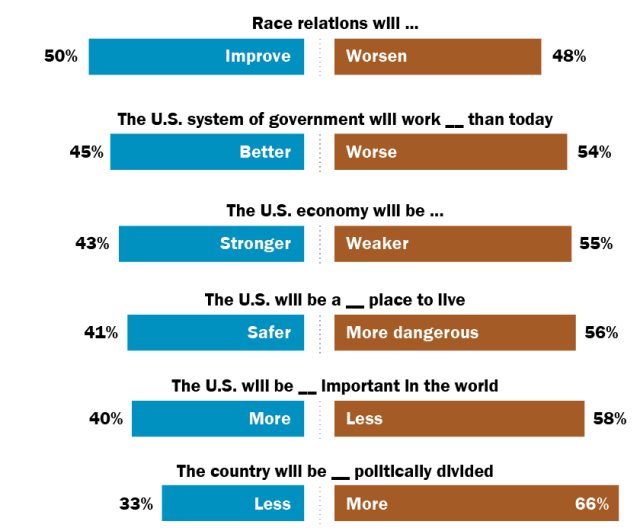
The Pew Research Center’s forward-looking questions about the year 2050 provide a stark illustration of the prevailing anxieties about the nation’s long-term prospects. The data reveals a strong sense of pessimism regarding several key areas:
- Political Division: A significant majority (66%) of U.S. adults believe the country will be more politically divided by 2050. This expectation reflects the current deep partisan schisms and a perceived lack of resolution.
- Global Standing: More than half (58%) anticipate that the U.S. will play a less important role in the world.
- Economic Outlook: A majority (55%) foresee a weaker U.S. economy.
- Safety and Governance: Over half (56%) believe the U.S. will become a more dangerous place to live, and a similar proportion (54%) expect the system of government to function worse than it does today.
However, the outlook is not entirely bleak. On the issue of race relations, the public is almost evenly divided, with 50% believing they will improve and 48% expecting them to worsen. This near-split suggests a societal awareness of the complexities and ongoing challenges in this area, with no clear consensus on future outcomes.
Encouragingly, as mentioned earlier, there have been positive shifts in expectations for the future since 2023. The proportion of Americans who believe the U.S. will be more important in the world by 2050 has increased by 13 percentage points. Similarly, expectations for a less politically divided nation have risen by 12 points, and the belief in a stronger economy has seen an 11-point increase. These incremental improvements suggest that while pessimism dominates, there are underlying currents of hope and a belief in potential positive change, particularly in economic and geopolitical spheres.
National Mood and Partisan Alignments
The data strongly indicates that an individual’s political affiliation is a significant predictor of their national outlook. Republicans and those leaning Republican tend to hold vastly different views compared to Democrats and those leaning Democratic. This divergence is particularly pronounced when assessing satisfaction with the country’s direction.
Historically, Republicans have expressed higher satisfaction levels when their party holds the presidency, a trend that has been consistent across administrations, including those of George W. Bush and Donald Trump. Conversely, Democrats have reported greater contentment during Democratic presidencies, such as those of Bill Clinton and Barack Obama. This pattern holds true in the current data, where Republicans express significantly higher satisfaction than Democrats.
This partisan lens also shapes perceptions of political success. When a party controls the White House, its supporters are more likely to feel that their "side" is winning on political issues. The shifts are particularly dramatic for Republicans. During the final year of the Biden administration, only 15% of Republicans felt their side was winning, but this figure surged to 60% following the first year of Trump’s second term. While Democrats also experience a boost in optimism when their party is in power, the magnitude of the shift among Republicans is notable.

Age Gaps in National Outlook
Significant age-related differences emerge when examining future expectations. Younger adults, particularly those under 30, tend to exhibit more pessimistic outlooks for the year 2050 compared to their older counterparts. This generational divide is evident across several key indicators:
- Race Relations: Only 43% of adults under 30 believe race relations will improve by 2050, compared to 58% of those aged 65 and older.
- Government Functioning: A mere 37% of young adults expect the U.S. system of government to work better by 2050, in contrast to 53% of seniors.
- Economic Strength: Just 36% of the youngest cohort anticipate a stronger economy, while 50% of the oldest cohort share this view.
- Overall Optimism: A concerning 42% of adults under 30 express optimism about the future of the U.S. by 2050, compared to 55% of those 65 and older.
Interestingly, on some measures of current satisfaction, age differences are less pronounced. Adults under 30 and those 65 and older report similar levels of satisfaction with the country’s current direction. However, younger adults express higher levels of happiness about the future than older adults, suggesting a more complex interplay of immediate feelings and long-term expectations.

Conclusion
As the United States stands on the precipice of its 250th anniversary, the national mood is a complex tapestry woven with threads of dissatisfaction and apprehension, yet interlaced with enduring optimism and a belief in potential future improvements. The data from the Pew Research Center underscores a populace deeply concerned about the current state of affairs, particularly regarding political division, institutional trust, and the trajectory of democracy. The prevalent sentiment that the nation’s best days may be behind it casts a shadow over the present moment.
However, the persistent feelings of hope and happiness when contemplating the future, coupled with the recent upward trend in expectations for economic strength and reduced political division, offer a counterpoint to the prevailing pessimism. The upcoming anniversary provides a critical juncture for reflection and a potential catalyst for a renewed sense of national purpose. Understanding these nuanced sentiments, the deep partisan divides, and the generational outlooks is crucial for navigating the challenges and opportunities that lie ahead for the United States. The nation’s ability to address its current discontents while harnessing its enduring optimism will undoubtedly shape its path in the decades to come.