Unconscious bias awareness training has emerged as the most prevalent and often knee-jerk response in the global fight against discrimination and inequality, frequently adopted as a quick-fix solution in the pursuit of equity and inclusion. This widespread embrace has fueled a multi-billion-dollar industry, yet mounting evidence suggests a critical problem: at best, these interventions are largely ineffective, and at worst, they can paradoxically exacerbate the very biases they aim to combat. A deeper understanding of human cognition and organizational dynamics reveals that a fundamental shift from mere awareness to systemic, design-led solutions is imperative for fostering a truly just and equitable world.
The Proliferation of Bias Awareness Training: A Reactionary Trend
The pattern of organizations defaulting to unconscious bias awareness training has become strikingly familiar over the past decade. Landmark social movements and internal crises frequently trigger this response. Following the resurgence of the #MeToo movement, which shone a harsh light on pervasive sexual harassment and gender-based discrimination, many corporations and institutions swiftly rolled out bias training programs. Similarly, in the wake of the global #BlackLivesMatter protests, sparked by renewed calls for racial justice, companies once again turned to these trainings, often for the second or third time, as a visible demonstration of their commitment to diversity, equity, and inclusion (DEI).
This trend extends beyond high-profile social movements. Individual employee grievances pertaining to perceived unfair treatment, exclusion, or discrimination often lead to company-wide mandates for bias training. The underlying assumption is that increased awareness of biases will naturally lead to changed behavior and a more inclusive culture. For many leaders, offering such training serves as a defensive shield against external criticism and internal calls for change, creating an illusion of progress. The pronouncement, "we’re offering bias training across the organization," is often presented as tangible proof that "things are going to change here." However, the lived experience within many of these organizations frequently contradicts this optimistic outlook. The critical question, then, is why this widely adopted strategy consistently falls short.
Understanding the Deep-Seated Limitations of Awareness-Based Approaches
The over-reliance on unconscious bias awareness training as the solution has inadvertently cultivated a lucrative industry, with consultancy firms and training providers profiting significantly from organizations’ earnest desire to "fix the problem." Despite this substantial investment, which some estimates place in the tens of billions globally each year, the tangible outcomes in terms of reducing discrimination or fostering genuine inclusion often remain elusive. Worse still, compelling research indicates that these programs can, in fact, be counterproductive.
The fundamental flaw lies in a misunderstanding of how human cognition operates, specifically the interplay between our conscious and unconscious minds. Pioneering work by psychologists like Daniel Kahneman and Amos Tversky elucidated the existence of two distinct systems of thinking: System 1, which is fast, intuitive, automatic, and largely unconscious, and System 2, which is slower, more deliberate, analytical, and conscious. Unconscious biases, stereotypes, and ingrained heuristics primarily reside and operate within System 1. Traditional bias awareness training, by its very nature, appeals predominantly to System 2—our rational, conscious mind. It aims to impart knowledge and foster conscious recognition of biases. However, simply knowing about biases, or even harboring good intentions, has minimal impact on the automatic, often deeply entrenched, operations of the unconscious mind. To effect lasting behavioral change, interventions must target System 1, the system responsible for the vast majority of our daily decision-making and actions. When training attempts to intellectually convince individuals to be more inclusive or to become consciously aware of their unconscious biases, it is, metaphorically speaking, "speaking the wrong language to the wrong brain system."
The Paradoxical Backlash: How Awareness Can Worsen Bias
The limitations of unconscious bias training extend beyond mere ineffectiveness; several well-documented psychological phenomena demonstrate how these trainings can actively backfire:
-
Mental Overload and Enhanced Bias: Attempting to be constantly and consciously aware of one’s unconscious biases creates significant cognitive load. Research has shown that when individuals experience mental overload, their reliance on automatic, heuristic-driven thinking (System 1) increases. This means that the very act of trying to suppress or monitor biases consciously can paradoxically strengthen their impact. Furthermore, when individuals are made aware of biases but lack concrete, actionable strategies to mitigate them, this knowledge can lead to a sense of paralysis, pushing them to rely even more heavily on default, often biased, behaviors, creating a self-perpetuating negative cycle.
-
Reinforcing Stereotypes and Biased Thinking: Contrary to their intended purpose, some studies and real-world observations suggest that unconscious bias awareness training can inadvertently strengthen existing stereotypes and biased thinking. By explicitly discussing common stereotypes or showing examples of biased decisions, the training can, through a process known as "stereotype activation," make these biases more salient and accessible in people’s minds. A 2014 study published in Psychological Science highlighted how certain diversity training methods could reinforce rather than reduce stereotypes by making participants overly focused on group differences.
-
Strengthening Misconceptions of Inequality: Recent research, such as a 2020 study published in Personality and Social Psychology Bulletin, has revealed another concerning backlash effect. When individuals in privileged positions are made aware of existing racial prejudice, inequality, and systemic discrimination, it does not always lead to a shift in their fundamental belief in a largely fair society. Instead, it can paradoxically strengthen this belief and even lead to a more optimistic (and inaccurate) perception of historical inequalities. This "awareness backfire" means that simply presenting facts about inequality may reinforce, rather than challenge, the status quo for some.
-
Reduced Motivation Due to "Naturalness" Argument: Many bias training programs emphasize that biases are "natural," an inherent part of human cognition, and that "everyone has them." While factually true, this framing can inadvertently reduce individuals’ motivation to actively work on mitigating their biases. If bias is presented as an inescapable, natural human trait, individuals may feel less personal responsibility to change their behavior, leading to complacency or even a sense of absolution.
-
Activating Shame, Fear, and Defensive Reactions: The very terminology, "Unconscious Bias Awareness Training," or even "Inclusion & Diversity Training," can trigger counterproductive emotional responses. These terms often carry connotations of deficiency or accusation, activating feelings of anxiety ("I am going to be fixed"), loss-aversion ("I’ll lose privilege, status, and power"), or even resentment ("Now, I’ll get them and show them how wrong they are"). Such defensive postures inhibit genuine learning and openness to change, diverting energy from constructive engagement to self-protection. The emphasis on "fixing" individuals rather than systems can be deeply alienating.
-
Triggering "Moral Licensing": Perhaps one of the most insidious backfire effects is moral licensing. Attending a bias training session can create a self-perception of being "one of the good people" who is not discriminatory, or of having "done my part" to address bias. This positive self-image can, unconsciously, grant individuals "moral credentials" that then make them more likely to engage in non-inclusive or even discriminatory behavior later. Studies, including seminal work by Benoît Monin and Dale Miller, have shown that individuals who express strong disagreement with sexist statements might subsequently be more likely to hire a man for a job where a woman is equally or more qualified, or even make sexist comments, because their "non-sexist" self-image feels secure. Similarly, those who outwardly reject racist statements have been observed to unconsciously discriminate against racial minorities in subsequent tasks. This phenomenon illustrates how the very act of engaging with bias training can inadvertently create a psychological permission structure for biased actions.
Fleeting Positives: The Limits of Shared Experience
While the critiques of unconscious bias training are substantial, it is important to acknowledge the limited positive effects that can emerge. These sessions can, at times, create a shared organizational experience, fostering a common vocabulary around concepts of inclusion and discrimination. "Aha-moments" can prompt self-reflection and reveal previously unseen patterns of bias within an organization or community. This shared language can indeed ease conversations about systemic issues and root causes that require addressing. However, studies consistently show that any positive attitudinal or behavioral shifts resulting from these trainings are typically short-lived, often dissipating within days or weeks. This ephemeral impact underscores that while awareness can be a starting point, it is rarely sufficient to drive deep, sustained behavioral or organizational change.
The Path Forward: Designing for Inclusion Through Nudges
Given the inherent limitations and potential backfires of awareness-based training, a more effective and sustainable path to de-biasing organizations lies in systemic, design-led interventions that appeal directly to the unconscious mind. We cannot fundamentally redesign how the human mind works, nor can we eliminate cognitive biases entirely. The gap between our two thinking systems will always exist. The true leverage lies in working with these inter-dependent cognitive systems, transforming potential barriers into strengths through intentional design.
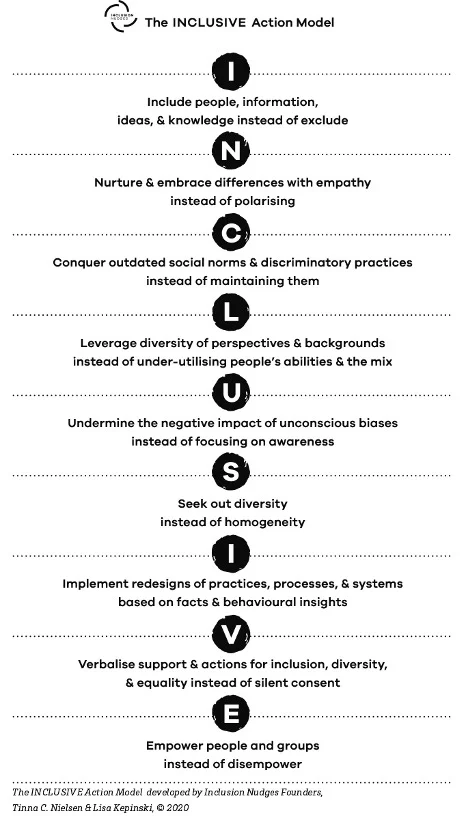
This is where the power of "Inclusion Nudges" comes to the forefront. Drawing from insights in behavioral economics, social psychology, and nudge theory (popularized by Cass Sunstein and Richard Thaler), Inclusion Nudges are defined as:
An Inclusion Nudge is an action designed to influence the unconscious mind, making it easy to be inclusive and to perform inclusive actions automatically in daily interactions and decision-making. These actions are practical applications of insights about human behavior and decision-making, combined with an understanding of the hidden barriers to achieving inclusion. Inclusion Nudges work by subtly steering the unconscious mind—both your own and that of others—to adopt inclusive behaviors by default, without relying on conscious effort or rational persuasion.
Inclusion Nudges operate by minimizing the impact of mental shortcuts (biases) and reducing the cognitive load on the conscious mind. Instead of attempting to convince people to change their ingrained biases through rational argument, Inclusion Nudges subtly reshape the environment or decision-making context to make the desired inclusive behavior the automatic, default choice. This approach aligns individual behavior with stated values and intentions, often without the need for threats, punishments, or even significant financial investment, while always respecting freedom of choice.
Illustrative Examples of Inclusion Nudges in Action:
The concept of mitigating bias through design is not new, yet its widespread adoption remains slow despite compelling evidence. A classic and highly effective example is the implementation of anonymous auditions by symphony orchestras, a practice that gained traction in the 1970s. Initially spurred by internal questions regarding the overwhelming predominance of white male musicians, a pilot program introduced screens to conceal candidates from selection committees during auditions. The results were immediate and profound: the number of women selected increased by approximately 50%, and the ethnic diversity of successful candidates also saw a radical shift. This design intervention, an Inclusion Nudge, became a permanent fixture in most major symphony orchestras worldwide. Some orchestras have even gone further, placing carpets behind screens to muffle the sound of shoes, recognizing that even subtle cues like footwear can unconsciously prime gender biases and subtly influence how committee members perceive the musical performance. This simple, low-cost design change effectively neutralized a significant source of unconscious bias, ensuring selections were based purely on merit.
Beyond orchestras, Inclusion Nudges can be applied across various organizational contexts:
- Hiring Processes: Anonymizing résumés by removing names, universities, and other identifying information known to trigger bias (e.g., gender, ethnicity, socioeconomic background) before the initial screening phase. This ensures candidates are judged solely on qualifications and experience.
- Performance Reviews: Implementing structured feedback forms with specific, objective criteria and requiring managers to provide examples for each rating, rather than relying on subjective general impressions. This reduces halo/horns effects and similarity bias.
- Meeting Dynamics: Designating a "devil’s advocate" or a "contributor’s tracker" in meetings to ensure all voices are heard and dominant personalities don’t monopolize discussions. This counteracts groupthink and amplification of certain voices.
- Promotion Panels: Requiring panels to explicitly list the specific skills and achievements that led to a promotion decision and comparing them against pre-defined criteria, rather than relying on subjective "fit" or "potential" which can be proxies for bias.
- Communication: Using gender-neutral language in job descriptions and internal communications, as well as employing diverse imagery in company materials, to signal an inclusive environment.
The effectiveness of these design-based interventions, many of which have been validated over decades, stands in stark contrast to the fleeting impact of awareness training. It is perplexing that despite over 40 years of evidence regarding designs like anonymous auditions, their implementation remains less widespread than the reliance on ineffective awareness programs. The imperative to accelerate the adoption of such proven methods is clear.
Conclusion: A Call for Systemic Change
The journey towards a truly equitable and inclusive world demands more than just awareness; it requires intentional, systemic redesign. We must move beyond the allure of quick-fix awareness training, which has proven to be a costly and often counterproductive endeavor. Instead, organizations must embrace a behavioral science-informed approach, leveraging Inclusion Nudges to mitigate the pervasive influence of unconscious bias by making inclusive behaviors the default and the norm. By strategically designing our environments, processes, and decision-making architectures, we can steer the unconscious mind towards equity, fostering cultures where inclusion is automatic and inherent, not an afterthought. This shift from individual "fixing" to systemic "designing" represents the most effective and sustainable path towards creating a more just and equitable society for the greater good of all. The time for passive awareness is over; the era of active, intelligent design for inclusion has arrived.