A federal judge has issued a temporary restraining order blocking Paramount Global’s proposed acquisition of Warner Bros. Discovery, following a lawsuit filed by twelve states that alleges the colossal media merger would violate antitrust laws. The unprecedented legal challenge casts a significant shadow over a deal that, if finalized, would fundamentally reshape the landscape of American entertainment and news media, consolidating control over a vast array of iconic cable channels and theatrical distribution arms.
The legal action, initiated this week, centers on concerns that the proposed merger would create a media behemoth with unchecked market power. Paramount’s potential acquisition of Warner Bros. Discovery would bring together two of the largest entertainment conglomerates in the world. This consolidation would grant the combined entity ownership of numerous flagship cable networks, including HBO, CNN, TBS, TNT, and the Discovery Channel, alongside Paramount’s own stable of channels such as CBS, MTV, Nickelodeon, and Comedy Central. Furthermore, the deal would merge the theatrical distribution capabilities of both studios, significantly influencing the production and release of films across the industry.
The antitrust lawsuit, filed by a coalition of state attorneys general, argues that the proposed merger would stifle competition, limit consumer choice, and potentially lead to increased prices for consumers of both entertainment content and news programming. The states contend that the concentration of media assets under a single corporate umbrella could lead to a reduction in diverse programming and limit the ability of independent creators and smaller studios to compete.
A crucial element of the states’ argument, and a point of significant public interest, is the potential impact on news media. Warner Bros. Discovery currently owns CNN, one of the most widely recognized news brands in the United States. Paramount, through its parent company, owns CBS News, another pillar of American journalism. According to a 2025 Pew Research Center survey, approximately one-third of U.S. adults regularly receive their news from CNN, while three-in-ten rely on CBS News. The prospect of these two major news organizations operating under a single corporate owner has raised alarms among media watchdogs and policymakers concerned about the future of independent journalism and the potential for consolidated ownership to influence news coverage.
The temporary restraining order issued by the federal judge is a preliminary step, designed to halt any further integration of the companies’ operations while the court reviews the merits of the antitrust claims. This injunction signifies that the judicial system is taking the states’ concerns seriously and will likely lead to a lengthy legal battle. The outcome of this legal process could have far-reaching implications for the media industry, setting precedents for future mergers and acquisitions and influencing the regulatory environment for large media corporations.
Background and Chronology of the Proposed Merger
The initial discussions and potential framework for a merger between Paramount Global and Warner Bros. Discovery have been circulating in industry circles for some time, fueled by intense competition in the streaming era and the ongoing consolidation of media assets. While specific timelines for preliminary negotiations have not been publicly disclosed, the formal announcement of the proposed acquisition is believed to have occurred in late 2025 or early 2026, setting the stage for regulatory review and subsequent legal challenges.
The process typically involves extensive due diligence by both parties, followed by the filing of notifications with antitrust authorities in various jurisdictions, including the U.S. Department of Justice and the Federal Trade Commission. However, the preemptive filing of an antitrust lawsuit by a group of states bypasses the standard regulatory review process and forces immediate judicial intervention. The states’ decision to file their lawsuit and seek an injunction suggests they believe the potential harm to competition is so significant that immediate action is warranted.
The temporary restraining order, issued by the federal court, is a short-term measure, typically lasting for a few days or weeks, to preserve the status quo while the court considers a request for a preliminary injunction. A preliminary injunction, if granted, would extend the halt on the merger for the duration of the legal proceedings, which can take months or even years. The states’ lawsuit will likely outline specific arguments regarding market concentration, potential for anti-competitive practices, and the impact on consumers, demanding that the court block the merger permanently.
Data on Media Consumption and Market Concentration
The proposed merger between Paramount Global and Warner Bros. Discovery involves entities that are deeply entrenched in the American media landscape. Warner Bros. Discovery boasts a portfolio that includes a significant number of the most-watched cable channels, particularly in news and entertainment. The company’s streaming services, Max (formerly HBO Max), have a substantial subscriber base, and its film studios have consistently produced blockbuster hits. Paramount Global, with its legacy broadcast network CBS and a diverse range of cable channels and film studios, is another major player.
The consolidation of these assets raises particular concerns regarding market share. For example, in the realm of cable news, the combined entity would exert significant influence. As highlighted by Pew Research Center data, CNN and CBS News are regularly consumed by a large percentage of the U.S. adult population. A single owner controlling both could lead to a reduction in the diversity of news perspectives and potentially concentrate advertising revenue, impacting smaller news outlets.
In the broader entertainment sector, the combined library of films and television shows would be immense, potentially giving the merged company significant leverage in content licensing and distribution negotiations. This could impact how other platforms, including emerging streamers and independent content creators, access popular content. The sheer scale of the combined operation would also give it considerable power in negotiations with advertisers, potentially leading to less favorable terms for those seeking to reach audiences through traditional and digital media.

Broader Implications for the Media Industry
The media industry has been undergoing a period of rapid transformation, driven by technological advancements and evolving consumer habits. The rise of streaming services, the proliferation of digital news sources, and the increasing demand for on-demand content have put pressure on traditional media companies. This has led to a wave of mergers and acquisitions as companies seek to achieve economies of scale, diversify their revenue streams, and gain a competitive edge.
The current trend of media companies investing more heavily in video content production, as noted by industry observers, is a testament to the evolving consumption patterns. News organizations, including The New York Times and The Wall Street Journal, are reportedly shifting resources towards video, recognizing the growing importance of this medium. This pivot to video is partly driven by the increasing consumption of news on video-focused social media platforms like YouTube, TikTok, and Instagram. Pew Research Center data from 2025 indicated that 35% of U.S. adults regularly get news on YouTube, a significant increase from 23% in 2020.
However, the preference for how Americans consume news remains relatively stable, with a slight edge to visual mediums. An August 2025 survey found that 44% of Americans prefer to watch the news, compared to 37% who prefer reading and 19% who prefer listening. These preferences have remained consistent since 2016, underscoring the enduring importance of television and video in news delivery.
The Paramount-Warner Bros. Discovery merger, if it were to proceed, would represent a monumental shift in this dynamic landscape. It would consolidate significant power and resources, potentially allowing the combined entity to dictate terms across multiple sectors of the media industry. Critics of such mega-mergers often point to the risk of a "too big to fail" scenario, where a consolidated entity becomes so integral to the media ecosystem that its failure would have catastrophic consequences, potentially leading to less stringent regulatory oversight in the future.
Analysis of Engagement Groups and Civic Life
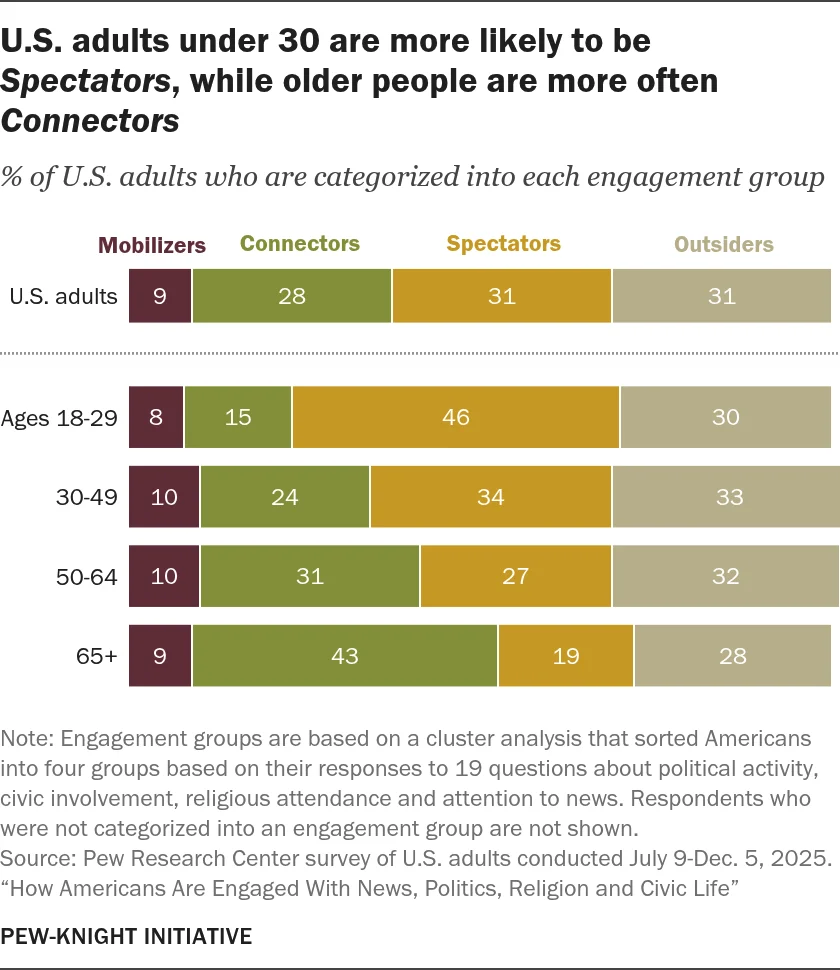
Beyond the corporate implications, Pew Research Center’s recent report on how Americans engage with news, politics, religion, and civic life offers a nuanced perspective on the broader societal impact of media consumption. The report identifies four distinct "engagement groups": Mobilizers, Connectors, Spectators, and Outsiders. This analysis, based on a survey conducted between July and December 2025, reveals differing patterns of participation across age groups and engagement styles.
The study found that older Americans are more likely to be categorized as "Connectors," individuals who actively participate in civic and community life, attend religious services, and engage in volunteer activities. In contrast, younger Americans, particularly those aged 18-29, are more prone to being "Spectators." Spectators tend to follow news and interact with it online but are less likely to be involved in other forms of civic or community engagement.
Specifically, the data indicates that among adults aged 18-29, 46% are Spectators, compared to only 15% who are Connectors. This contrasts sharply with adults aged 65 and older, where 43% are Connectors and only 19% are Spectators. This generational divide highlights a potential challenge for civic engagement, as a significant portion of the younger population, while informed through media, may be less actively involved in traditional forms of community participation.
The "Mobilizers" are a smaller group characterized by high levels of engagement across political, civic, and religious activities. The "Outsiders" represent those who are disengaged from most forms of public life. The report’s detailed breakdown across age demographics provides valuable insights into how different segments of the population interact with information and participate in society, offering a backdrop against which the implications of media consolidation can be considered. A more concentrated media ownership could, in theory, influence the information flow to these various engagement groups, potentially shaping their perceptions and participation in civic life.
Looking Ahead: The Future of Media Regulation and Ownership
The ongoing legal battle over the Paramount-Warner Bros. Discovery merger is likely to be a protracted and closely watched affair. The states’ antitrust lawsuit signals a potentially more assertive stance from regulators and state governments regarding the consolidation of media power. The outcome could influence how future large-scale media mergers are reviewed and whether existing antitrust laws are deemed sufficient to address the complexities of the modern media landscape.
The trend towards increased video content creation and consumption by news organizations, coupled with the growing reliance on social media platforms for news, further complicates the regulatory environment. Policymakers and industry leaders will need to grapple with questions of platform accountability, content moderation, and the potential for algorithmic amplification of certain types of information.
As the legal proceedings unfold, the media industry will be observing closely, anticipating the potential ramifications for competition, innovation, and the future of news and entertainment delivery. The temporary restraining order represents a significant pause in what could have been one of the most transformative media deals in recent history, opening a critical window for public debate and judicial scrutiny on the concentration of media ownership in the United States.