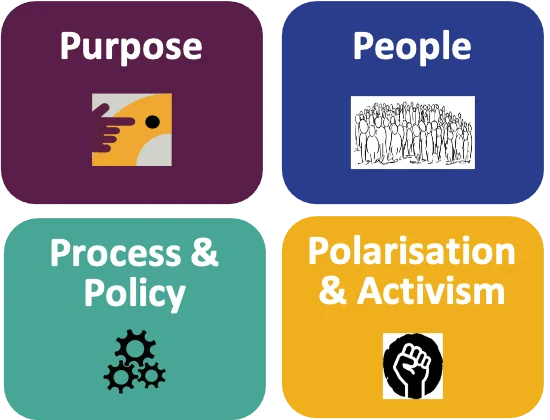
The past two years have served as a global laboratory for the most rapid and comprehensive transformation of the workplace since the Industrial Revolution. As the COVID-19 pandemic necessitated unprecedented shifts in operations, it simultaneously triggered a profound psychological and sociological re-evaluation of the professional landscape. This period, characterized by high volatility and ambiguity, has fundamentally altered the social contract between employer and employee. Organizations are now grappling with four core pillars of change: the search for individual purpose, the shifting power dynamics of the workforce, the necessity of revised process and policy, and the rising tide of polarization and employee activism.
A Chronology of Disruption and Response
The disruption began in early 2020 as lockdowns forced a mass migration to remote work. What was initially perceived as a temporary crisis measure soon evolved into a permanent structural shift. By the summer of 2021, the narrative had transitioned from "crisis management" to "The Great Resignation," a period marked by historic turnover rates in the United States, the United Kingdom, and across Europe.
Data from the U.S. Bureau of Labor Statistics revealed that in August 2021 alone, 4.3 million Americans voluntarily left their positions. This trend was not isolated to one sector; it spanned industries from healthcare—which faced extreme burnout—to technology and service-based roles. Simultaneously, the United Kingdom reported a record-breaking 1 million open job vacancies during the same period. By late 2021, the focus had shifted from mere retention to a broader "Great Reset," as workers demanded better alignment between their personal values and their professional outputs.
The Rise of Purpose-Driven Employment
The pandemic acted as a catalyst for a global existential audit. For millions of employees, the isolation and uncertainty of lockdowns prompted a critical question: Is my current role worth the personal sacrifice?
Research from McKinsey & Company indicates that nearly two-thirds of U.S. respondents reconsidered their personal purpose in life due to the pandemic. This sentiment was echoed in the 2021 Edelman Trust Barometer, which found that 60% of employees were either actively searching for or had already transitioned to roles that better aligned with their personal values.
The implication for organizational leadership is stark: compensation and traditional career advancement are no longer the primary levers for retention. Today’s workforce prioritizes lifestyle, psychological safety, and the integration of personal purpose into the professional sphere. This shift is particularly pronounced among younger generations; Millennials are three times more likely than their predecessors to evaluate their employment through the lens of purpose. Conversely, the "Great Retirement" phenomenon, which saw the number of U.K. workers over 50 retiring early more than double, suggests that for many, the pandemic served as the final push toward exiting the workforce entirely rather than continuing in roles that felt disconnected from their values.
The Human Capital Crisis and Economic Inequality
The shift in power from employers to employees has created a new, complex economic reality. While "The Great Resignation" captured headlines, it obscured the more troubling phenomenon of "The Great Divergence." While some workers had the agency to demand better conditions, others faced involuntary job losses.
Global data from the International Labour Organization (ILO) notes that 2021 saw global working hours remain 4.3% below pre-pandemic levels—a deficit equivalent to 125 million full-time jobs. The economic recovery has been uneven, with low-wage workers bearing the brunt of the instability. The OECD has highlighted that the decline in working hours was most significant in low-paid sectors, exacerbating pre-existing inequalities.
For organizational leaders, the challenge is twofold: they must address the "rage quitting" and talent attrition caused by negative work environments, while also ensuring that their diversity, equity, and inclusion (DEI) strategies do not inadvertently leave behind those most impacted by the economic contraction.
Re-engineering Process and Policy
As businesses move toward hybrid and remote models, the traditional workplace infrastructure is being dismantled. The "always-on" culture and the rigid adherence to office-based presenteeism have been exposed as outdated.
A critical failure identified in recent studies is the disconnect between executive perception and employee experience. A Future Forum pulse report found that while 66% of executives believed they were being "very transparent" regarding post-pandemic workforce policies, only 42% of employees concurred. Furthermore, 66% of executives admitted to designing these policies with little to no input from the workforce.
This top-down approach is increasingly viewed as a liability. Effective policy, according to current organizational research, requires the co-creation of rules. When employees are included in the design of hybrid work schedules and communication protocols, engagement and retention scores improve. The historical bias that favored senior male staff for remote work requests is now being challenged by a more diverse workforce that demands equitable access to flexible working conditions as a matter of policy, not privilege.
Polarization, Activism, and the New Social Contract
The workplace has become an extension of the broader social and political arena. With 60% of people in 17 countries reporting that their societies are more divided now than before the pandemic, these tensions are manifesting in the office. Issues such as mandatory vaccination policies and broader social justice movements have tested the limits of corporate neutrality.
The murder of George Floyd in May 2020 served as a pivotal moment for workplace activism. Employees are no longer satisfied with "nice-sounding" public statements regarding DEI. They are demanding that leaders take definitive, public stances on social issues. The 2021 Edelman Trust Barometer Special Report revealed that 76% of employees expect their employers to act on social issues, and 33% of employees have quit jobs specifically because their employer failed to speak out on a societal or political issue that they felt was relevant.
This environment has led to a resurgence in organized labor and a new expectation for "allyship through action." The era of the "silent executive" has effectively ended. Leaders are now being evaluated by their ability to navigate complex social landscapes while maintaining internal cohesion and psychological safety.
Implications for the Future of Work
The cumulative effect of these trends is a fundamental reconfiguration of the workplace. Organizations that continue to operate on pre-2020 assumptions risk losing top talent and alienating the next generation of workers.
To remain competitive, organizations must move beyond performative measures. This involves:
- Integrating Purpose: Leaders must facilitate environments where employees can see the direct impact of their work on both the organization’s mission and society.
- Inclusive Design: Policies concerning remote work, compensation, and career progression must be data-driven and inclusive, removing the barriers that have historically favored specific demographics.
- Active Allyship: Executive leadership must move from passive statements to measurable, transparent actions that support underrepresented groups and address systemic inequalities.
- Agile Experimentation: In a state of constant flux, policies cannot be static. Organizations should adopt a model of agile experimentation, continuously gathering employee feedback and iterating on processes to meet changing needs.
The pandemic-era shifts are not merely temporary adjustments to a temporary crisis; they represent a permanent realignment of priorities. The organizations that will thrive in the coming decade are those that recognize this shift not as a burden, but as an opportunity to build more sustainable, equitable, and effective workplaces. As we emerge from the height of the pandemic, the focus must remain on creating structures that are flexible enough to adapt to future shocks and human-centric enough to foster genuine engagement. The "Great Reset" is not a singular event, but an ongoing process of refinement, listening, and intentional design.