In the contemporary corporate landscape, marked by volatile markets, rapid technological shifts, and the lingering structural impacts of the global pandemic, organizational leaders are increasingly looking toward team composition as a primary lever for success. While Diversity, Equity, and Inclusion (DEI) initiatives have historically prioritized demographic representation—focusing on gender, race, and ethnicity—a growing body of research suggests that cognitive diversity represents the next essential evolution in human capital strategy. By integrating varied information-processing styles and mental frameworks, organizations are better positioned to navigate complexity, mitigate systemic risk, and foster genuine innovation.
The Evolution of Diversity Frameworks
The discourse surrounding diversity has undergone a significant transition over the past two decades. In the early 2000s, the "business case" for diversity was primarily centered on legal compliance and corporate social responsibility. By the 2010s, academic literature began to quantify the correlation between demographic diversity and financial performance. McKinsey & Company’s seminal 2015 report, "Why Diversity Matters," provided empirical evidence that companies in the top quartile for racial and ethnic diversity were 35% more likely to have financial returns above their respective national industry medians.
However, as organizations achieved higher levels of representation, a secondary challenge emerged: the "diversity paradox." Teams with diverse demographics sometimes struggled to reach consensus or innovate effectively if they shared a uniform way of processing information. This led to the emergence of cognitive diversity as a formal field of study, focusing not on how people look, but on how they think.
Defining Cognitive Diversity: The Robertson Framework
Cognitive diversity encompasses the variations in mental frameworks, personality styles, and problem-solving approaches within a team. Psychiatrist Peter Robertson, whose work has been instrumental in this field, categorizes cognitive diversity into two primary domains that determine how teams respond to uncertainty.
First, the dimension of "Knowledge and Information Processing" differentiates between those who prefer to consolidate existing systems and those who prioritize the generation of novel, experimental knowledge. Second, "Perspective and Expertise Facilitation" identifies whether individuals prefer to leverage their specific, specialized expertise or act as an orchestrator, synthesizing the ideas and inputs of others.
Research conducted by Alison Reynolds and David Lewis has underscored that teams exhibiting a high degree of diversity across these two parameters are consistently faster and more accurate in solving complex problems. Their findings suggest that when a team consists of individuals with different mental models—some focusing on risk management and others on exploration—they create a "friction" that, when properly managed, prevents the cognitive trap of groupthink.
The Role of Psychological Safety in Team Dynamics
The effectiveness of cognitive diversity is strictly contingent upon psychological safety—a term popularized by Harvard Business School professor Amy Edmondson. Psychological safety refers to the belief that one will not be punished or humiliated for speaking up with ideas, questions, concerns, or mistakes.
In studies of high-performing teams during periods of crisis, researchers found that cognitive diversity without psychological safety often leads to either "group conformity"—where dissenting voices are suppressed—or "combative tension," where the team devolves into unproductive conflict. When leaders foster an environment of psychological safety, cognitive diversity becomes a catalyst for constructive debate. This environment encourages team members to iterate, experiment, and challenge assumptions, which are the fundamental components of agile problem-solving.
Chronology of Corporate DEI Integration
- 2000–2010: Focus on legal compliance, anti-discrimination policy, and basic representation metrics.
- 2011–2018: The emergence of "Business Case DEI." Organizations begin linking demographic diversity to profitability, leading to the adoption of formal D&I departments.
- 2019–2021: The COVID-19 pandemic forces a shift toward remote, cross-functional collaboration, exposing the limitations of demographic-only diversity in high-uncertainty environments.
- 2022–Present: A shift toward "Inclusive Leadership" models. The emphasis moves from hiring quotas to the behavioral management of diverse teams, with an increased focus on cognitive neurodiversity and information processing styles.
The Impact of Inclusive Leadership
According to Deloitte Australia’s research into inclusive leadership, the behaviors of direct supervisors are responsible for up to 70% of the variance in employee perceptions of inclusion. This data indicates that policy-level mandates are insufficient; organizational culture is defined at the team level through daily interactions.
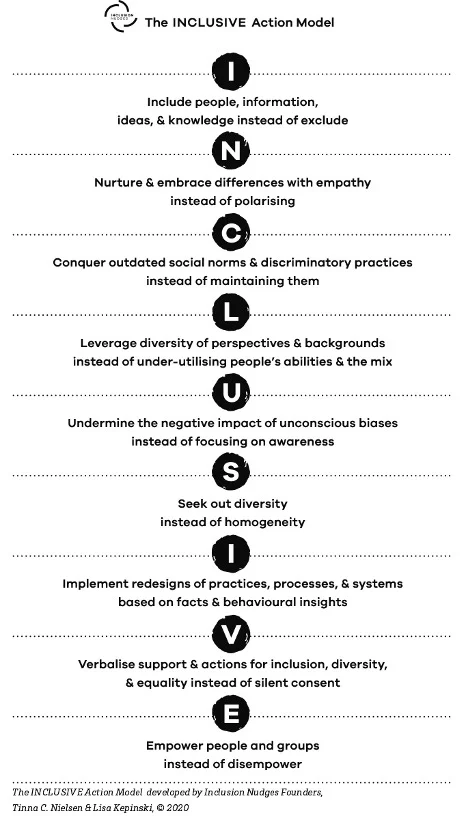
Despite this, a persistent "implementation gap" remains. Many leaders report feeling ill-equipped to facilitate the difficult dialogues required to manage a cognitively diverse team. This hesitation often stems from a fear of causing offense or an inability to navigate conflicting viewpoints without damaging team cohesion. Experts Tinna Nielsen and Lisa Kepinski, authors of the Inclusion Nudges guidebooks, argue that the solution lies in behavioral design. By implementing small, repeatable actions—or "nudges"—leaders can institutionalize fairness and belonging, turning these concepts from abstract values into daily habits.
Broader Implications for Global Organizations
The shift toward valuing cognitive diversity has profound implications for recruitment, performance management, and organizational structure. If cognitive diversity is the differentiator for success in complex environments, traditional "culture fit" hiring processes may be counterproductive. Hiring for "culture add" rather than "culture fit" requires organizations to assess how a candidate’s problem-solving style complements existing team members.
Furthermore, the integration of demographic and cognitive diversity is not an "either-or" proposition. The most resilient organizations are those that pursue both simultaneously. Demographic diversity provides the necessary variety of life experiences and perspectives, while cognitive diversity ensures those perspectives are applied to problem-solving in ways that are not hindered by homogeneous thinking.
Analyzing the Future of Work
As AI and automated systems begin to handle more routine, data-intensive tasks, the human element of business—strategy, innovation, and complex decision-making—becomes increasingly valuable. In this context, cognitive diversity is not just a human resources goal; it is a competitive advantage. Organizations that fail to cultivate this form of diversity risk becoming "echo chambers" that are unable to pivot when faced with market disruptions.
The data supports the necessity of this shift. Companies that successfully implement inclusive leadership and leverage diverse cognitive styles report higher levels of employee engagement and retention. For minority groups, who often bear the brunt of non-inclusive work environments, these practices are not merely beneficial—they are essential for professional longevity and advancement.
Conclusion
The challenge for the modern executive is to transition from the era of passive diversity advocacy to one of active, behavioral inclusion. By recognizing that diversity is a multi-dimensional asset—encompassing both the identity of the individual and the unique way they process the world—organizations can build the cognitive agility required for the next decade of global volatility.
The path forward involves a systematic approach to leadership development. Providing managers with the tools to facilitate constructive disagreement, encouraging psychological safety, and designing inclusive team structures will be the defining tasks for HR and executive leadership in the coming years. As the research suggests, the most effective teams of the future will be those that have learned to balance the comfort of consensus with the essential, sometimes difficult, value of diverse perspectives. In an uncertain world, cognitive diversity is the ultimate hedge against obsolescence.