
A federal judge issued a preliminary injunction on September 24, 2026, mandating that the Trump administration immediately restore White House access to reporters from CNN, MS NOW, and Politico. The ruling comes after a legal challenge filed by the news organizations following the sudden revocation of their press credentials last week. The incident represents a significant escalation in the ongoing friction between the executive branch and segments of the national press corps, bringing long-standing debates regarding the boundaries of presidential authority and the protections afforded by the First Amendment to the forefront of the American political discourse.
Chronology of the Dispute
The conflict originated on September 17, 2026, when the White House Press Office informed representatives from CNN, MS NOW, and Politico that their permanent press passes had been suspended. The administration cited “security concerns” and “repeated failure to adhere to established decorum protocols” during recent press briefings as the justification for the move. Within 48 hours of the announcement, the affected outlets joined forces to file a lawsuit in the U.S. District Court for the District of Columbia.
The plaintiffs argued that the revocation was not motivated by legitimate security or decorum concerns but was instead a retaliatory measure intended to punish news organizations for critical reporting. By September 22, the court held an emergency hearing, during which the plaintiffs’ attorneys contended that the exclusion of specific, high-profile media organizations from the White House grounds constituted a violation of the Fifth Amendment’s due process requirements and an infringement upon the First Amendment rights of the press to gather news. The administration’s legal team maintained that the president possesses broad, discretionary authority to manage the White House complex and that access to the grounds is a privilege, not a constitutional right. The judge’s ruling on the 24th rejected the administration’s arguments for permanent exclusion, emphasizing that the government cannot use access as a tool for viewpoint-based discrimination.
The Landscape of Public Trust and Press Freedom
The legal battle over credentials unfolds against a backdrop of deep ideological polarization regarding the role of the media. Data from a June 2026 survey conducted by the Pew-Knight Initiative illustrates a significant divide in how the American public perceives the state of press freedom under the second Trump administration. Overall, 44% of U.S. adults believe the press has become less free during this term, while 12% perceive an increase in freedom, and 26% report observing no change.
The partisan chasm is stark: 72% of Democrats view the current environment as increasingly hostile to journalists, whereas only 15% of Republicans share that assessment. This skepticism is mirrored in the public’s consumption habits and levels of trust. Research from March 2025 indicated that a majority of Republicans express distrust in CNN, MS NOW, and Politico, with 58% of Republicans specifically noting a lack of trust in CNN. President Trump has frequently cited this perceived bias in his public remarks, often characterizing the coverage from these specific outlets as “unfair” and “negative,” framing the revocation of credentials as a necessary response to what he describes as two years of biased reporting.
Corporate Consolidation and Editorial Oversight
The broader media ecosystem is currently undergoing a structural transformation that may influence how news is delivered and scrutinized. Paramount has officially reached a settlement in a multi-state antitrust lawsuit, paving the way for its acquisition of Warner Bros. Discovery. This merger will consolidate two of the largest news-gathering operations in the United States: CNN and CBS News.

As a condition of the settlement, Paramount has agreed to the establishment of an independent editorial board tasked with providing oversight for the news networks. This move is designed to address concerns regarding the concentration of media power and potential conflicts of interest in reporting. According to a 2025 Center survey, these two entities are vital to the American news diet, with one-third of U.S. adults reporting that they receive their news from CNN, and three-in-ten relying on CBS News. With nearly half of the population (46%) utilizing at least one of these sources for regular updates, the editorial independence of this new conglomerate carries significant implications for the diversity of information available to the public.
Statistical Analysis of Public Concern
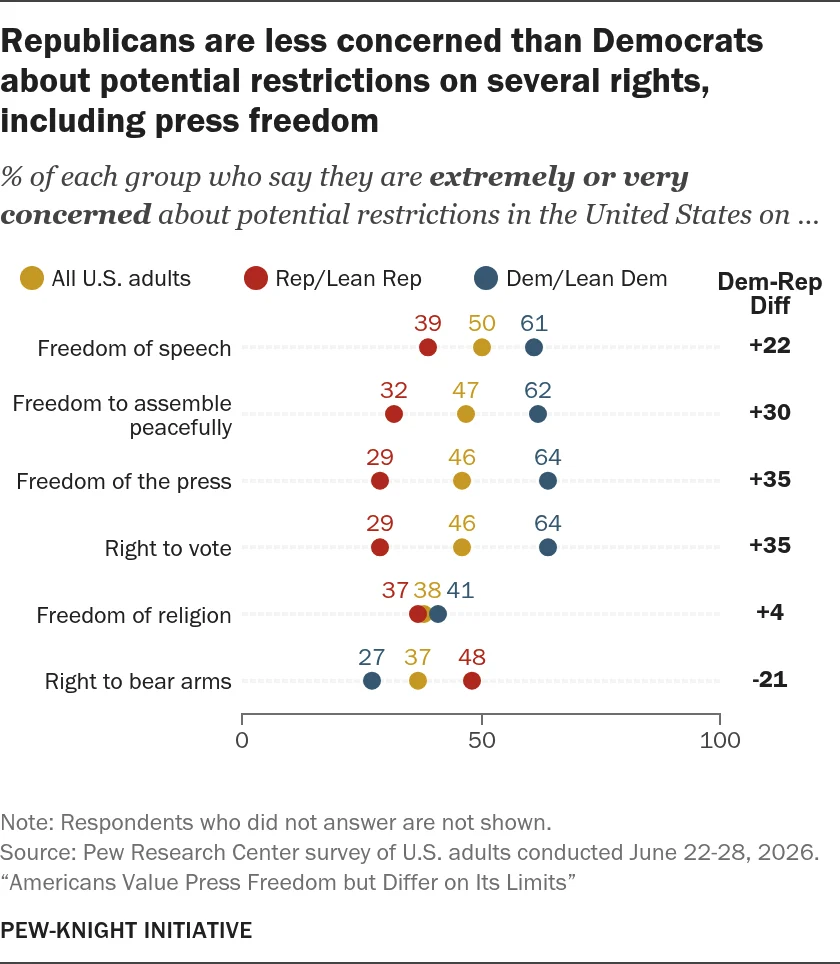
Public concern regarding the health of democratic institutions is not limited to the press. The Pew-Knight Initiative report released in September 2026 reveals that 46% of U.S. adults are extremely or very concerned about potential restrictions on press freedom. This level of anxiety is comparable to concerns regarding other foundational rights, including freedom of speech (50%), the right to peaceful assembly (47%), and the right to vote (46%).
The data highlights a consistent pattern of partisan divergence. Democrats are notably more concerned than Republicans regarding potential restrictions on freedom of the press and the right to vote, with a 35-percentage-point gap between the two groups on both issues. Conversely, Republicans are more likely to express concern regarding potential limits on the right to bear arms, a concern shared by 48% of the group compared to just 27% of Democrats. These findings suggest that the national conversation regarding constitutional rights is increasingly filtered through a partisan lens, where the perceived threat to a specific right often aligns with the political party’s core advocacy priorities.
Implications for the Future of News Gathering
The court’s decision to restore press access serves as a temporary reprieve for the affected news organizations, but the case is far from closed. The litigation will likely proceed to a full trial, which will further examine the constitutional parameters of the White House’s authority over the press corps. Legal analysts suggest that the outcome of this case could set a significant precedent for how future administrations manage access to government officials.
Beyond the courtroom, the incident has prompted a broader discussion within the media industry about the importance of objective reporting in a climate of high distrust. Journalists and media watchdogs have emphasized that the role of the White House press corps is to provide independent scrutiny of the executive branch, regardless of the president’s approval rating or the tone of the coverage. The administration’s critics argue that by attempting to exclude certain outlets, the White House is essentially attempting to curate the narrative, potentially stifling the public’s ability to receive information from a variety of perspectives.
Conversely, supporters of the administration argue that the press has abandoned its traditional role of reporting the news in favor of activism, thereby forfeiting the traditional deference that was once afforded to the White House press corps. This argument resonates with a significant portion of the electorate that feels alienated by mainstream media narratives.
As the 2026 calendar progresses, the intersection of legal battles, corporate media consolidation, and public opinion shifts remains a critical area of focus. The ability of the press to maintain access and credibility while operating in a highly volatile political environment will likely continue to be a defining feature of the current era of American politics. Whether through further judicial intervention or a recalibration of the relationship between the press and the presidency, the struggle for information access will continue to shape the democratic process in the coming months and years. The outcome of the ongoing litigation remains a focal point for those monitoring the health of the American news media and the foundational principles of the First Amendment.




