
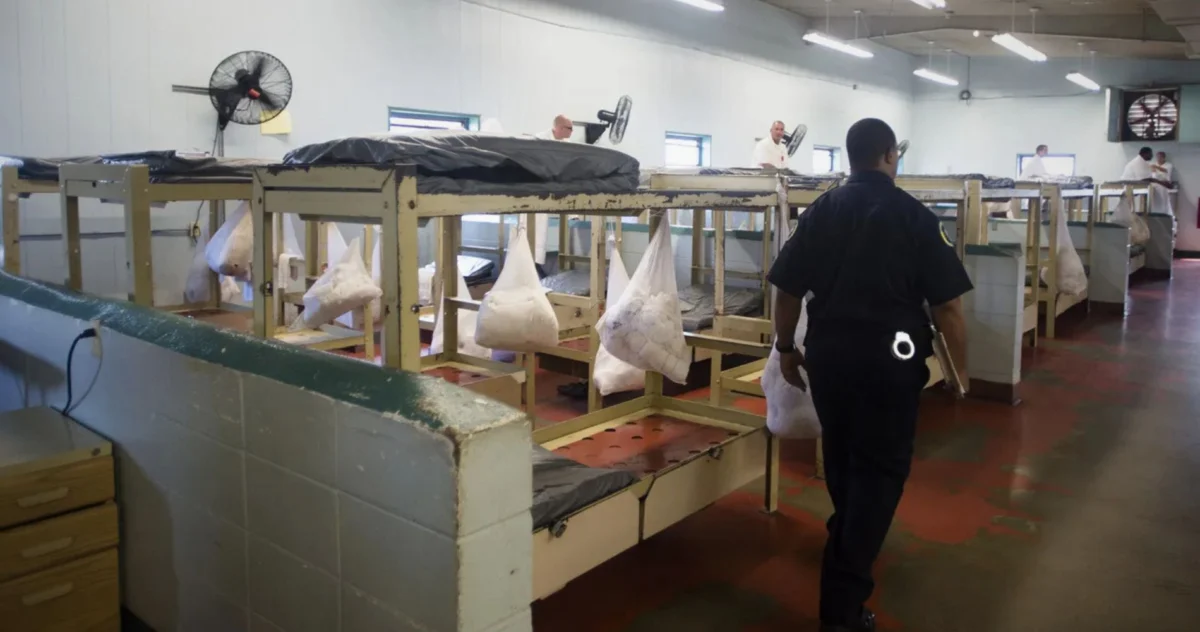
The indictment, returned on December 5, 2025, represents a significant development in the ongoing scrutiny of the Alabama Department of Corrections (ADOC). Melvin Ledarrius Thomas, 35, faces a two-count indictment charging him with reckless manslaughter and failing to perform a legal duty regarding a person in his custody. These charges stem from the death of 45-year-old Antwion Webb, who was fatally stabbed while incarcerated at the Donaldson Correctional Facility in Bessemer, Alabama.
The case has drawn sharp attention from legal experts, civil rights advocates, and the families of those incarcerated within the state’s notoriously overburdened prison system. For years, critics have argued that the pervasive violence within Alabama’s facilities is not merely an unfortunate byproduct of inmate populations, but a consequence of systemic mismanagement, understaffing, and, in some documented instances, the active or passive complicity of correctional personnel.
The Incident: A Fatal Failure of Duty
According to records and the subsequent indictment, the incident occurred during the late-night hours of Friday, September 12, 2025. Antwion Webb was attacked by another incarcerated individual within the walls of the Donaldson facility. The assault resulted in a severe, sharp-force injury to Webb’s chest.
While the immediate cause of death was the stabbing, the criminal charges against Thomas focus on his alleged failure to provide essential medical intervention and his decision-making following the initial assault. Prosecutors allege that Thomas, while acting in his official capacity as a correctional officer, was aware that Webb had sustained a life-threatening wound. Rather than securing emergency medical care or isolating the victim for treatment, it is alleged that Thomas recklessly returned Webb to the general population.
Webb’s condition continued to deteriorate throughout the night. Despite the severity of his injuries, he did not receive the emergency surgical intervention required to save his life. He was pronounced dead at 4:36 a.m. on Saturday, September 13, 2025. The delay in medical care, according to the indictment, directly contributed to his passing.
Chronology of Events
The legal and administrative aftermath of the incident unfolded over several months:
- September 12, 2025: Antwion Webb is stabbed in the chest during an assault at the Donaldson Correctional Facility.
- September 13, 2025: Mr. Webb is pronounced dead by medical personnel at 4:36 a.m.
- September 20, 2025: One week after the incident, Melvin Ledarrius Thomas’s employment with the Alabama Department of Corrections is terminated.
- December 5, 2025: A grand jury returns a two-count indictment against Thomas, formalizing the charges of reckless manslaughter and failure to perform a legal duty.
- August 26, 2026: Thomas is booked into the Jefferson County Jail. He is released the same day after posting a $20,000 bond.
- October 26, 2026: Thomas is scheduled to appear for his formal arraignment to enter a plea regarding the charges.
The Context of Systemic Prison Violence
The death of Antwion Webb occurs against a backdrop of prolonged federal oversight and a crisis of violence that has plagued the Alabama prison system for decades. In April 2019, the United States Department of Justice (DOJ) formally notified the ADOC that its facilities were unconstitutionally violent. The federal government’s investigation found that the state failed to protect incarcerated individuals from prisoner-on-prisoner violence, sexual assault, and excessive force by staff.
Since that 2019 notification, the situation has shown little sign of stabilization. Documentation from the Equal Justice Initiative (EJI) and other watchdog organizations indicates that more than 100 individuals have been killed within Alabama’s prison system since the DOJ’s intervention. These homicides are often attributed to a combination of severe staffing shortages—which leave large housing units unsupervised for extended periods—and a culture of negligence that has been allowed to fester.
The allegation that correctional officers may be conspiring with, or ignoring, violence between incarcerated people is a frequent point of contention in civil rights litigation. When staff members fail to intervene in active assaults or, worse, facilitate them, they erode the basic security protocols intended to keep the facility safe. The indictment of Thomas highlights a shift toward holding individual officers criminally liable for their specific failures, rather than focusing solely on institutional policy reform.
Legal and Ethical Implications
The indictment of Melvin Ledarrius Thomas serves as a cautionary signal to other correctional employees. While qualified immunity often protects public officials from civil liability, criminal charges such as reckless manslaughter bypass these protections when it can be proven that an officer acted with conscious disregard for a substantial and unjustifiable risk.
Legal experts observing the case note that the "failure to perform a legal duty" charge is particularly significant. In a correctional setting, the state has a "special relationship" with those it incarcerates. Because inmates cannot seek their own medical care or protect themselves from harm when locked in a cell, the state assumes a non-delegable duty to provide for their safety and health. When an officer observes a life-threatening injury and chooses to ignore it or, as alleged here, returns an injured person to an environment where they are vulnerable to further harm, that duty is breached.
For the families of the incarcerated, the prosecution of Thomas is viewed as a necessary, if overdue, step toward accountability. For years, families have reported that when their loved ones are injured or killed, the internal investigations conducted by the ADOC often result in no disciplinary action against staff, leaving the deaths shrouded in silence. The intervention of the judicial system in this case suggests that local prosecutors are beginning to treat prison deaths with the same level of investigative rigor as homicides occurring in the civilian population.
Broader Impact on the Alabama Department of Corrections
The Alabama Department of Corrections remains under intense pressure to improve its operational standards. The death of Antwion Webb is one of many incidents that have fueled arguments for wholesale reform, including the potential for federal receivership of the system. Proponents of reform argue that as long as staffing levels remain critically low and the culture of indifference toward inmate safety persists, incidents like the one at Donaldson will continue to occur.
As the case of State of Alabama v. Melvin Ledarrius Thomas moves toward arraignment and trial, it will likely serve as a focal point for broader discussions regarding the rights of the incarcerated. The outcome of the trial could set a precedent for how future allegations of staff negligence are handled in Alabama courts. If a conviction is secured, it may embolden prosecutors to more frequently pursue criminal charges against prison staff who abandon their duties, potentially acting as a deterrent against the "look the other way" culture that critics claim is prevalent.
However, challenges remain. The legal process is expected to be lengthy, and the defense will likely argue that the realities of understaffing and the high-stress environment of a maximum-security facility must be considered when evaluating the officer’s split-second decisions. Conversely, the prosecution will focus on the clear breach of medical protocol and the moral obligation of a sworn officer to protect the life of a person in his charge.
As October 2026 approaches, the focus remains on the courtroom in Jefferson County. For the family of Antwion Webb, the proceedings offer a potential for justice, while for the state of Alabama, the case represents another chapter in a long-standing crisis that continues to demand systemic change and heightened accountability at every level of the correctional hierarchy. The eyes of the public, the legal community, and federal oversight bodies will be watching closely to see if this indictment marks a turning point in the management and oversight of Alabama’s prisons.




