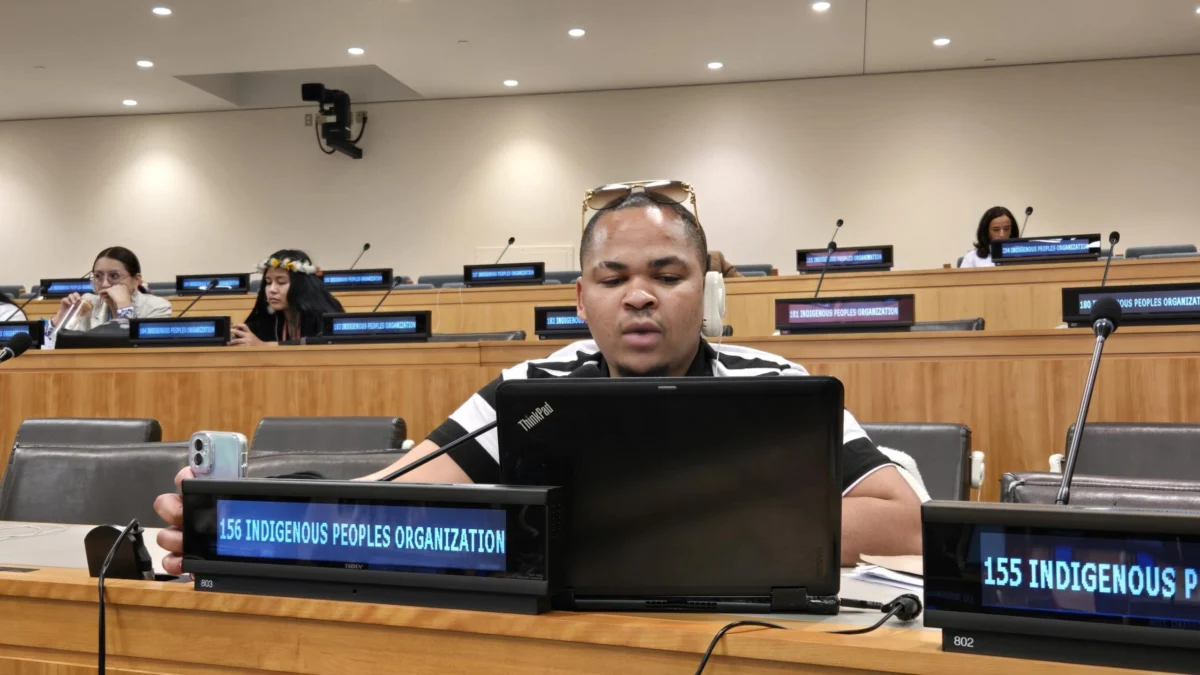
New York – April 23, 2026 – Samuel Stanley, Chairperson of the Indigenous Ink Network and Director of the Indigenous Youth Summit, delivered a compelling address at the 25th session of the UN Permanent Forum on Indigenous Issues, drawing urgent attention to the specific challenges faced by Indigenous youth in Botswana, particularly the San and Nama Peoples. While acknowledging recent positive commitments from the Government of Botswana towards human rights and youth empowerment, Stanley emphasized significant shortcomings, most notably the exclusion of Indigenous youth realities within the newly developed national youth policy and the persistent struggle for land rights.
Recognizing Progress, Demanding Deeper Inclusion
Stanley commenced his statement by acknowledging the growing recognition by the Government of Botswana of the importance of human rights, citing recent commitments expressed at the highest political levels. He also recognized positive steps towards a more human rights-based approach to governance, including engagement with UN mechanisms and the development of national policies aimed at youth empowerment. These developments, he stated, provide crucial foundations for building stronger, more inclusive frameworks. The recent visit of the UN Special Rapporteur on the Rights of Indigenous Peoples was also highlighted as a welcome initiative, with encouragement for continued cooperation with international human rights systems.
However, Stanley’s address quickly pivoted to the critical concerns that persist despite these advancements. He expressed deep concern that the recently developed national youth policy fails to adequately recognize or address the specific realities and rights of Indigenous youth, particularly those of the San Peoples. This omission, he argued, risks reinforcing existing inequalities and excluding Indigenous youth from national development processes.
The Imperative of a Human Rights-Based Approach
A fundamental tenet of Stanley’s argument was the necessity of a human rights-based approach to policymaking. He asserted that such an approach demands that all policies be inclusive, non-discriminatory, and responsive to the distinct identities and lived experiences of marginalized groups. Indigenous youth, he stressed, are not a monolithic category of "youth." They are rights holders with unique cultural, social, and historical contexts that must be explicitly acknowledged and respected. The failure to do so, as seen in the current national youth policy, perpetuates a cycle of marginalization, preventing Indigenous youth from fully participating in and benefiting from national development.
Land Rights: The Bedrock of Identity and Survival
Central to the concerns raised by Stanley were Indigenous land rights. For the San Peoples, land is intrinsically linked to their identity, culture, spirituality, and very survival. The continued displacement, restricted access to ancestral territories, and the lack of legal recognition of traditional land tenure systems represent, in his view, serious violations of fundamental human rights. These violations directly impact the rights to self-determination, culture, and livelihood, eroding the very foundations of their existence.
Stanley underscored that any meaningful human rights-based governance framework must prioritize the recognition, protection, and restitution of Indigenous land rights. He posited that without secure land tenure, other crucial rights, such as access to education, healthcare, and meaningful participation in decision-making processes, cannot be fully realized. This interconnectedness highlights the holistic nature of Indigenous rights and the need for comprehensive, rights-based solutions.
Background and Context: A History of Dispossession
The San Peoples, often referred to as the Bushmen, are the oldest inhabitants of Southern Africa, with a history stretching back tens of thousands of years. Their traditional territories historically encompassed vast swathes of land across Botswana, Namibia, South Africa, and Zimbabwe. However, over centuries of colonial expansion and the establishment of nation-states, they have experienced significant dispossession and marginalization.
In Botswana, the San have faced numerous challenges, including forced removals from their ancestral lands to make way for national parks, game reserves, and commercial agricultural ventures. The protracted legal battles and ongoing disputes over land rights, particularly concerning areas like the Central Kalahari Game Reserve, have been well-documented. The issue of water access in these arid regions has also been a point of contention, exacerbating the challenges faced by displaced communities.
The Indigenous Ink Network, as highlighted by Stanley’s affiliation, is an organization dedicated to amplifying the voices and advocating for the rights of Indigenous peoples in Botswana, with a particular focus on knowledge sharing and capacity building among Indigenous youth. The Indigenous Youth Summit further serves as a platform for young Indigenous individuals to connect, share experiences, and strategize on advocacy efforts.
UN Permanent Forum on Indigenous Issues: A Crucial Platform
The UN Permanent Forum on Indigenous Issues (UNPFII) is an advisory body to the Economic and Social Council (ECOSOC) of the United Nations. Established in 2000, it provides a platform for Indigenous peoples to voice their concerns and contribute to UN decision-making processes on issues concerning their rights, development, environment, education, health, and culture. The annual sessions bring together Indigenous representatives from around the world, government officials, UN agencies, and NGOs to discuss pressing issues and formulate recommendations.
The 25th session, where Stanley delivered his statement, likely focused on a range of contemporary challenges facing Indigenous communities globally. The specific emphasis on youth policy and land rights within the context of Botswana reflects recurring themes that are central to the UNPFII’s mandate and the broader struggle for Indigenous self-determination.
Supporting Data and Broader Implications
While specific statistical data directly linked to the omission of Indigenous youth in Botswana’s national policy was not provided in the statement, broader trends offer context. Reports from organizations like the UN Development Programme (UNDP) and the World Bank consistently highlight the disproportionate impact of poverty, discrimination, and lack of access to essential services on Indigenous populations worldwide. These disparities are often amplified for Indigenous youth, who face unique challenges in education, employment, and social integration.
The implications of excluding Indigenous youth from national policies are far-reaching. It can lead to:
- Perpetuation of Intergenerational Poverty: Without targeted interventions that acknowledge their specific needs, Indigenous youth may remain trapped in cycles of poverty, lacking the skills and opportunities to improve their socio-economic status.
- Erosion of Cultural Heritage: The lack of recognition and support for Indigenous cultures can lead to the erosion of traditional knowledge, languages, and practices, diminishing cultural diversity.
- Limited Political Participation: When policies do not reflect their realities, Indigenous youth are less likely to engage in political processes, further marginalizing their voices in decision-making that affects their lives.
- Increased Social Exclusion and Vulnerability: A lack of inclusive policies can exacerbate feelings of alienation and vulnerability, potentially leading to increased risks of social issues such as substance abuse and crime.
Potential Reactions and Official Responses
While not explicitly stated in the provided text, it is reasonable to infer that the Botswana government, having expressed recent commitments to human rights, would likely acknowledge Stanley’s statement. Official responses at such forums often involve reiterating commitments to inclusivity and human rights, while also highlighting existing government initiatives.
- Government Acknowledgment: A typical response might involve a government representative stating their commitment to reviewing the national youth policy to ensure it addresses the needs of all youth, including Indigenous populations. They might also emphasize ongoing efforts to address land rights issues through established legal and administrative channels.
- Civil Society Engagement: Indigenous organizations and international human rights groups present at the UNPFII would likely lend their support to Stanley’s call for action, further pressuring the government to implement concrete changes.
- UN Agency Support: UN agencies involved in youth development, human rights, and Indigenous peoples’ issues might offer technical assistance and support to the Government of Botswana in developing more inclusive policies and programs.
Looking Ahead: The Path to Realization
In his concluding remarks, Samuel Stanley reiterated that while positive steps have been taken by Botswana toward strengthening human rights governance, these efforts must be deepened and made more inclusive. He emphasized that the realization of Indigenous Peoples’ rights, particularly for youth, requires deliberate, targeted, and sustained action grounded in human rights principles. The dignity, knowledge, and rights of the San Peoples must not only be recognized in principle but fully realized in practice.
The statement delivered at the UN Permanent Forum on Indigenous Issues serves as a critical reminder of the ongoing challenges faced by Indigenous youth globally and the imperative for governments to move beyond rhetoric to concrete, rights-based actions. The success of Botswana’s commitment to human rights will ultimately be measured by its ability to translate these principles into tangible improvements in the lives of all its citizens, especially its most marginalized communities.