A comprehensive new survey conducted by the Pew Research Center reveals a significant and widespread unfavorable view of Israel across a majority of the 36 countries surveyed in early 2026. The findings, released on June 4, 2026, also indicate a substantial lack of confidence in Israeli Prime Minister Benjamin Netanyahu’s ability to navigate global affairs. These sentiments appear to be influenced by ongoing geopolitical events, including a significant military campaign launched by the United States and Israel in Iran in late February 2026.
The survey, which polled 44,657 individuals between February 8 and May 13, 2026, paints a stark picture of global public opinion. A median of 67% of adults across the surveyed nations expressed an unfavorable view of Israel, with only 25% holding a favorable opinion. This sentiment is particularly pronounced in Muslim-majority countries and across Europe.
Context: A Volatile Geopolitical Landscape
The timing of the survey is critical, falling in the immediate aftermath of a major military escalation in the Middle East. On February 28, 2026, the United States and Israel initiated a coordinated military operation targeting Iran. This action, widely reported to be in response to escalating regional provocations and Iranian support for proxy militant groups, significantly heightened global tensions. The repercussions of this conflict, including potential impacts on international trade, regional stability, and humanitarian concerns, were likely fresh in the minds of respondents when they were asked about their views of Israel and its leadership.
This military intervention followed a period of sustained regional instability, characterized by increased missile exchanges, drone attacks, and heightened rhetoric from various state and non-state actors. The Pew Research Center’s previous surveys had already indicated a trend of declining favorability towards Israel in many parts of the world, a trend that this latest data suggests has been exacerbated.
Widespread Unfavorable Views of Israel

The survey data reveals a deeply divided global opinion landscape regarding Israel. In many of the surveyed nations, substantial majorities hold negative perceptions.
-
Europe: European nations consistently show high levels of unfavorable views. In Italy, the Netherlands, and Spain, over three-quarters of adults expressed an unfavorable opinion of Israel, with a significant portion indicating a very unfavorable view. Germany, France, and the United Kingdom also reported high percentages of unfavorable opinions, exceeding 65%. Even in countries like Greece and Hungary, where favorable views are slightly higher than in Western Europe, unfavorable opinions still represent a majority or near-majority.
-
Asia-Pacific: Muslim-majority nations in the region, including Malaysia, Indonesia, and Pakistan, registered exceptionally high unfavorable ratings, with percentages in the high 80s and 90s. Japan also showed a strong negative sentiment, with 83% of respondents holding an unfavorable view. While countries like India and Thailand showed a more balanced distribution, unfavorable opinions still edged out favorable ones in India.
-
Middle East: Views in Turkey and the West Bank/East Jerusalem were overwhelmingly negative, with 97% and 85% unfavorable ratings respectively. The survey was unable to conduct interviews in Gaza, limiting the scope of data from this specific region.
-
North and South America: Canada and the United States also showed a majority with unfavorable views of Israel, at 65% and 60% respectively. In Latin America, countries like Chile and Mexico saw a majority express unfavorable opinions, while Brazil and Peru showed a slightly more divided picture, though unfavorable views still held a plurality.
-
Africa: Sub-Saharan African nations presented a more varied picture. While South Africa leaned towards unfavorable views, Kenya, Nigeria, and Ghana reported higher percentages of favorable opinions, suggesting that views on the continent are not monolithic and may be influenced by different regional dynamics and historical relationships.
Demographic and Ideological Divides

The survey also highlighted significant differences in opinion based on age and political ideology.
-
Age: In several countries, particularly in North America and Europe, younger demographics expressed more negative views of Israel than their older counterparts. For instance, in Hungary, 72% of adults aged 18-34 held an unfavorable view, compared to 45% of those aged 50 and older. This generational divide suggests a potential for evolving public opinion on the issue in the coming years.
-
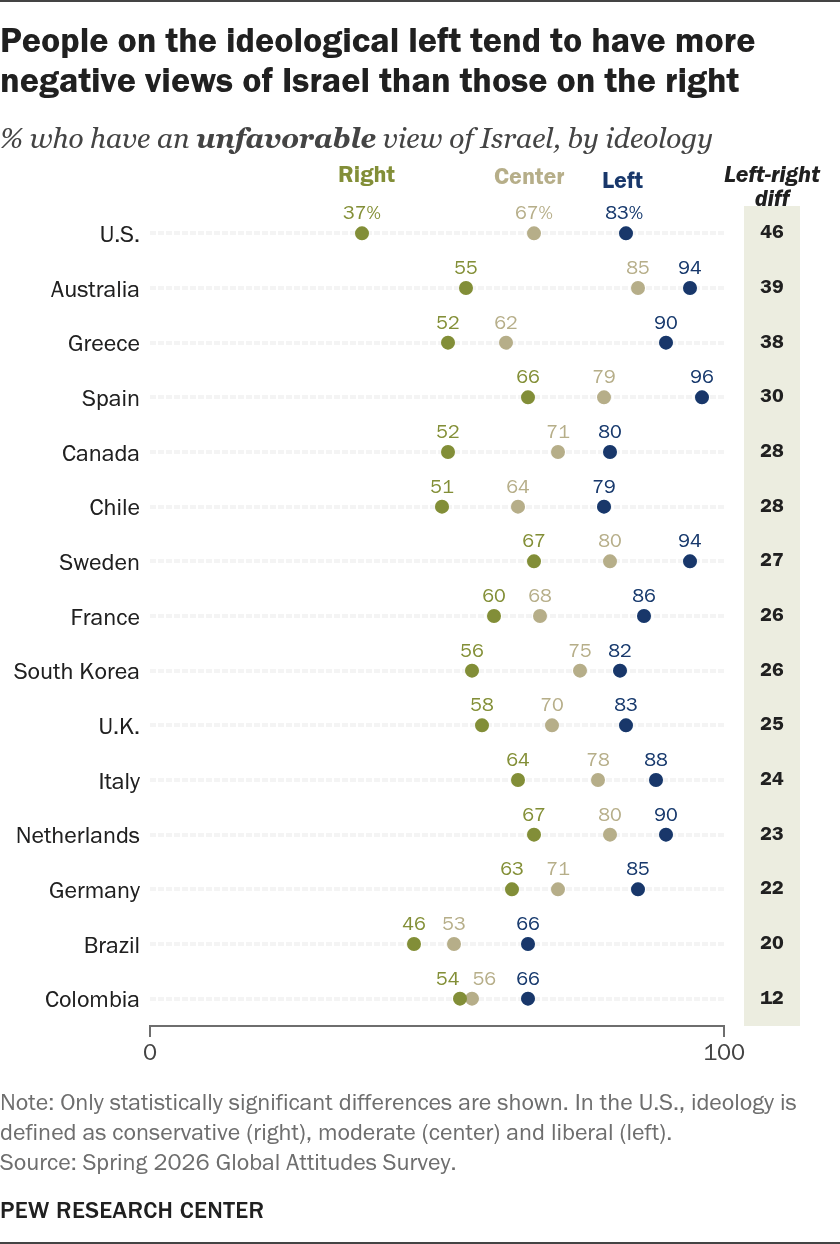
Ideology: Political ideology played a crucial role in shaping views of Israel. In many surveyed nations, individuals identifying with the ideological left consistently expressed more negative opinions than those on the right. This divergence was particularly stark in the United States, where 83% of liberals reported an unfavorable view, compared to only 37% of conservatives. Similar significant gaps were observed in Australia, Greece, Spain, Sweden, and other European countries. This ideological split underscores the politicization of perceptions regarding Israel.
Shifting Sentiments Since 2025
The current findings represent a continuation and, in many cases, an intensification of trends observed in previous years. When compared to data from the Spring 2025 Global Attitudes Survey, unfavorable views of Israel have become more prevalent in 13 of the 24 countries for which trend data is available.
Argentina, for example, saw a notable shift, with unfavorable opinions rising from 46% in 2025 to 55% in 2026. Similarly, Australia, Italy, Nigeria, Poland, and the United Kingdom experienced significant increases in the share of respondents holding very unfavorable views.
The only surveyed country where views appeared to warm towards Israel since the previous year was Greece, though favorable opinions still remained relatively low at 30%. This overall trend suggests a deepening global concern or disaffection regarding Israel’s actions and policies.
Low Confidence in Prime Minister Netanyahu
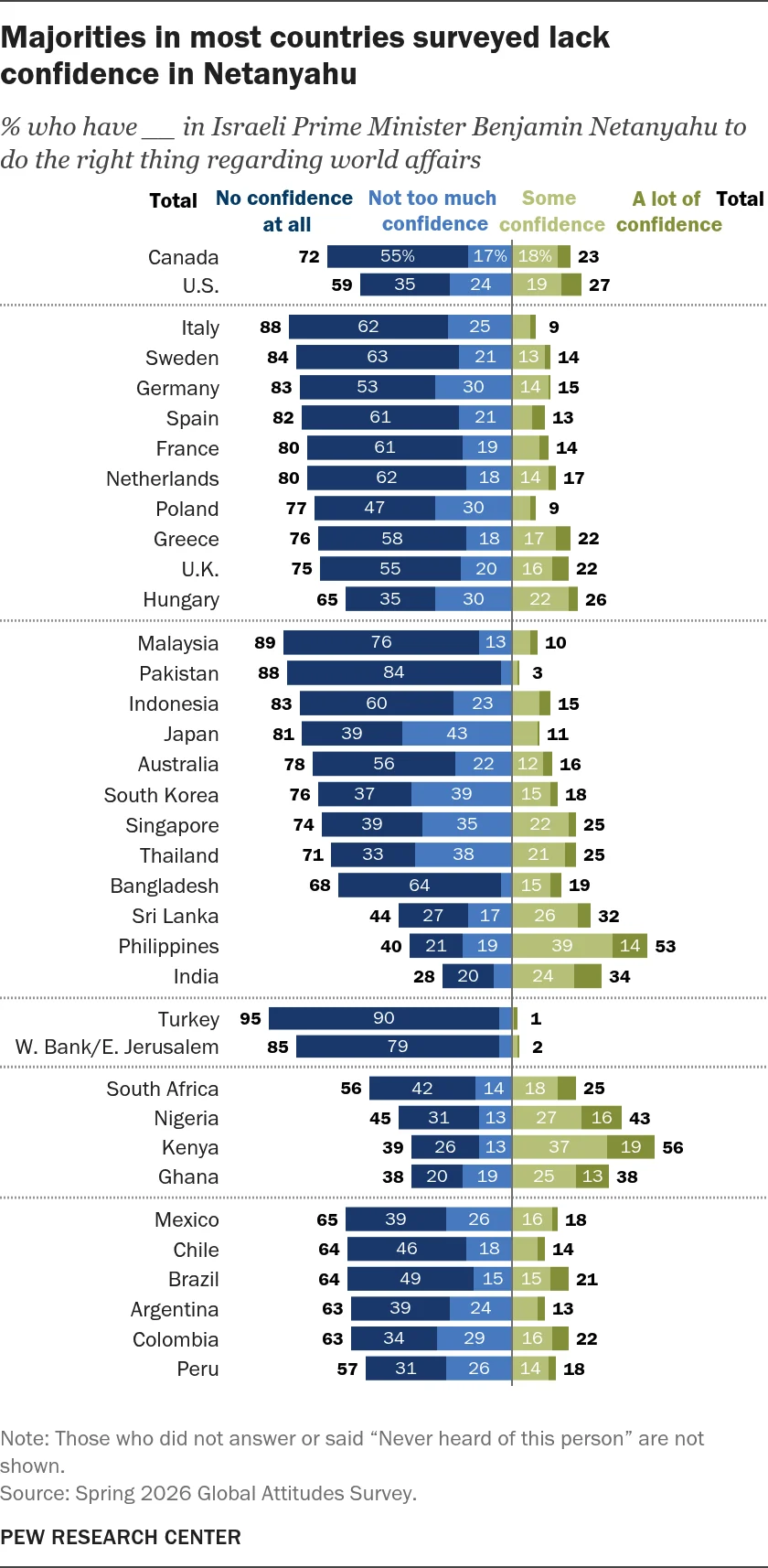
Parallel to the negative views of Israel, the survey revealed a widespread lack of confidence in Prime Minister Benjamin Netanyahu’s leadership on the global stage. Majorities in most of the 36 surveyed countries expressed either "not too much confidence" or "no confidence at all" in his ability to "do the right thing regarding world affairs."
-
Regional Disparities in Confidence: The lack of confidence was particularly acute in Europe and parts of Asia, with countries like Italy, Sweden, Germany, Spain, France, and the Netherlands reporting over 80% expressing little to no confidence. Muslim-majority nations like Pakistan and Turkey also showed near-universal lack of confidence.
-
Outliers: Kenya and the Philippines emerged as notable exceptions, being the only surveyed countries where more than half of the population expressed confidence in Netanyahu. India also presented a more balanced view, with a higher proportion expressing confidence compared to many other nations.
-
Demographic Trends: Similar to views on Israel, confidence in Netanyahu also varied by age and ideology, with younger individuals and those on the ideological left generally expressing less confidence than their older and more ideologically conservative counterparts.
Erosion of Confidence Over Time
The survey also tracked changes in confidence in Netanyahu since 2025. In 13 of the 24 countries with comparable data, confidence in his handling of world affairs has declined. South Korea showed the most significant drop, with confidence levels falling by 12 percentage points. Italy and Hungary also saw substantial increases in the proportion of people expressing "no confidence at all," with double-digit percentage point rises. This decline suggests a growing global skepticism towards Netanyahu’s foreign policy approach.

Methodology and Data Collection
The Pew Research Center conducted this extensive survey through phone and online interviews with a representative sample of adults in each of the 36 countries. The survey was designed to capture the views of the adult population across diverse geographical regions, including North America, Europe, Asia-Pacific, the Middle East, Africa, and Latin America. The methodology employed aimed to ensure statistical rigor and representativeness, providing a robust dataset for understanding global public opinion. The full survey questions and methodology details are available through the Pew Research Center’s publications.
Implications and Broader Impact
The findings of this Pew Research Center survey carry significant implications for Israel’s international standing and its diplomatic efforts. The pervasive negative sentiment and lack of confidence in its leadership could pose challenges for diplomatic initiatives, international cooperation, and the country’s broader foreign policy objectives.
The stark ideological and generational divides within many countries suggest that public opinion on Israel is not monolithic and is subject to differing interpretations and values. The timing of the survey, coinciding with a major military operation in Iran, undoubtedly cast a shadow over perceptions, potentially amplifying existing concerns and creating new ones.
As global geopolitical dynamics continue to evolve, these survey results offer a crucial snapshot of international public sentiment, highlighting the complex and often challenging environment in which Israel and its leadership operate on the world stage. The trend of increasingly unfavorable views and declining confidence, particularly among younger demographics and on the political left, points to a potential long-term shift in global perceptions that warrants continued monitoring and analysis.