Immigrants have played a pivotal role in expanding and diversifying the Black population in the United States, a trend that has accelerated significantly over the past two decades. Between 2000 and 2024, the number of Black immigrants residing in the U.S. has seen a substantial and steady increase, now constituting approximately one in ten individuals within the broader Black community. This demographic shift occurs against a backdrop of recent fluctuations in the overall U.S. immigrant population, which experienced its first decline in 50 years in 2025. The precise impact of recent federal immigration policies, including the cessation or proposed termination of temporary deportation protections for individuals from several nations and a pause on the issuance of diversity visas, on the specific growth trajectory of the Black immigrant population remains a subject of ongoing observation.
Pew Research Center has consistently provided in-depth analysis on both the U.S. Black population and immigrant communities. The following report synthesizes key findings regarding Black immigrants in the United States, drawing upon the most recent comprehensive data available, primarily from the U.S. Census Bureau’s 2024 American Community Survey.

A Surge in Black Immigration: Key Statistics and Trends
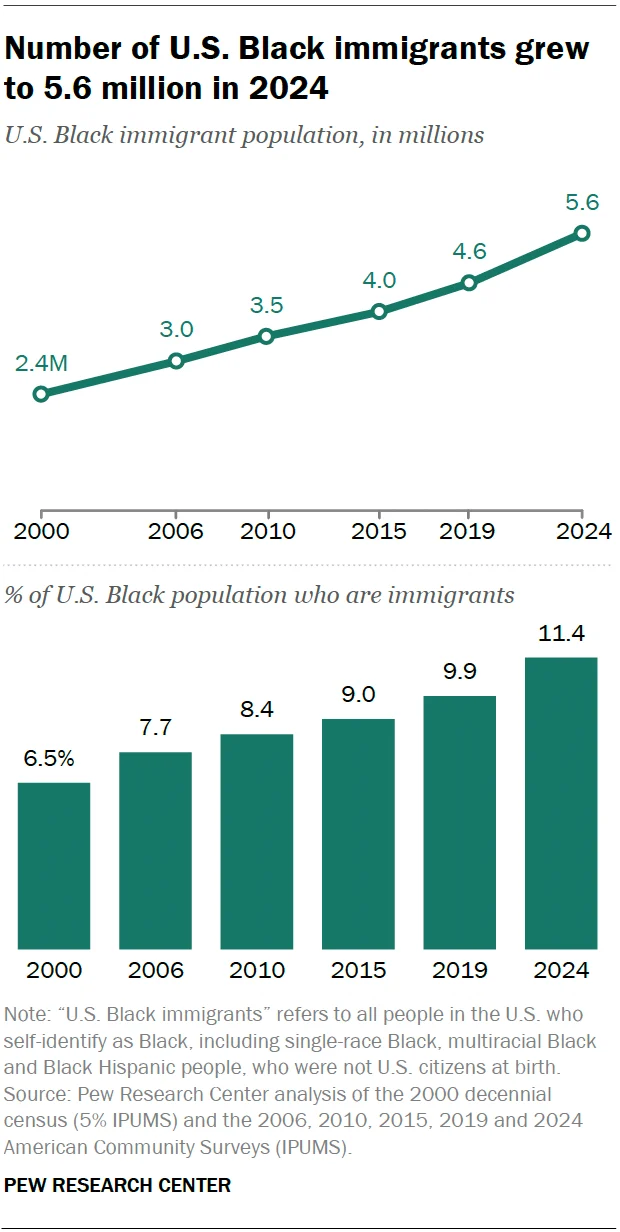
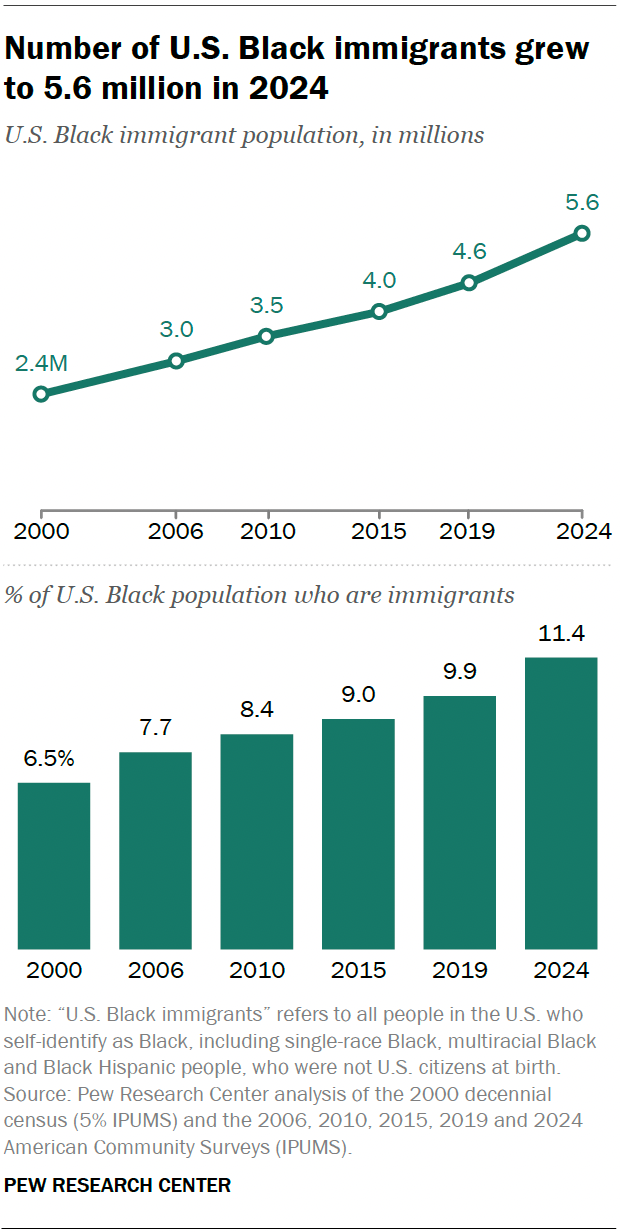
The period between 2000 and 2024 witnessed a dramatic transformation in the U.S. Black immigrant demographic. The number of Black immigrants living in the United States more than doubled, growing from approximately 2.4 million in 2000 to 5.6 million in 2024. This substantial influx accounted for a significant portion of the overall growth in the Black population, contributing roughly a quarter of the 13 million increase observed during the same timeframe.
As of 2024, Black immigrants represent 11.4% of the total Black population in the U.S. Concurrently, they constitute 11.2% of the entire immigrant population residing in the country.
Further analysis, based on the U.S. Census Bureau’s 2025 Current Population Survey, reveals that a quarter of all Black Americans are either immigrants themselves or are U.S.-born individuals with at least one immigrant parent. This proportion is comparable to that of White Americans (24%), but notably lower than that of Hispanic (66%) or Asian Americans (86%).
Shifting Origins: The Rise of African-Born Immigrants
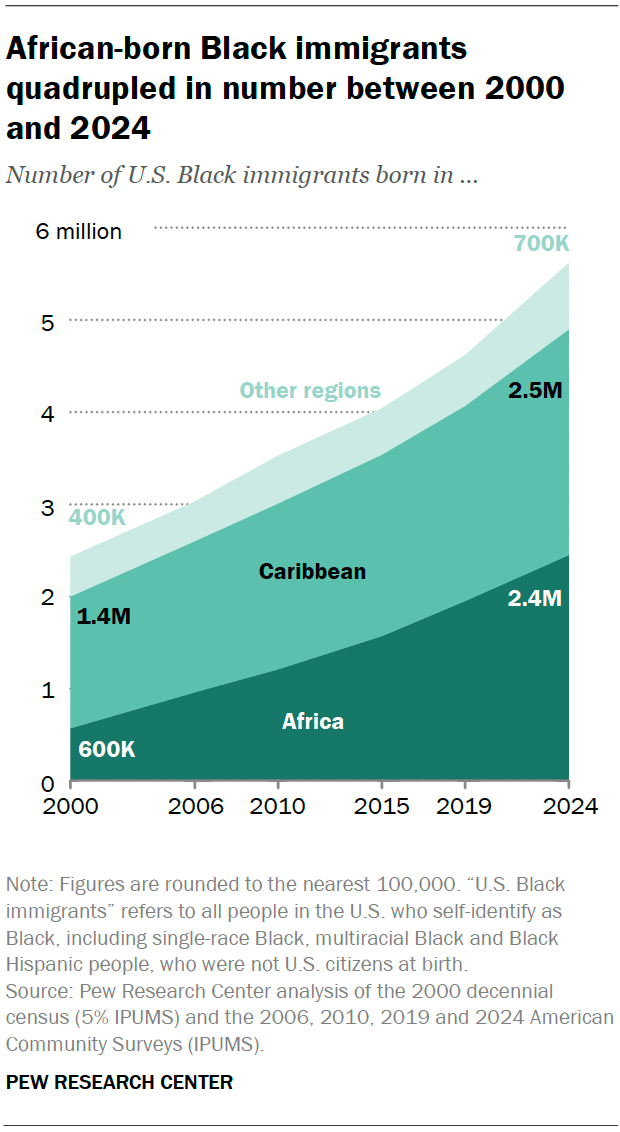
A prominent trend in Black immigration to the U.S. is the rapid growth of individuals born in African nations. Between 2000 and 2024, the number of African-born Black immigrants surged fourfold, escalating from around 600,000 to 2.4 million. This expansion has led to African-born immigrants now comprising 44% of all Black immigrants in the U.S., a substantial increase from their 24% share in 2000. This figure is closely mirrored by the proportion of Black immigrants born in the Caribbean, which also stands at 44%, representing approximately 2.5 million individuals.
Top Countries of Origin and Recent Arrival Trends
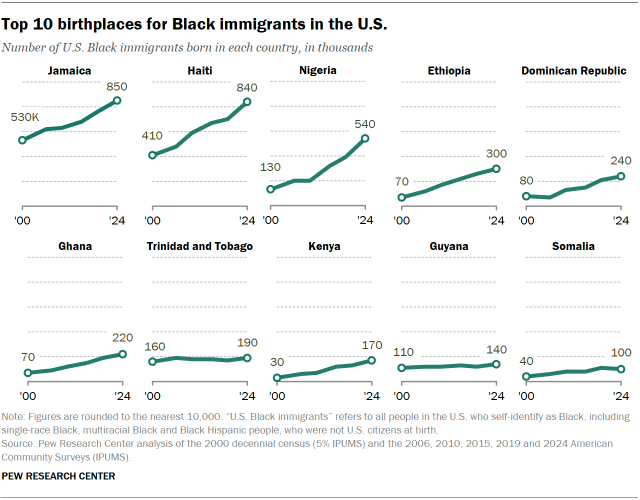
The demographic landscape of Black immigrants in the U.S. is largely shaped by individuals originating from a select group of countries. In 2024, four in ten Black immigrants hailed from Jamaica, Haiti, and Nigeria. Collectively, immigrants from the top ten countries of birth for Black immigrants, predominantly located in Africa and the Caribbean, accounted for 64% of all Black immigrants in the U.S.
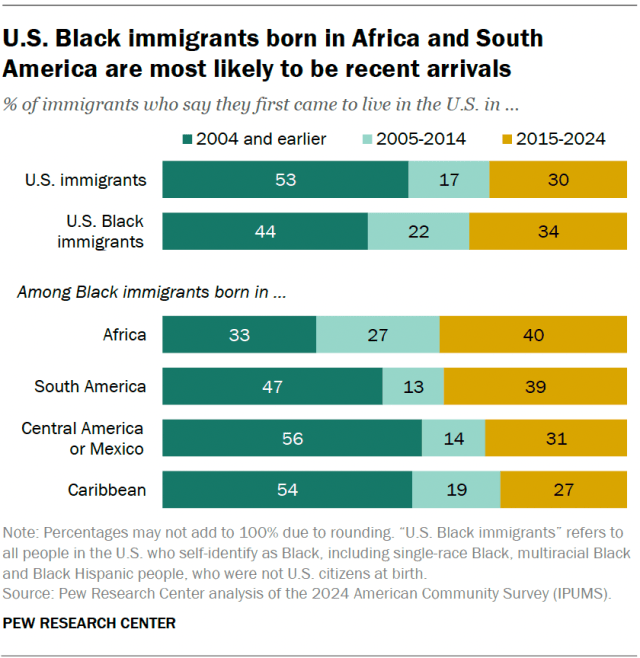
Black immigrants also appear to be more likely to be recent arrivals to the United States compared to the overall immigrant population. Between 2015 and 2024, 34% of Black immigrants arrived in the U.S., a slightly higher proportion than the 30% of all U.S. immigrants who arrived during the same period. This trend is particularly pronounced among Black immigrants from Africa and South America, with 40% and 39%, respectively, immigrating in 2015 or later.
Geographic Distribution: Hubs of Black Immigrant Communities
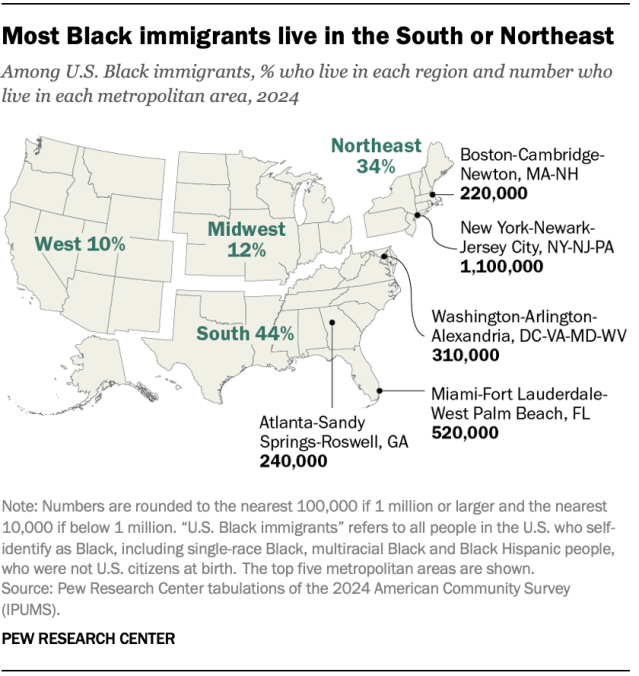
Metropolitan areas across the United States serve as focal points for Black immigrant communities. New York City stands out as the largest hub, hosting approximately 1.1 million Black immigrants in 2024. Following closely is the Miami metropolitan area, with an estimated 520,000 Black immigrants, and the Washington, D.C. area, with 310,000. Other significant metropolitan areas attracting substantial Black immigrant populations include Atlanta, Boston, Houston, and Dallas.
Within these larger metropolitan areas, specific countries of origin often cluster. For instance, in New York City, a significant portion of the Black immigrant population is from Jamaica and Haiti. In the Washington, D.C. area, Nigerian immigrants form a substantial demographic. In contrast, the Miami metro area sees a large presence of individuals from Haiti and other Caribbean nations.
Regionally, the majority of Black immigrants are concentrated in the South (44%) and the Northeast (34%). The Midwest and West account for 12% and 10% of the Black immigrant population, respectively.
Legal Status and Citizenship: A Profile of Integration
In 2023, an estimated 79% of Black immigrants were residing in the U.S. legally, while 21% were considered unauthorized. This proportion of unauthorized Black immigrants was lower than that of the overall U.S. immigrant population, which stood at 27%. It is noteworthy that the number of unauthorized Black immigrants reached an all-time high in 2023, mirroring the record high in the total unauthorized immigrant population.
A significant majority of Black immigrants have achieved U.S. citizenship. In 2024, 61% of Black immigrants were naturalized U.S. citizens, a notable increase from 44% in 2000. This figure compares favorably to the overall immigrant population, where 51% are naturalized citizens. The rate of naturalization varies by region of origin, with higher percentages of naturalized citizens among those born in the Caribbean (64%), Africa (59%), and South America (55%). Immigrants from Central America and Mexico show a lower naturalization rate at 43%.
Educational Attainment and Language Proficiency
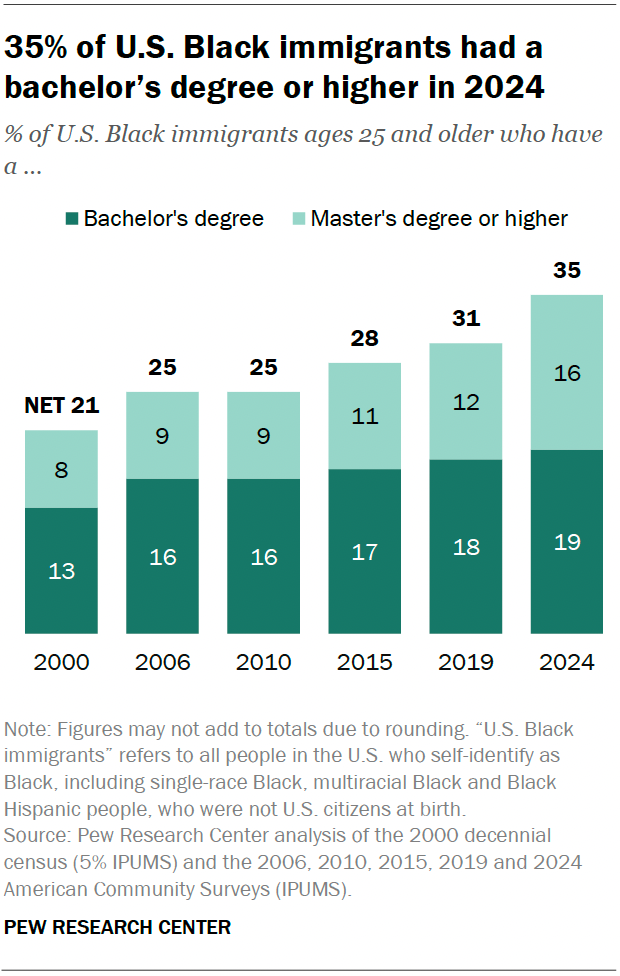
The educational profile of Black immigrants in the U.S. reflects a growing trend of higher education. In 2024, 35% of Black immigrants aged 25 and older held a bachelor’s degree or higher, an increase from 21% in 2000. This educational attainment is particularly high among Nigerian-born Black immigrants, with 67% possessing a college degree, while Mexican-born Black immigrants have a significantly lower rate at 13%.
Overall, Black immigrants are as likely as the general immigrant population (36%) to have a college degree. However, they demonstrate a higher likelihood of holding a bachelor’s degree compared to U.S.-born Black adults, of whom 26% have attained higher education.
Regarding language, a substantial majority of Black immigrants aged five and older (73%) reported proficient English skills in 2024. This indicates they either exclusively speak English at home or consider themselves to speak it "very well." While this represents a slight decrease from 77% in 2000, Black immigrants remain significantly more likely to be proficient in English than immigrants overall, where the figure stands at 53%.
Despite high English proficiency, a considerable portion of Black immigrants continue to speak a non-English language at home. In 2024, 62% of Black immigrants aged five and older reported speaking another language at home, while 38% spoke only English. Among the most common non-English languages spoken by Black immigrants are French, Spanish, Haitian Creole, Portuguese, and various African languages such as Yoruba, Swahili, and Igbo.
Context and Methodology
This analysis builds upon previous research by the Pew Research Center, with this particular update reflecting data from 2024 and 2025. The research methodology involves a comprehensive review of federal data sources, including the U.S. Census Bureau’s American Community Survey and Current Population Survey, as well as data provided by IPUMS from the University of Minnesota. It is important to note that certain data collection years, such as the 2020 ACS due to COVID-19 related issues, were excluded to ensure comparability.
The definition of "Black population" used in this analysis encompasses all individuals who self-identify as Black, either alone or in combination with other races or Hispanic ethnicity. Similarly, "immigrants" are defined as U.S. residents born in foreign countries to non-U.S. citizen parents, while "U.S. born" refers to individuals born in the U.S., its territories, or abroad to U.S. citizen parents.
Implications and Future Outlook
The sustained growth and increasing diversity within the U.S. Black immigrant population present a compelling narrative of demographic evolution. As this population continues to expand and integrate, its influence on the social, cultural, and economic fabric of the United States is likely to grow. The data highlights the multifaceted origins of this community, with a significant and growing presence from African nations, alongside a strong and established Caribbean demographic.
The higher educational attainment and English proficiency among many Black immigrants suggest a strong capacity for economic and social integration. However, the presence of unauthorized immigrants within this population, while lower than the national average, remains a key aspect to monitor, particularly in light of evolving immigration policies.
The geographic concentration in major metropolitan areas points to the formation of vibrant diasporic communities that contribute to the cultural richness of these cities. As these trends continue, understanding the evolving characteristics and contributions of Black immigrants will be crucial for policymakers, community leaders, and researchers seeking to comprehend the dynamic nature of American society. The interplay between immigration patterns, federal policies, and the integration experiences of Black immigrants will undoubtedly shape the future demographic landscape of the United States.