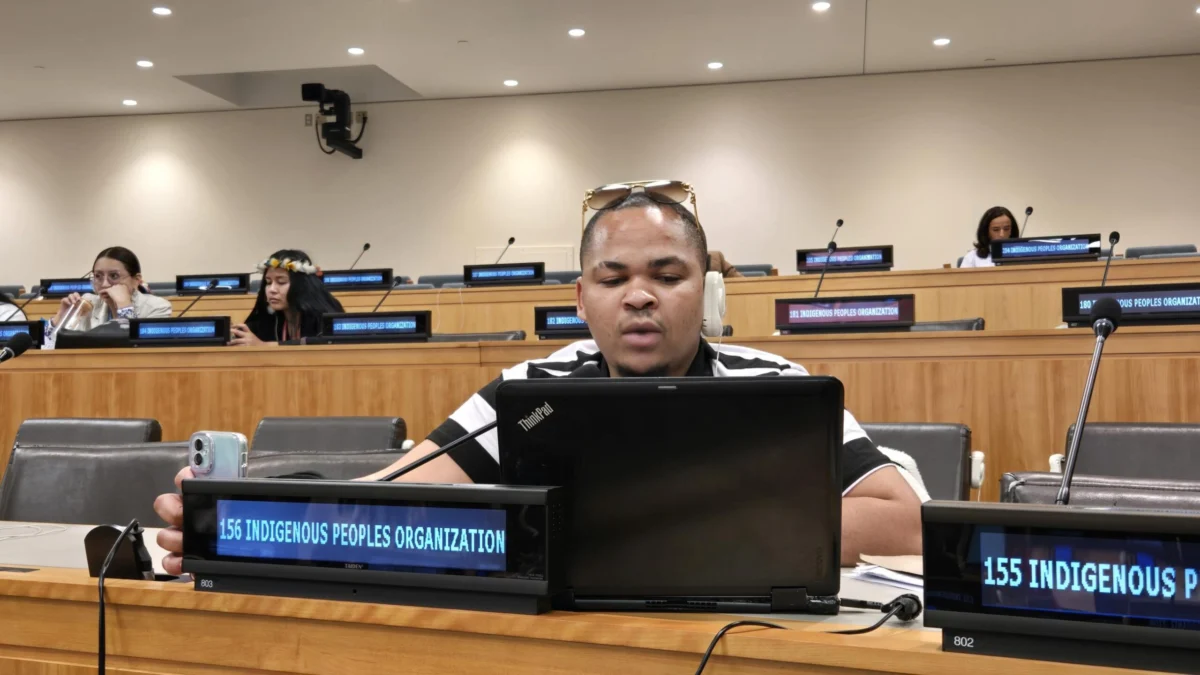
New York – April 23, 2026 – At the 25th session of the UN Permanent Forum on Indigenous Issues, Samuel Stanley, Chairperson of the Indigenous Ink Network and Director of the Indigenous Youth Summit, delivered a compelling address on behalf of Indigenous youth, with a specific focus on the San and Nama Peoples of Botswana. While acknowledging recent governmental commitments to human rights and youth empowerment, Stanley highlighted persistent gaps in policy and practice that threaten the fundamental rights and well-being of Indigenous youth. His statement underscored the critical importance of land rights as the bedrock of Indigenous identity, culture, and survival, and urged Botswana to adopt a truly inclusive, human rights-based approach to governance.
Botswana’s Progress and Persistent Challenges
Stanley’s statement began by recognizing Botswana’s evolving stance on human rights, citing recent high-level political pronouncements and the development of national policies aimed at youth empowerment. He specifically noted the positive implications of engagement with United Nations mechanisms and the recent visit of the UN Special Rapporteur on the Rights of Indigenous Peoples as foundational steps towards a more rights-based governance model. These acknowledgements reflect a growing international awareness and a domestic shift, however tentative, towards aligning national policies with global human rights standards. The development of national youth policies, in theory, presents an opportunity for broad societal inclusion and development.
However, the core of Stanley’s message conveyed a stark reality: these positive developments are not yet translating into tangible benefits for all Indigenous youth. A significant concern raised was the inadequacy of Botswana’s recently formulated national youth policy. Stanley asserted that this policy fails to sufficiently recognize or address the distinct realities and rights of Indigenous youth, particularly those belonging to the San communities. This omission, he warned, risks perpetuating existing inequalities and marginalizing Indigenous youth from national development agendas, thereby undermining the very principles of inclusivity that such policies are intended to promote.
The Inherent Rights of Indigenous Youth
Stanley emphasized that Indigenous youth are not a monolithic group subsumed under a general category of "youth." Instead, they are rights-holders with unique cultural, social, and historical contexts that demand explicit recognition and tailored policy responses. A truly human rights-based approach, he argued, necessitates policies that are inherently inclusive, non-discriminatory, and responsive to the specific lived experiences of marginalized populations. Without this nuanced understanding, national policies risk reinforcing systemic disadvantages rather than dismantling them.
Land Rights: The Cornerstone of Identity and Survival
The critical issue of land rights emerged as the central theme of Stanley’s address. For the San Peoples, as for many Indigenous groups worldwide, land is far more than an economic resource; it is inextricably linked to their identity, cultural heritage, spiritual practices, and their very means of survival. Stanley detailed how ongoing displacement, restricted access to ancestral territories, and the lack of legal recognition for traditional land tenure systems constitute grave violations of fundamental human rights. These violations directly impact the rights to self-determination, cultural expression, and the ability to sustain livelihoods.
The United Nations Declaration on the Rights of Indigenous Peoples (UNDRIP), adopted in 2007, explicitly affirms the rights of Indigenous peoples to their lands, territories, and resources. Article 26 of UNDRIP states that Indigenous peoples have the right to own, use, develop, and control the lands, territories, and resources that they possess by reason of traditional ownership or other occupation or use, as well as those which they have otherwise acquired. The situation described by Stanley in Botswana appears to fall short of these internationally recognized standards, highlighting a significant disconnect between global commitments and on-the-ground realities.
Calls to Action for the Government of Botswana
In light of these pressing concerns, Stanley outlined a series of concrete actions that the Government of Botswana should undertake. These recommendations, though not fully detailed in the provided text, are implicitly directed towards rectifying the systemic issues raised:
- Prioritize Recognition and Protection of Indigenous Land Rights: This involves legally acknowledging traditional land tenure systems and actively protecting Indigenous territories from encroachment and exploitation.
- Ensure Inclusive Policy Development: National policies, particularly those concerning youth and development, must be developed through meaningful consultation with Indigenous communities, ensuring their voices and specific needs are integrated.
- Uphold the Right to Self-Determination: Indigenous peoples must have the agency to make decisions about their own affairs, including the management of their lands and resources.
- Facilitate Access to Justice and Redress: Mechanisms must be established to address historical injustices and provide avenues for restitution and compensation for past dispossession.
- Strengthen Cooperation with International Human Rights Mechanisms: Continued engagement with UN bodies and Special Rapporteurs is crucial for accountability and ongoing dialogue.
Broader Implications and the Path Forward
Stanley concluded his address by reiterating that while Botswana’s steps towards human rights governance are acknowledged, these efforts require substantial deepening and a more inclusive approach. The realization of Indigenous Peoples’ rights, particularly for youth, demands deliberate, targeted, and sustained action rooted in human rights principles. The dignity, knowledge, and rights of the San Peoples, he stressed, must not merely be recognized in principle but fully realized in practice.
The implications of Stanley’s statement extend beyond Botswana. His address serves as a stark reminder that the challenges faced by Indigenous youth in Botswana—related to land rights, policy exclusion, and cultural recognition—are echoed in Indigenous communities across the globe. The UN Permanent Forum on Indigenous Issues plays a vital role in providing a platform for these voices, fostering international dialogue, and holding states accountable to their human rights obligations.
The success of Botswana’s commitment to human rights will ultimately be measured by its ability to translate policy pronouncements into tangible improvements in the lives of its Indigenous citizens. The exclusion of Indigenous youth from national policy frameworks and the continued struggle for secure land tenure are not merely abstract issues but represent critical barriers to their social, economic, and cultural development. A comprehensive and rights-based approach, centered on the specific needs and inherent rights of Indigenous peoples, is essential for fostering a truly equitable and just society in Botswana and for fulfilling the promise of international human rights commitments. The ongoing engagement with international bodies like the UN Permanent Forum on Indigenous Issues offers a crucial pathway for continued advocacy, monitoring, and the eventual realization of full rights for all Indigenous peoples.